THE CHRONICLES: 1975 - 1979

CHRONICLING THE GOLDEN ERA
PART XVI: 1975
(✓ = Items that have separate 'Chronicles' articles written about them.)
The last year of The Golden Era that still had enough positivity about it to fit the description 'Golden'...? Perhaps...
But politically and socially, 1975 continued the downturn that began so markedly in 1974; it was a year that attempted to steady the ship and avoid catastrophe... But those attempts would lead to public disillusionment and bewilderment... And the old guard Establishment was regrouping - reinventing itself - and preparing to return to power...
The music of 1975 was a plus; the albums output was an upturn in quality after a disappointing 1974.
For me, personally, it was a very important year of change and adventure: I left school; I had my first big adventure in life by going to London to see Led Zeppelin live; and I was now facing life's decisions about the future... without being equipped to do that...
Let's have an overview of how it all panned out...
WORLD POLITICS and CONFLICT
✓ North Vietnam took advantage of the turmoil and frailty that had beset U.S politics in 1974, by invading South Vietnam and consequently conquering the whole country. Neighbouring countries in Southeast Asia, Cambodia and Laos, also fell to communist forces during 1975.
✓ India's President Indira Gandhi declared a state of emergency in the country, with severe restrictions on freedom and free speech being imposed.
✓ In Lebanon, the influx of Muslim refugees fleeing the Jewish - Palestinian War in 1948; then the state of Israeli's victory over Egypt, Syria, and Jordan in the Six Day War of 1967, and then the expulsion from Jordan of Palestinian refugees / and members of the political and paramilitary Palestinian Liberation Organisation (PLO) in 1970, led to the destabilising of the delicate political - social - ethnic balance in that country, and civil war broke out between various Muslim, Christian, and Druze factions: with Syria supporting Sunni Muslim groups, and Israel supporting Christian groups.
The Lebanese Civil War lasted until 1990.
✓ In Spain, Fascist dictator General Franco died on November 20th., while still in office. Franco had gained power in Spain in 1939, after the victory of his Fascist forces in the Spanish Civil War (1936 - 1939).
The world wondered which way Spain would now turn, politically, and overtures were made towards the country by the various powerful interests in the world at the time. In the end, Spain restored the Spanish monarchy, and made the rightful claimant to the throne, Franco ally Juan Carlos, King Jaun Carlos, on November 22nd., and went about the process of establishing a democratic monarchy system of government.
U.S POLITICS
After the disruptive, game changing events in U.S politics during 1974: with the forced resignation of President Nixon, and the appointment as U.S President of Vice President Gerald Ford (the first U.S President who had not been elected as either VP or President), the USA kept a low profile on the international stage politically during 1975...
UK POLITICS
✓In February 1975 The Conservative (aka Tory) Party held a leadership contest, after doubts were raised over the leadership of Edward Heath in the wake of two narrow defeats in both of the 1974 UK General Elections.
The Tories pulled off an unexpectedly progressive move: electing the first ever female leader of a major UK political party: Margaret Thatcher. Thatcher was known to be politically right of centre, and a promoter of free market economics - and of reducing the welfare budget for the poorest and most vulnerable.
The backdrop in UK politics was a 1970 - 1974 Tory Government that had been routed by the power of the trade union movement - and had been driven from office as a result: losing the snap General Election in February 1974 to a hung parliament result: with Labour as the biggest party; then losing the inevitable second General Election to Labour by a flimsy 3 seats.
✓ Meanwhile, the trade union movement, instead of modifying its demands and industrial action to support its political ally, the Labour Party, increased its pressure on the UK Government: slowly grinding the UK economy and industry to a stumbling crawl over the duration of this Labour Government: 1974 - 1979.
This played into the hands of the Conservative right wing: and Thatcher looked like a daring, vibrant, and progressive alternative to what was by 1975 being seen as the tired old failing politics by both main parties - and the bullying overreach of the trade union movement...
UK GOVERNMENT INDUSTRIAL RELATIONS
✓ The dismal state of UK industrial relations was, perhaps significantly, underlined by the first ever industrial action by doctors since the National Health Service (NHS) was set up in 1948.
In April, consultants (the most senior doctors) complained that the provision introduced by the previous Conservative UK Government that allowed them a certain amount of private practice had been stopped by this Labour UK Government. Constantly, they curtailed their working hours within the NHS until a deal could be negotiated.
In November, Junior doctors complained about the long hours that they were forced to work - for moderate salaries. They worked to rule: limiting the hours that they'd agree to work.
The two disputes were dealt with very differently:
The consultants, whose professional body is The British Medical Association (BMA), were met at the Prime Minister's (PM) residence and place of work, number 10 Downing Street, by PM Harold Wilson and members of his government. A compromise was agreed, with consultants allowed a certain amount of private practice.
The junior doctors picketed and took industrial action, like any other trade union workers in dispute. They were initially supported by their senior colleagues in the BMA, but when their dispute was continued past the agreement that had reached with the UK Government in December, the BMA withdrew its support. The junior doctors' dispute lasted until January 1976.
✓ THE BRITISH - IRISH 'TROUBLES'
1975 was another year of escalating violence in the British - Irish 'Troubles'; and a year when the behind the scenes scheming and plotting, subterfuge and intrigues between the various parties involved became more evident.
The Miami Showband Massacre: the murder of innocent musicians by British Loyalist paramilitaries - supported, it is strongly suspected, by members of the British security forces, brought to light some indication the of behind the scenes scheming that went on on all sides during 'The Troubles'.
On the Irish Republican side, the Provisional Irish Republican Army (P-IRA) brokered a supposedly secret ceasefire agreement with the UK Government in December 1974, which carried into 1975.
But it was considered a sham in many ways: other Republican paramilitaries carried out terrorist activities in Northern Ireland; some units of the P-IRA in Northern Ireland simply didn't recognise the ceasefire; and while the P-IRA was at ceasefire with the British security forces in Northern Ireland, it was involved in a violent feud with the Official IRA (O-IRA).
Also - the ceasefire agreement did not apply to P-IRA activity on the British mainland. An active P-IRA unit commited terrorist attacks in the Southeast of England throughout 1975, before being captured in December of that year.
Moreover, the British Loyalist paramilitaries got word of the supposedly secret ceasefire agreement, and intensified their activities against Republicans in an attempt to provoke the P-IRA into breaking the agreement.
A YEAR OF INTERNATIONAL TERRORISM
1975 was, sadly and tragically, yet another year when the use of terrorism to protest - and attempt to achieve results for various causes, escalated.
I refer the reader to the 'Chronicles' article 'POLITICS, THE COLD WAR, AND CONFLICT - 1975':
https://m.facebook.com/story.php?id=100041857974741&story_fbid=1187437509328170
And particularly the link to the Wikipedia page that details terrorist activities during 1975:
https://en.wikipedia.org/.../List_of_terrorist_incidents...
INTERNAL COOPERATION
✓Good and positive news came in the form of the Soviet Union's Soyuz - Apollo (NASA) combined mission to link up a Soyuz and an Apollo space capsule - with the two crews meeting and greeting in space.
It was a welcome thaw in The Cold War - and symbolic as well as real and tangible progress towards International peace and cooperation.
✓And in Finland, l leaders of The Soviet Union led Warsaw Pact alliance and the North Atlantic Treaty Organisation (NATO) members, signed The Helsinki Accords - agreeing to limit the number of nuclear weapons in the world.
SPORT
✓1975 gave us what many consider to be the greatest boxing match in history: Muhammad Ali v. Joe Frazier III: The Thrilla In Manila.
MOVIES
The movie industry had been in the doldrums in the early 1970s: some classic movies, certainly, but movie makers had decided that TV was the way ahead, and 'for theatres' movie making suffered.
But 1975 - and and one movie in particular - changed that: the old fashioned, edge of the seat thriller type - with a ferocious monster in the mix - movie - 'Jaws': a scary killer shark tale that everyone wanted to be frightened by...
✓And legendary director John Huston fulfilled a long held dream of his by making the Rudyard Kipling story, 'The Man Who Would Be King' into a very successful movie: starring Sean Connery, Michael Caine, and Christopher Plummer.
TV
'Supercop' shows were big around the early 1970s - so too 'buddy' shows, like 'Alias Smith And Jones' and 'MASH'; 1975 gave us a combination of the two, with 'Starsky And Hutch' - it was a huge success.
✓MY 1975
My first big adventure: going to London to go see Led Zeppelin; leaving school for good; and being part of my native Glasgow's 800th. birthday as a city...
CONCLUSION
I have described 1974 as the year that was the beginning of the end of The Golden Era... I think maybe 1975 was the last year in this era of ours that could - just about - properly fit the description of being 'Golden'...(???)
The music was good that year... Movies were about to become big again - thanks to movie events in 1975... The Space Race had taken its first steps towards becoming a cooperative adventure between the Soviet Union and NASA / the USA.
There were advances in the causes of equality of women; and progress in the social acceptance and rights of gays, and of ethnic minorities.
But the effect of the down turn that western society was going through after the unsettling political events that had disrupted the 1970s - culminating in the turmoil of 1974 - continued and was gathering pace.
Terrorism continued to spread and to increasingly be used as the preferred means of expressing protest - and attempting to achieve results, by activists and paramilitary groups all over the world.
The world was changing... While the hopeful, well intented, good and worthy causes of the social and cultural revolution of the 1960s were splitting and fragmenting - instead of conciliating and consolidating... the old Establishment institutions and forces were regrouping and reinventing themselves... waiting in the wings to take advantage of the discord - to re-emerge and roll back the ethos of the 1960 revolution...
1976 would be another step towards that...
(I found the various images used in the collage for this article online. My acknowledgment and thanks to the various people who own them / posted them (identity unknown to me). ). (M).
Textual content © Copyright MLM Arts 02. 07. 2024. Edited and re-posted: 08. 09. 2024

1975: POLITICS, THE COLD WAR, SATIRE, AND CHANGE
(✓ indicates a story that has a separate article in the 'Chronicles' 1975 section)
POLITICAL CARTOONS
Top - far left: the lighter, more compromising US foreign policy approach in the Middle East - 'small gains, 'step by step'' - is depicted in a cartoon that shows President Ford dancing arm in arm with Egyptian and Israeli politicians. The Sanai II agreement between Israel and Egypt reaffirmed a cessation of hostilities between the two countries.
✓ Top centre: A West German - Dutch cartoon depicts the European Economic Community (EEC) reluctantly welcoming the UK as confirmed members - after the UK referendum of 1975. Behind Prime Minister Harold Wilson, troops what the cartoonist considers to be the UK's unwelcome baggage: a failing National Health Service; Bolshie, powerful trade unions; and, interestingly, Third World immigrats...
✓ Top right: The UK Conservative Party leadership contest is depicted as a dog show. The eventual winner, Margaret Thatcher, is described as 'a charming little bitch - whose bite is worse than her bark'...
✓ Lower left: An Indian newspaper cartoon, satirically condemning the State of Emergency - including strict censorship - imposed on India by the government of Indira Gandhi in 1975. The clever caption reads: 'Don't we have a lovely CENSOR of humour'...
✓ Centre right: This cartoon depicts the uncertainties over the direction that Spain will take after the death of longtime Fascist dictator General Franco. Spain shown as a glamourous lady being courted by various competing political and economic powers.
✓ Lower right: This cartoon depicts the influence of corporate lobbyists on U.S Government environmental policy. A bill to restrict strip mining in the USA was vetoed by President Ford. The cartoon shows powerful corporate interests 'ripping off' the US - both literally (in terms of ripping up the land for strip mining), and figuratively (in terms of corporate influence over the US Government)...
---------------
✓ APOLLO - SOYUZ SPACE MISSION
There was good news for Cold War relations and 'Space Race' cooperation in 1975. The US National Aeronautics and Space Administration (NASA) collaborated with the Soviet Union's space program, when a manned NASA Apollo space capsule docked in space with a manned Soviet Soyuz space capsule, in a joint mission that would be the basis for the future International Space Station.
NHS JUNIOR DOCTORS and CONSULTANT DOCTORS INDUSTRIAL ACTION
1975 was an indication of how poorly UK Governments had been at industrial relations and employment issues during the 1970s; and how trade union (and also, in this case, professional representative bodies: The British Medical Association (BMA)) applied pressure and increasingly punitive industrial action.
The Conservative UK Government of 1970 - 1974 was constantly embroiled in conflict with the Trade Union Council (TUC), which finally brought it down in 1974... But only to be replaced by a weak Labour Government with a wafer thin majority - which the trade union movement took advantage of...
Since the formation of the National Health Service (NHS) in 1948 (the public funded, government administered provision of health care for all), there had never been industrial action by doctors or nurses.
In 1975 that changed - in what was a tale of two separate disputes: handled differently.
The Consultants (senior doctors) objected when their right to have a certain amount of private practice (which had been given to them by the previous Conservative Government) was curtailed by the Labour Government. Between January and April they responded by restricting the hours that they worked in NHS practice.
They negotiated via their profession body - The British Medical Association - and held personal talks with the Prime Minister Harold Wilson and Health Secretary Barbara Castle at Downing Street. The dispute was resolved when Castle agreed to allow Consultants who wished to to work part-time for the NHS and continue private practice.
Here's a link to the BBC article about the 1975 doctors' disputes:
https://www.bbc.com/news/health-18270523
In November, junior doctors took industrial action over pay and conditions.
They too restricted their working hours. Initially they had support from The BMA, but as the dispute continued past an agreement reached in December, and wore on into January 1976, senior doctors turned against the junior staff's cause and BMA support dwindled. In effect, the junior doctors became gonit alone mavericks - identifying more with the TUC members and their and industrial action than with the more elite professional body, The BMA.
In January 1976 the dispute was resolved by compromise.
This is a link to the People's History of The NHS site article on the junior doctors' dispute:
https://peopleshistorynhs.org/when-do-doctors-strikes.../
The Consultants and junior doctors employment disputes were yet another example of how weak UK Government and politics in general had become - and how fragmented, disorganised, and disunited UK society was becoming.
UK SEX DISCRIMINATION ACT 1975
The UK Sex Discrimination Act brought about fairer and more equal treatment of women and men - single or married - in the workplace and on training courses,
US CIVIL RIGHTS AMENDMENTS 1975
The US Civil Rights Amendments of 1975 made provided fairer and more equal treatment of gay people in the areas of employment and housing rights.
THE MCWHIRTER FOUNDATION
And finally, a story of an act of good in response to a bad and evil act of terrorism: The McWhirter Foundation is founded.
✓ In November 1975 Ross McWhirter - who, with his identical twin brother Norris was co-founder of The Guinness Book of World Records, and co-hosts of the UK children's TV show 'Record Breakers' - was assassinated by the Provisional Irish Republic Army (P-IRA).
In response to this horrific tragedy, Ross's twin brother set up The McWhirter Foundation - a charity promoting good citizenship and the resolving of social disputes by means of reasonable, fair minded discussion and debate.
CONCLUSION
1975 followed on from the disruptive turmoil of 1974 - but managed to calm the storm - at least enough to slow down the decline that had set in.
It was a decline that was bringing about desperate changes in the world - particularly in the West, in an attempt to rescue the social and cultural progress of the previous decade or so... But changes that would, by the end of the 1970s, bring about the destruction of the ideals of the 1960s youth social and cultural revolution, and the end of what we call The Golden Era...
In 1976 politics in the USA would change, as the electorate is given its chance to react to the destructive events of the presidency of President Nixon - and the resultant presidency of the unelected President Ford, in the US Presidential Election... A lighter touch, more diplomatic, social conscience Democrat President Carter was elected...
In the UK in 1976, popular opinion is growing weary of Bolshie trade union aggression and weak UK Government. Veteran PM Harold Wilson resigns and hands over to his Foreign Secretary, James Callaghan...
Some suggest that Wilson saw the writing on the wall, as the Conservative Party's new, radical, very right of centre, leader, Margaret Thatcher, was catching the public mood and gaining popularity...
But that's for the 'Chronicles' history of 1976...
(I found the various images in the collage used for this article online. My acknowledgment and thanks to those who own them / posted them. ) (M)
Textual content © Copyright MLM Arts 29. 05. 2024. Edited and re-posted: 30. 05. 2024. Edited and re-posted: 18. 06. 2024

1975: POLITICS, THE COLD WAR, and CONFLICT
(✓ = Events that have a separate
'Chronicles' article written about them.)
1974 had been the year of the beginning of the end of The Golden Era: politics and political stability in the U.S and UK was in turmoil; Northern Ireland was inflamed by 'The Troubles'; terrorism was rampant in the world.
1975 was to be a year of attempting to 'hold the line', in terms of Western politics and Cold War conflict; and in terms of the major terrorist conflicts around the world: most notably, Northern Ireland and the British Loyalist and Irish Republican paramilitary groups operating in Ireland and in the UK mainland.
Around the world it was a year of significant events that would have a lasting impact - mainly a negative impact on the future.
VIETNAM / SE ASIA✓
In December 1974 North Vietnam violated the 1973 Vietnam War Paris Peace Accords by making incursions into South Vietnam. The USA did nothing in response...
In January 1975 North Vietnam advanced aggressively into South Vietnam; by April 1975 North Vietnam had taken the South Vietnam capital, Saigon, and conquered the whole country.
US personnel and as many Vietnamese people as could be accommodated by US Military transport helicopters hurriedly fled Saigon during the North Vietnamese conquest. It was a humiliation for the USA - and came in the wake of 1974's political scandal and the resignation of President Nixon.
The fall of South Vietnam on the 30th. of April 1975 was preceded by the fall of neighbouring Cambodia to the communist forces of Pol Pot's Khmer Rouge (assisted by the communist forces of the Viet Cong) on April 17th. 1975.
The victorious communist forces of the now united Vietnam also assisted the communist Pathet Lao / Lao People's Front to conquer Vietnam's neighbour, Laos, in December 1975.
The impotency of the USA - after the political turmoil of 1974 - led to this rapid 'domino effect' in the Southeast Asia Cold War conflict zone. Once North Vietnam tested what the response of the USA would be to its incursions into South Vietnam in December 1974, and found that response to be placid acceptance - the fall of the entire Southeast Asia conflict zone was on the cards soon after.
THE BRITISH - IRISH 'TROUBLES'
1975 was, as ever, a complex year in the history of 'The Troubles': 'secret' negotiations; ceasefire; subterfuge; suspected British security forces collusion with Loyalists; feuding within the Republican movement; Republican terrorism on the UK mainland... And the usual, tragic, death and destruction...
In December 1974 the Labour Party UK Government 'secretly' negotiated a ceasefire with the Provisional Irish Republic Army (P-IRA) that was to last until January 2nd. 1975. In January 1975 it was extended, and would last until January 1976. But the supposedly secret ceasefire negotiations became known to groups supporting the British Loyalist position: both official and unofficial / paramilitary - and they were deeply displeased by it and and suspicious of it. Some suspected that it was a ploy by the P-IRA to allow them time to regroup and re-equip - especially as part of the ceasefire agreement was a more relaxed approach to Republic of Ireland - Northern Ireland border security.
Consequently, he so-called ceasefire agreement with the P-IRA led to increased Loyalist paramilitary activity - in an attempt to provoke the P-IRA into breaking the agreement.
But the situation was was even more complex than that, as, for one thing, some P-IRA units simply didn't recognise the ceasefire agreement and continued activity; plus, there was the appearance of other, small Republican movement paramilitary groups that would carry out attacks against Loyalists - but officially be declared to be not connected to the P-IRA.
Significantly too, during the 1975 ceasefire period, the P-IRA and the Official IRA (O-IRA) engaged in a violent feud against each other.
✓ Moreover, the ceasefire agreement didn't seem to apply to P-IRA units active on the UK mainland: most notably the unit that operated around the SE of England, which became known as The Balcombe Street Gang - after the conclusion of The Balcombe Street Siege, in December 1975, which resulted in its the gang's capture.
✓ The Balcombe Street Gang had been responsible for atrocities throughout the SE of England during 1974 and 1975, including the high profile assassination of Guinness Book of World Records founder - and UK children's TV host - Ross McWhirter.
In Northern Ireland, Loyalist terrorist activity took an even more sinister twist in response to the UK Government - P-IRA ceasefire. In a year of violence aimed at undermining the ceasefire, a particularly cynical and brutal - and, Investigations suggest, sinister - event, was 'The Miami Showband Massacre': when Loyalist paramilitaries - some also members of the official British Army part-time Ulster Defence Regiment (UDR) - used British Army uniforms to pose as an official border checkpoint, and then stopped the tour van used by The Miami Showband and attempted to frame a band of musicians as P-IRA weapons smugglers - and murdered band members on the spot when the operation went wrong. Investigations into this atrocity revealed strong evidence (even proof) of possible collusion between Loyalist paramilitary groups, Ulster police officers, a official British Army operatives. ✓
On October 2nd. 1975, the Loyalist Ulster Volunteer Force (UVF) carried out a series of attacks across Northern Ireland, killing 12 people and injuring 45.
On an (unsuccessful) attempted positive note, The Northern Ireland Constructional Convention - a proposal put together by the UK Government in 1974 to attempt a governing body in Ulster which more fairly represented the Roman Catholic/ Republican community - was established on 1st May, by elections using Proportional Representation (PR) - thereby ensuring a representation by elected Republicans.
It was unpopular with Loyalists, who determined to undermine it, as it was a threat to their built-in dominance as the majority of the populace.. Strikes were called throughout the province, and Loyalist politicians from various patties allied together in common cause to make the new political body unworkable. The Northern Ireland Constitutional Convention was disbanded in March 1976.
A link to the University of Ulster CAIN site, giving an overview of 'The Troubles' during 1975:
https://cain.ulster.ac.uk/othelem/chron/ch75.htm
A link to Access Research Knowledge (ARK) UK site article on The Northern Ireland Constitutional Convention:
https://www.ark.ac.uk/elections/fc75.htm
A link to the Wikipedia article on the October 2nd. UVF attacks:
https://en.wikipedia.org/.../October_1975_Northern....
(I found the various images used in the collage for this article online. My acknowledgment and thanks to the various people who own them/ posted them (identity unknown to me). ) (M).
Textual content © Copyright MLM Arts 20. 06. 2024
THE REST OF THIS ARTICLE WILL FOLLOW LATER...
1975: POLITICS, THE COLD WAR, AND CONFLICT

1975: JANUARY - APRIL: NORTH VIETNAM INVADES SOUTH VIETNAM: CONQUERS THE COUNTRY IN APRIL.
THE USA EVACUATES ITS PERSONELL - AND AS MANY VIETNAMESE ALLIED PERSONELL AS POSSIBLE.
BACKGROUND
On January 27th. 1973, the Vietnam War peace talks in Paris, France, that had been on-going since 1968, reached a ceasefire agreement, in which the USA would withdraw from the conflict, North Vietnamese forces would withdraw from South Vietnam - and both sides would respect a demilitarized zone (similar to that which separates North Korea and South Korea), and a ceasefire - if not actual peace - would be observed.
Although this was hailed as a great breakthrough for peace, U.S negotiator Henry Kissinger was skeptical about the lasting effectiveness of the agreement...
(For more, please see the 'Chronicles' section: 'The Chronicles: 1973.)
1974 saw U S politics in turmoil: the various scandals that had stalked President Nixon and his administration - which had already forced the resignation of Vice President Spiro Agnew in 1973, and his replacement by Senator Gerald Ford - finally caught up with President Nixon himself, and he too was forced to resign in August 1974.
That left the U.S public - and U.S politics - in turmoil, as well as shock and disillusionment - and a USA with the first U.S President in history who was not elected as either President or VP: when Gerald Ford was appointed U.S President after Nixon's resignation.
President Ford's main - it might be argued, his ONLY - job in office, was to try to clean up the mess - and hold a despondent USA together...
On December 12th. 1974, the North Vietnamese People's Army of Vietnam (PAVN) began hostilities against the South Vietnamese city of Phước Long (close to the border with Cambodia), which was defended by the Army if the Republic of Vietnam (ARVN). This assault was a clear violation of the 1973 Paris peace agreement.
It is reasonably assumed by some analysts that this campaign was launched partly to test the response of the USA, in light of the USA's state of political turmoil. The USA made no response to the attack on Phước Long.
(For more, please see the 'Chronicles' section: 'The Chronicles: 1974.)
JANUARY 1975
Emboldened by the USA not responding to its hostilities against South Vietnam in December 1974, the PAVN pushed on, and on January 6th. 1975, the North Vietnamese forces captured Phước Long. Again the USA did not respond to this significantly increased aggression by the PAVN.
FEBRUARY 1975
February saw the PAVN push on still further into South Vietnam, with the objective of conquering the city of bBuôn Ma Thuột in the Central Highlands of Vietnam - a clear induction that North Vietnam no longer intended to uphold the Paris peace treaty: it was intent in conquering all of Vietnam.
U.S impotency and dithering was underlined by President Ford's response. Quoting the Wikipedia article '1975 In The Vietnam War':
25 February - 3 March
A bipartisan Congressional delegation visited South Vietnam at the request of Ford. The delegation was led by John Flynt, a supporter of continued aid to South Vietnam and included Bella Abzug, Donald M. Fraser and Pete McCloskey, all opponents of continued aid. The delegation was unable to agree a unified position, other than their dislike of Ambassador Graham Martin...'
In short: a team of U.S delegates who, from the outset disagreed with each other about what the U.S response to North Vietnam should be, in the end could only agree upon their mutual dislike of the U.S Ambassador to South Vietnam.
MARCH 1975
The PAVN pushed on through South Vietnam, March 1st. saw a massive invasion of the Central Highlands - and the rout of South Vietnamese ARVN forces - which suffered heavy losses.
By March 25th., Hue, South Vietnam's third largest city, had fallen to the PAVN.
APRIL 1975
South Vietnamese military resistance had all but collapsed, and the PAVN swept through South Vietnam - closing in on the capital, Saigon.
It was only on April 29th., with the PAVN storming Saigon, that the USA ordered an airlift of helicopters from U.S aircraft carriers to evacuate U.S citizens - and as many Vietnamese refugees as could be rescued (numbering some 7000) - from Saigon. The image of desperate people queuing to board the shuttling convoy of U.S helicopters has become an iconic image of the fall of Saigon - and the North Vietnamese conquest of South Vietnam.
On April 30th. 1975 the Vietnam War was finally - and truly over: the PAVN took control of Saigon - North Vietnam had conquered South Vietnam - and Vietnam was united under communist rule.
The inevitable had finally happened... And the world reacted more with relief at the end of the terrible loss of life and the destruction caused by the North Vietnamese PAVN Spring Offensive, than with any kind of shock or outrage...
Further reading:
Here's a link to the Wikipedia page on The Vietnam War 1975:
https://en.wikipedia.org/wiki/1975_in_the_Vietnam_War
A link to the Wikipedia page on The Spring Offensive:
https://en.wikipedia.org/wiki/1975_spring_offensive
A link to the Britannica site article on The Fall Of South Vietnam:
https://www.britannica.com/.../The-fall-of-South-Vietnam
A link to the site
study.com article on The Fall Of Saigon:
https://study.com/.../the-fall-of-saigon-during-the...
A link to The National Museum Of American Diplomacy article on The Fall Of Saigon:
https://diplomacy.state.gov/.../fall-of-saigon-1975.../
A link to the site: Battlefield Vietnam timeline (covering 1973 - April 1975):
https://en.wikipedia.org/wiki/1975_spring_offensive
(I found this image online. My acknowledgement and thanks to whoever posted it / owns it (identity unknown to me), and if course to New York's The Daily News newspaper, which is the newspaper featured. )
Textual content: © Copyright MLM Arts 15. 04. 2024. Edited and re-posted: 17. 04. 2024

1975: NOVEMBER 10th. : THE UNITED NATIONS (UN) RESOLUTION 3379 DECLARES ZIONISM TO BE A FORM OF RACISM
(Revoked in 1991)
The history of International politics and diplomacy is one of nebulous, murky wheeling and dealing; of scheming and manipulation; of rhetoric and propaganda...
A BRIEF HISTORY OF ZIONISM
The modern Zionist movement can be traced back to 1897 and the the Austro - Hungarian journalist Theodore Herzl, and his reaction to the wrongful conviction for treason, in 1894, of Jewish French Army officer, Alfred Dreyfus.
Herzl, himself a Jew, saw 'The Dreyfus Affair' as the final straw a long history of antisemitism in Europe, and organised the Zionist Movement in the cause of buying land in Palestine for the purpose of settling the Jewish diaspora in a safe, independent location.
This was the origin of the Kibbutz system: large areas of land in Palestine (which had been largely neglected, malarial swamp land) converted into agricultural communities - run on secular socialist / communist lines.
I'm 1917, the British 'Balour Declaration' proposed a recognised Jewish state in Palestine. At that time Palasstine was under Ottoman Turkish rule, but after the end of World War I, in 1918, it came under British rule, after a 1920 mandate made by the UN's predessesor, The League of Nations.
It wasn't until after World War II, when the horror of 'The Holocaust' (the extermination of some 6 million Jews by the Nazis) came to light, that the establishment of a Jewish homeland in Palestine became a priority.
THE ROOTS OF THE MODERN DAY ARAB - ISRAELI CONFLICT
The horror of The Holocaust played a major part in the decision by The UN to allow the Jewish people of the world a homeland in their historical, emotional home, Palestine, in 1947 - a proposal that partitioned Palestine between the new State of Israel and the lands that remained occupied by indigenous Arab Palestinians - and the small minority of indigenous Palestinian Jews and Christians.
(It is notable that the indigenous Palestinian religious Jews did not support the establishment of the Israeli state - as it was a purely political, secular phenomenon.)
The Arab and other Muslim nations in the Middle East rejected the proposal.
The UK was given the mandate to police Palestine and suppress the conflict between the Israeli settlers and the indigenous Arabs.
In 1948, with the conflict in Palestine spiralling out of control, the British withdrew. The UN admitted Israel as a member state. The Muslim nations, however, did not recognise the legitimacy of the State of Israel.
The State of Israel was established by Zionist, secular Jews, but used religious symbolism and history to establish it's right to the land; and, also, in an attempt to persuade religious Jews (who initially rejected the State of Israel) of the religious and biblical legitimacy of the modern State of Israel.
It was only after the 'Six Day War' in 1967, when Israel captured the symbolic city of Jerusalem, that religious Jews began to be persuaded of the legitimacy of the State of Israel.
The modern history conflict between The State of Israel, the Palastinian Arab community, and the Muslim nations in the Middle East, has its roots in that situation.
In terms of The Cold War, the Soviet Union originally attempted to court Israel as an ally, but Israel rejected this advance, and so the Soviet Union backed the Arab and other Muslim countries against Israel. Israel had strong backing from the USA and its allies.
THE DIPLOMATIC AND POLITICAL MANIPULATION OF A UN (and a previous UN resolution designed to eliminate discrimination between peoples)...
THE UN AND THE PLO
In 1974 Palestinian Liberation Organisation (PLO) leader, Yasser Arafat, gained a propaganda coup by being invited to speak at The UN; his address became known as the 'Olive Branch Speech': as he used the rhetoric that suggested that he came with an olive branch in one hand, but that the PLO was prepared to use violence, and the UN should not let the olive branch slip from his hands.
The UN granted the Palestine 'observer status'.
Arafat also met the Soviet Union's President Brezhnev in Moscow - which reinforced the cordial relations between the Soviet Union and the PLO.
(For more, please see: 'The Chronicles: 1974)
UN RESOLUTION 3379
On November 1975, the UN passed Resolution 3379: which declared Zionism to be a form of racism, and should be condemned on that basis.
The resolution was brought by The Arab League (a cooperation between Arab nations), and was supported by other Muslim countries, as well as countries in what was known as 'The Second World': nations that were allied to and / or sympathetic towards the Soviet Union during The Cold War.
This combination of countries was enough to ensure a majority in the vote on the resolution:
For: 72 votes
Against: 35 votes
Abstained: 32
In bringing the resolution, the sponsors cited UN resolution 1904, from the year 1963 (the following is from the site Welcome To The United Nations):
'...''Recalling its resolution 1904 (XVIII) of 20 November 1963, proclaiming the United Nations Declaration on the Elimination of All Forms of Racial Discrimination, and in particular its affirmation that "any doctrine of racial differentiation or superiority is scientifically false, morally condemnable, socially unjust and dangerous" and its expression of alarm at "the manifestations of racial discrimination still in evidence in some areas in the world, some of which are imposed by certain Governments by means of legislative, administrative or other measures"...'
In this way, the assembling of allied, and / or countries of diplomatically and politically mutually beneficial interests, combined with the citing of / diplomatic manipulation of a previous UN resolution, brought about a UN resolution that was not universally beneficial - but, rather, benefitted the Soviet Union - and its allies in the Middle East conflict... And created resentment from the West and Israel.
In response to Resolution 3379, Israeli ambassador Hertzog addressed the UN, saying (excerpt):
'..."For us, the Jewish people, this resolution based on hatred, falsehood and arrogance, is devoid of any moral or legal value. For us, the Jewish people, this is no more than a piece of paper and we shall treat it as such." ...'
And the USA ambassador, Daniel Patrick Moynihan, said before the vote:
'... "The United Nations is about to make anti-Semitism international law."...'
Adding:
'... "[The United States] does not acknowledge, it will not abide by, it will never acquiesce in this infamous act ... A great evil has been loosed upon the world." ...'
In December 16th. 1991, several years after the fall of The Soviet Union and the end of The Cold War, UN Resolution 3379 was revoked.
CONCLUSION
This event from 1975 - The UN Resolution 3379 - is an important historical lesson on how politics and diplomacy work - then and now; and how, even in organisations set up with the best intentions of attempting to find a civilized, mature way to resolve humanity's disputes and disagreements - such as The United Nations - in the end it still comes down to humanity's ingenuity for scheming, subterfuge, manipulation, and wheeling and dealing - to gain, not cooperation and conciliation - but some kind of advantage ivert 'thy other side'...
Cautionary note from a historian:
Don't EVER be duped by any person or organisation that claims that they have identified the main or only cause of humanity's disputes - whether they blame religion - or this or that political ideology - or whatever else... And then claim that they have the solution - and its dependent upon getting rid of the thing that they blame.
It's all just manipulative rhetoric and propaganda - and a failure to recognize our common humanity - and to towards acceptance of our differences, under the the acceptance of common humanity...
(I found the image used with this article online. It's from a YouTube video by the site: The Jewish Education Project. My acknowledgement and thanks to that site. )
Further reading reading:
Wikipedia page on Resolution 3379:
https://en.wikipedia.org/.../United_Nations_General...
Welcome To The United Nations site article on Resolution 3379:
https://www.un.org/unispal/document/auto-insert-181963/
The Jewish Education Project site article on Resolution 3379:
https://educator.jewishedproject.org/.../un-resolution...
New York Times article on Resolution 3379:
https://www.nytimes.com/.../un-votes-7235-to-term-zionism...
Textual content (article): © Copyright MLM Arts 25. 04. 2024. Edited and re-posted: 29. 04. 2024

Article to follow...

1975: NOVEMBER 27th. : ROSS MCWHIRTER (co-founder of The Guinness Book of Records, and kids TV show presenter) IS ASSASSINATED BY THE PROVISIONAL IRA.
Of all the incidents that occured during the 1960s onwards flare-up of The British - Irish 'Troubles', somehow the assassination of kids TV show presenter, Ross McWhirter, is the event that saddened me the most - and made 'The Troubles' more directly and immediately impact on me: being still pretty much a kid myself at the time, and, like most kids in the UK, a fan of the show that he co-hosted with his twin brother, Norris, and much loved UK all-round entertainer, Roy Castle.
The show was called 'Record Breakers', and debuted in 1973. It was all about world records - and occasionally the show would feature attempts to break them. Roy Castle himself set the new world record for fastest tap dancer, on an episode of the show.
Ross and Norris McWhirter were the founders of The Guinness Book of Records, in 1955. They were happy to be co-hosts of the show; they were charming - and, like Roy Castle, became much loved celebrities too.
THE PROVISIONAL IRA (P-IRA) ACTIVE UNIT IN SE ENGLAND
In a strange arrangement, from January 1975 the UK Government had agreed a ceasefire with the P-IRA that applied to activities by the terrorist group in Northern Ireland, but apparently still allowed for P-IRA activity on the UK mainland.
(From what I understand if the situation, it was the case that some elements of the P-IRA did not agree with the P-IRA decision on the ceasefire agreement (?))
A P-IRA unit was active in the southeast of England throughout 1975, and committed devastating bomb attacks. In December 1975 the gang was tracked down and pursued by police in London, in a dramatic car chase. They took refuge in a residential property in Balcombe Street, northwest London - taking the middle-aged husband and wife residents of the house hostage. After a siege of several days, the gang surrendered. They were arrested, put on trial, covicted - and imprisoned.
(There will be a separate article on 'The Balcombe Street Gand - and Siege' posted in the near future.)
ROSS MCWHIRTER OFFERS A REWARD FOR INFORMATION ON THE P-IRA UNIT
On November 4th. 1975, Ross McWhirter, via his group Self Help - which was set up to encourage people to assist the police with the enforcement of law and order - offered a reward of between £20,000 and £50,000 for information on the P-IRA gang operating in SE England.
I remember thinking at the time that that was a brave - though risky - thing to do, when it was announced on the TV news. But I also thought that the P-IRA was too public relations savvy to harm a popular kids TV show host...
THE P-IRA ASSASSINATE ROSS MCWHIRTER
On the 27th. of November, 1975, two P-IRA operatives, Harry Duggan and Hugh Docherty, ambushed Ross McWhirter outside his home on the outskirts of north London and shot him in the head and chest at point blank range. Mr. McWhirter later died of his wounds, at Chalk Farm Hospital.
Harry Duggan and Hugh Docherty were among those arrested at the end of the Balcome Street Siege I December 1975.
Also in December 1975, Norris McWhirter set up the McWhirter Foundation, in honour of his late twin brother: a foundation for the promotion of a better society.
CONCLUSION: PERSONAL IMPACT
Being in the UK - and most notably, in Glasgow: which, having a connection to 'The Troubles' had an overspill effect from those events, 'The Troubles' indirectly impacted my community, so the events were closely followed in the news. But it was still a remote situation: it didn't hit home in ways that directly affected me - not really...
Yet, somehow the killing of much loved TV personality Ross McWhirter - whom I'd watched on TV since I was about 12 years old: - hit home...
I thought about his equally much loved brother, Norris - his identical twin; and how, they say, twins feel the loss of a sibling even more deeply than the usual grief at the loss of a loved one.
I thought about the brothers' co-host, Roy Castle - a cheerful, easy-going family entertainer.
I wondered why the P-IRA would target a kids TV host? I mean, Ross McWhirter offering a reward for information on the gang didn't make them any more or less wanted - or more or less a priority for police investigation. And killing him wouldn't change anything, surely... In fact, it would play badly with public opinion, I'd have thought...?
In the end, I couldn't really fathom it. I didn't know how I felt. It was all so pointless; so barbaric.. I just felt sad... Very, very sad...
As if as a show of defiance, and in honour of Ross McWhirter, the show 'Record Breakers' returned for a new season, some short time after the killing. It was co-hosted by Roy Castle - and by Ross's twin brother, Norris... I admired them both for that. Especially Norris. They continued to co-host the show for several more years.
Further reading:
The Guardian newspaper article on the assassination of Ross McWhirter:
https://www.theguardian.com/.../28/mainsection.martinwalker
The Wikipedia page on Ross McWhirter:
https://www.theguardian.com/.../28/mainsection.martinwalker
The McWhirter Foundation:
https://www.mcwhirterfoundation.org.uk/our-history-1
(I found this image online. My acknowledgement and thanks to whoever posted it / owns it (identity unknown to me); and to The Times newspaper.) (M).
Textual content: © Copyright MLM Arts 22. 04. 2024. Edited and re-posted: 23. 04. 2024

1975: DECEMBER 12th.: THE BALCOMBE STREET SIEGE / THE CAPTURE OF THE PROVISIONAL IRA UNIT ACTIVE IN THE SE of ENGLAND BETWEEN 1974 and 1975
BACKGROUND
The British - Irish 'Troubles' is a subject that is centuries old and extremely complex. The most notorious and longest lasting flare-up, starting from the late 1960s and lasting into the 1990s, is the history of 'The Troubles' that 'Chronicles' is concerned with - and has been attempting to describe an overview of.
The complexity of the issues is such, that for any deep level of understanding of 'The Troubles', commited study is required; 'Chronicles' aim is to provide a fair and evenhanded overview that might (I know in some cases has) stimulate interest in the subject and further study.
1975
1975 was yet another year of intrigue, subterfuge, and twists and turns in the tangled history of 'The Troubles'.
In January 1975, the UK Labour Government supposedly secretly negotiated a truce with the P-IRA; a truce that lasted until February 1976.
But...
For one thing, the truce was not as secret as was supposed: supporters of the British Loyalist factions in Northern Ireland got word of the truce and planned ways to undermine it
And also: some elements of the P-IRA simply didn't acknowledge the truce, and continued to operate terrorist activities.
Moreover, while the truce was in place, the P-IRA and the Official IRA (O-IRA) engaged in a feud: battling each other.
Meanwhile, P-IRA operatives in mainland UK - most notably the unit in the SE of England, maintained terrorist activities.
THE BALCOMBE STREET GANG / SIEGE
OVERVIEW
In 1974 an active service unit of the Provisional Irish Republican Army (P-IRA) based around London and the Southeast of England was responsible for a devastating series of terrorist attacks in England until the unit was tracked down by police after a failed attempt to bomb a restaurant in Mayfair, London. The Metropolitan Police ('Met') interception of the P-IRA unit as it prepared to attack the restaurant, resulted in a car chase, before the P-IRA operatives broke into a private residence in nearby Balcombe Street and were cornered by police in what is recorded in history as 'The Balcombe Street Siege'. The P-IRA unit subsequently became referred to as The Balcombe Street Gang.
BACKGROUND
The P-IRA active service unit in question in this article, was responsible for a series of devastating bombings and shootings in and around London and the SE of England, from 1974 until the operatives were captured in December 1975.
This P-IRA Active Service Unit (ASU) was, of course, under intense scrutiny by London's Metropolitan Police ('Met'), in the course of which the 'Met' noted that the gang tended to repeat attacks on the same targets.
On February 26th. 1975, an unarmed London police officer, Stephen Tibble, was shot and killed by one of the ASU, after police officers stumbled upon the ASU bomb making factory at an address in Kensington, London.
In November 12th. 1975, the ASU fired shots through the window of Scott's restaurant in Mayfair, killing one person and wounding 15 others.
On November 27th., 1975, the ASU assassinated high profile victim Ross McWhirter - who, along with his twin brother Norris, was the founder of The Guinness Book of World Records; both Ross and Norris were popular children's TV show hosts of the BBC show 'Record Breakers'. ✓
(✓ = There is a separate 'Chronicles'article on this subject.)
These incidents contributed to the 'Met' closing in on the P-IRA unit.
Suspecting another attack on Scott's restaurant, plain clothes officers were deployed around Mayfair. The strategy paid-off when the P-IRA unit was spotted in a vehicle in the vicinity of Mayfair.
A pursuit ensued - resulting in the events described above: the siege of a residential flat in Balcombe Street.
The P-IRA unit demanded to be put on a flight to the Irish Republic. The 'Met' negotiators declined and insisted that the ASU surrender and leave their hostages unharmed. In the end, the P-IRA ASU complied: they surrendered and did not harm the hostages.
(It is said that part of the 'Met' strategy was to deliberately allow the P-IRA unit access to radio communications in which the 'Met' requested that the British Army Special Air Service (SAS) be brought in; and that that is what finally persuaded the P-IRA unit to surrender. I cannot confirm if this is accurate.)
The P-IRA unit was tried and convicted of the terrorist activities that it was responsible for. They received life sentences. They were released in 1999 as part of the peace agreement known as 'The Good Friday Agreement'.
ANOTHER TWIST IN THE TANGLED 'TROUBLES'
During their trial, The Balcombe Street Gang instructed their legal representatives that they were responsible too for 1974 bombings in Guilford, Surrey, and Woolwich, London: attacks for which other people were convicted.
Despite The Balcombe Street Gang claiming responsibility for these attacks, the four convicted of the Guildford attacks and the seven convicted of the Woolwich attacks remained in prison for another 15 years, before their convictions were quashed as 'unsafe'.
CONCLUSION
I have been made aware by regular, long time contributors to 'Chronicles' - especially from the USA - that a simplistic Idea about 'The Troubles' is commonly held and taught outside of the UK and The Irish Republic; boiling down to 'it was all about Protestants and Roman Catholics killing each other over religion'. What's been rewarding about presenting an overview of 'The Troubles' here on 'Chronicles', is that I've been able, even in overview, to get some folks interested in the subject on a deeper level - and to realise that this is indeed a very old, very deep, and extremely complex issue - and not reducible to the above mentioned simplistic understanding.
The Balcombe Street Gang / Siege story is another part of this tragic and complex history.
FURTHER READING:
This is a link to the Routledge publisher site for the book 'The Road To Balcombe Street':
https://www.routledge.com/The.../Moysey/p/book/9780789029133
Here's a link to the invaluable source for information on 'The Troubles' the University of Ulster CAIN site, outlining 1975:
https://cain.ulster.ac.uk/events/truce/chron.htm
A link to a brief overview The Balcome Street Gang on the YouTube channel Audioversity:
https://youtu.be/69eusKvIRfU?si=-A3pzn2_E_GyRu-c
A link to the Wikipedia page on The Balcombe Street Gang:
https://en.wikipedia.org/wiki/Balcombe_Street_Gang
A link to the Wikipedia page on The Balcombe Street Siege:
https://en.wikipedia.org/wiki/Balcombe_Street_siege
(The image used with this article is from the cover of the book: 'The Road To Balcombe Street' (see link above). My acknowledgment and thanks to the author and publishers.) (M).
Textual content: © Copyright MLM Arts 27. 05. 2024. Edited: 29. 05. 2024
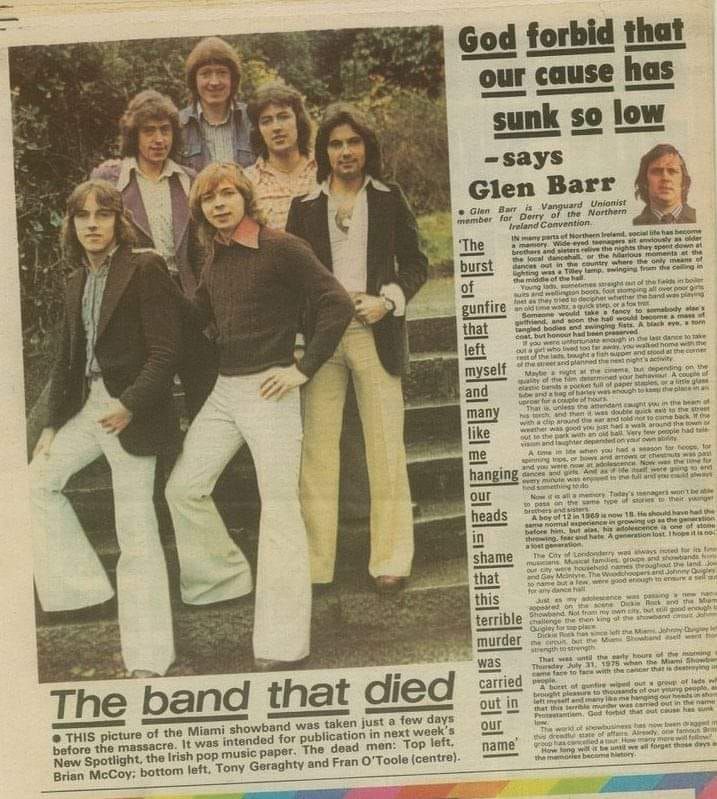
1975: A JULY 31st. : ULSTER: THE MIAMI SHOWBAND MASSACRE
If any event in the history of the 1960s and 70s (and beyond) flare-up of the centuries old 'British - Irish Troubles' can be said to offer some insight into the conniving, the subterfuge, the unseen scheming and behind the scenes plotting that was part of this conflict, then this tragic massacre of innocent musicians - entertainers; a club / cabaret band based in the Irish Republic, that toured the whole of Ireland, and was very popular with people across the social divide - is that event. It is recorded in history as 'The Miami Showband Massacre'.
This incident is so toxic and tangled that, for recording on this medium, it is only possible to give as detailed an overview sketch as possible. I have added links for further reading.
A NECESSARY BACKGROUND OVERVIEW
'SECRET' NEGOTIATIONS BETWEEN THE UK GOVERNMENT AND THE PROVISIONAL IRA (P-IRA): PEACE TREATY - AND LOYALIST SUSPICIONS
On December 22nd., 1974, the Republican paramilitary P-IRA announced a Christmas ceasefire that would last until January 02nd., 1975. The ceasefire was extended to what became a temporary peace treaty that lasted until January 26th., 1976.
It later emerged that during December 1974 and into 1975, the UK Government had been in what they (mistakenly) supposed were secret negotiations with the P-IRA, and the P-IRA political wing, Sinn Fein, and the extended peace treaty resulted from that.
Part of the agreement was that British forces would scale-down activity in Republican areas in Ulster; and cross-border security would be somewhat relaxed.
It is suggested by some, that some people on the Republican side believed that this would be the precursor to a British withdrawal from Northern Ireland.
Here's a link to the excellent University of Ulster CAIN site (which covers 'The Troubles') account of these particular events:
https://cain.ulster.ac.uk/events/truce/chron.htm
The above mentioned - supposedly secret - negotiations, reached the attention of Loyalist leaders in Ulster - who became alarmed at the prospect of a UK Government sellout. It is possible too that elements within the British security forces were concerned that the P-IRA would just use the ceasefire in two ways:
As a positive propaganda excercise.
To use the time to re-equip and rebuild, before relaunching their terrorist campaign at a time that suits them.
There was also concern that the ceasefire and the relaxing of security measures would impact security at the Northern Ireland - Irish Republic border, and potentially allow P-IRA activity, like the movement of arms and personell, to go on unchecked.
The Loyalist paramilitary groups spent 1975 launching fierce, bloody attacks against the Republican community, in an attempt to provoke the P-IRA to break the ceasefire.
This is another example of where the complex, tangled subterfuge and intrigue of 'The Troubles' is highlighted: other, smaller and much less significant, Republican paramilitary groups, such as the Irish National Liberation Army (INLA) carried out brutal and bloody reprisal attacks against the Loyalist community... But not the P-IRA - which could legitimately claim to have played no part in the attacks, and thereby continue the peace treaty.
THE MASSACRE: AN OVERVIEW OF THE RELEVANT PARTIES
THE MIAMI SHOWBAND
The Miami Showband is the name of a Pop band based in Dublin, in the Irish Republic, which was formed in 1962. The band played clubs and other venues throughout Ireland (and elsewhere), and was very successful in the singles charts in the Irish Republic. There were personell and image changes in the course The Miami Showband's history.
THE ULSTER VOLUNTEER FORCE (UVF)
The Ulster Volunteer Force was / is an Ulster Loyalist paramilitary organisation that was set up in 1912 as The Ulster Volunteers - becoming The Ulster Volunteer Force in1913, in response to fears that the British Government was planning to give Ireland (which was at that time fully part of Great Britain) its independence, and thereby leave the Loyalist, Protestant majority in Ulster under the rule of the Roman Catholic, Republican majority in Ireland as a whole.
The UVF regrouped an reactivated in 1965, and when 'The Troubles' flared up again in the late 1960s, the UVF was prominent as a Loyalist community group.
Th UVF had been inbanned by the UK Government in 1966, but in April 1974 the recently elected UK Labour Government, and its Northern Ireland Secretary, Merlyn Reece, legalised the UVF again. In October 1975 the banning of the UVF was reinstated, in part because of 'The Miami Showband Massacre'.
(The UVF was by no means the only Loyalist paramilitary group; in both the Loyalist and the Republican communities, there were several paramilitary groups that were active in the conflict.)
THE ULSTER DEFENCE REGIMENT (UDR)
The Ulster Defence Regiment was an official British Army regiment; it was mostly part-time soldiers (akin to the British Territorial Army, or the U.S National Guard). It was formed in 1970, during the early years of the latest flare-up of the 'British - Irish Troubles', for the purpose of assisting the Ulster police force - The Royal Ulster Constabulary (RUC) - in managing 'The Troubles'.
Not surprisingly, the UDR was almost entirely made up of people recruited from the British Loyalist community in Ulster.
THE EVENTS OF THE MIAMI SHOWBAND MASSACRE
On July 30th., 1975, The Miami Showband, a six piece band based in Dublin, and with members from both the Irish Republic and Northern Ireland, had finished a successful gig in Banbridge, County Down, Northern Ireland, and was heading home to Dublin. The band's drummer remained in Northern Ireland, to visit his parents in nearby Armagh; the band's manager had gone on ahead with the equipment van.
At around 2.00 - 2.30am on July 31st., the minibus carrying the other five members of the band was stopped by a number of armed men as it headed towards the Northern Ireland - Republic of Ireland border, in what appeared to be an official British Army check.
The armed group that stopped the band's minibus were dressed in UDR uniforms. But, what was obviously not known to the band members, was that this was not an official British Army check: the men in uniform were acting on behalf of the UVF; this was a UVF subterfuge / killing operation.
This scenario is further twisted by the fact that it became known later - after the enquiry into the incident, which resulted in the arrest, trial, and criminal conviction three of the UVF operatives - that at least four of the men were members of the part-time UDR - as well as being members of the UVF: including two of the men who were later convicted; the third convicted man was a former member of the UDR.
The band was ordered to line up by the roadside, while some of the 'troops' searched the minibus.
The later investigations revealed that the plan by this UVF unit, was to plant a time bomb on the minibus, then release the band to continue the drive south; the bomb would detonate - and the assumption would be that the band had been smuggling weapons for the P-IRA, and one of their smuggled bombs had accidentally exploded.
If successful, the UVF operation would have gone undetected; and calls for tightened security on the border would have been ramped up...
...And innocent people - poplar entertainers - would have died - and been falsely incriminated and vilified...
The UVF mission went wrong, however - but caused hideous death, damage and destruction just the same...
While the time bomb was being planted on the minibus, it exploded - killing two of the UVF operatives. In shock and panic, the other UVF men opened fire on the band members - killing three of them and wounding the other two.
Because it failed in its original objective, the UVF mission was discovered - and an investigation found the members of the UVF unit that had survived the attack - and they were convicted.
FURTHER INTRIGUE AND CONSPIRACY THEORIES
This tangled web of deceit and subterfuge is further complicated by the discovery that, besides being members and former members of the UDR, the UVF members responsible for 'The Miami Showband Massacre' were found to be members of the shadowy Glenanne Gang: an alliance of Ulster Loyalists from official legitimate agencies - the Royal Ulster Constabulary (RUC), the UDR - and members of Loyalist paramilitary groups.
Here's a link to the Wikipedia page on The Glenanne Gang:
https://en.wikipedia.org/wiki/Glenanne_gang
The toxicity deepens with the suggestion - suspicion, by some commentators and investigators, that the British authorities - notably, British Military Intelligence - was involved in the massacre; and that a British Intelligence officer, Captain Robert Nairac, of The Grenadier Guards, was the British Army 'handler' for the gang that carried out 'The Miami Showband Massacre'.
These suspicions and suggestions remain entirely speculation - and have never been confirmed.
What is confirmed, however, is that 'The Miami Showband Massacre' was carried out by UVF members who were members, or former members, of the UDR, and that some or all of them were members of the underground group known as The Glenanne Gang.
'The Miami Showband Massacre' was condemned across the board by all sides in the Ulster community - and around the world.
The image shown to accompany this article is from a Sunday newspaper report (I don't know which paper, but I think it may be The Sunday World - a very popular newspaper in Ireland, which, I think (?) has different editions published for Northern Ireland and The Irish Republic). It reports on the tragedy, and has an interview with Loyalist politician Glen Barr - from the Vanguard Party (a Loyalist political party), in which he condemns the massacre in profound terms:
'God forbid that our cause has sunk so low...'
CONCLUSION
Amidst all that is known about 'The Miami Showband Massacre', and all that speculated, suspected, and suggested about what may - or may not - be hidden information about the incident, what IS known, is that innocent people - musicians, who were popular across the social divide, and provided escape from the conflict and terror, were murdered mercilessly, in the name of the murky, toxic world of terrorism, subterfuge, and conspiracy that was 'The British - Irish Troubles'...
R.I.P - the fallen members of The Miami Showband...
A link to the the Wikipedia account:
https://en.m.wikipedia.org/wiki/Miami_Showband_killings
A link to the Irish Central site retrospective account:
https://www.irishcentral.com/.../miami-showband-massacre...
A link to the Northern Ireland Conflict Videos YouTube site video on the events:
https://youtu.be/9Bfcjr_VgFw?si=pFUBgybNTdbkT0LR
Here's a link to the Wikipedia page on Captain Nairac:
https://en.wikipedia.org/wiki/Robert_Nairac
(I found this image online. It is, as described above, from a Sunday newspaper, but I am not certain which one. My acknowledgement and thanks to whoever posted. the image / owns the image; and of course, to whichever newspaper published it.) (M).
Textual content: © Copyright MLM Arts 27. 03. 2024. Edited and re-posted: 01. 04. 2024
1975: PROTEST, ACTIVISM, SATIRE, AND CHANGE

1975: JULY 17th. : THE DOCKING OF THE NASA APOLLO and THE SOVIET SOYUZ SPACECRAFT
...Brings the Cold War 'Space Race' to an end... Temporarily...* ... While the Cold War military and political conflict trundled on regardless...
This is an event from 1975 that provides an example (one of many, if you study history) of how history, and the history of human interaction, politics, geo-politics, ideological differences, MUST be studied without dogma and without preconceived ideas of what these events in history were all about.
History is always complex; there are always examples of how, from reasons of pragmatism, material necessity, and inherent humanity, cooperation and alliance existed between what appear to be implacable enemies.
The exploration of space: as Gene Roddenberry put it in the groundbreaking pop culture sci-fi show 'Star Trek' 'the final frontier', began during The Cold War between the Soviet Union led communist ideology, and the USA led western capitalist democratic ideology: a conflict that began as soon as World War II had ended...
In it's early years, during the late 1950s, it was propagandised, militarised, and used to terrorise and triumphalise... That is, by the politicians and the military hawks on both sides.
The 1957 Soviet Sputnik satellite - the first telecommunications satellite - caused panic in the USA; the Soviet Union putting the first human being in space - Yuri Gagarin, in 1961, caused such a fear of Soviet supremacy in the Space Race, that U.S President Kennedy had to announce the morale lifting declaration that the USA would put men on the moon before the end of the 1960s.
Meanwhile, Soviet President Khrushchev made ideological propaganda out of the Gagarin triumph, by declaring that Gagarin 'didnt see God up there'**
(**This declaration is often wrongly attributed to Gagarin himself, but it was in fact Khrushchev who said this; Gagarin is thought to have been a Russian Orthodox Christian; he was at least sympathetic towards Orthodox Christianity.)
In 1969 the Apollo 11 mission fulfilled the U.S promise to conquer the moon...
While the politicians propagandised / and or panicked, and the military sabre rattled, the cosmonauts and astronauts - and the ordinary people of the world - just celebrated great human achievements.
Yuri Gagarin was paraded around the world and cheered as a hero by crowds everywhere. A dinner in his honour was held by The Queen, at Buckingham Palace.
The Apollo 11 astronauts left a specially made token on the moon, in honour of Gagarin, who had tragically been killed in an airplane crash, months before the moon landing...
And, on July 11th., 1975, the final mission of the National Aeronautics and Space Administration (NASA) Apollo space program* saw fruition of the Apollo - Soyuz cooperation mission, in which Apollo CSM-111, Soyuz 7K-TM No.75, connected via a docking module, and three American astronauts: Thomas P. Stafford, Vance D. Brand, and Deke Slayton; and two Soviet cosmonauts:Alexei Leonov and Valery Kubasov, shook hands - and went on to collaborate on scientific experiments... and on the diplomatic and humanitarian demonstration of what humanity SHOULD BE all about...
Meanwhile - the Cold War's other battlefield - military conflict, propaganda, and ideological crowing and posturing - continued unabated...
The uneasy ceasefire brokered between the USA / South Vietnam and Soviet Union backed North Vietnam in January 1973, was broken in April 1975 by the massive invasion and conquest of South Vietnam by its communist neighbour, North Vietnam.
The panicked evacuation of South Vietnam, by U.S officials, the remaining U.S Military presence, and U.S citizens and the South Vietnamese allied personnel that could be accommodated, was a humiliation for the USA and the West - and a triumph for the Soviet Union and its Vietnamese ally - and for communist ideology...
And in Cambodia in April 1975, Pol Pot and his Khmer Rouge communist forces took control of the country and declared a resetting of the calendar to the beginning of Year 1.
('... You may leave here for four days in space - but when you return, it's the same old place
The pounding of the guns is a frightening disgrace...' (The Eve If Destruction' Barry McGuire (1964).)
...Yet, while all that conflict, destruction, propaganda and triumphalism was going on, the main protagonists - the USA and the Soviet Union - were planning and cooperating on one of the greatest advances in human detente and advancement of knowledge in history...
Moreover, going back to 1962, at around the same time as the most dangerous 'moment' in the Cold War - 'The Cuban Missile Crisis' - the USA and the Soviet Union engaged in talks over the sharing of information on space exploration, which resulted in the 'Dryden-Blagonravov Agreement:: which 'called for cooperation on the exchange of data from weather satellites, a study of the Earth's magnetic field, and joint tracking of the NASA Echo II balloon satellite.' (My thanks to Wikipedia.)
CONCLUSION
It makes you wonder... What's going on in the 'Big Picture' when it comes to politics, conflict and International relations...? The picture offered to the public is this, this, and this - and we, the public, act and react accordingly - basically rooted in fear of one thing or another... But behind the scenes, diplomacy, politics, 'horse trading', cooperation, on a different level, and towards a different goal, is ongoing - yet kept much lower profile than the gung-ho warmongering and propagandising...
(*After the chaotic period of political instability and weakness that the West's leading Cold War nations, USA and the UK, went through from 1974 to 1979, the result was a swing towards significantly right of centre, economics driven politics, which militarised economics - and then re-militarised the 'Space Race': with the USA proposing using U.S economic muscle to fund the so-called 'Star Wars Program: - which would put anti-ballistic missile weapons into space.)
But for this posting, let's celebrate this triumph of human ingenuity, search for knowledge, cooperation - and shared humanity...
Here are links to further reading:
Wikipedia: Apollo - Soyuz;
https://en.m.wikipedia.org/wiki/Apollo%E2%80%93Soyuz
NASA - Apollo - Soyuz Test Project:
https://www.nasa.gov/apollo-soyuz-test-project/
The websitesiteDiscovery: Apollo-Soyuz Mission: When the Space Race Ended:
https://www.discovermagazine.com/.../apollo-soyuz-mission...
The Miscow Times: Forty year anniversary of the Apollo - Soyuz mission:
https://www.discovermagazine.com/.../apollo-soyuz-mission...
(I found this image online. My acknowledgement and thanks to whoever posted it / owns it (identity unknown to me. ). (M).
Textual content © Copyright MLM Arts 19. 93. 2024. Edited and re-posted: 91. 04. 2024

1975: MAY: PRESIDENT FORD VETOES ENVIRONMENTAL RESTRICTIONS ON STRIP MINING COAL
This cartoon, by renowned U.S political cartoonist Herblock, depicts a caricature of corporate interest (in this case, coal mining companies and their interested parties) 'ripping off ' the environment and, in the view of those protesting against environmental damage by corporate / industrial interests, ripping off the future of environmental health and safety.
It was in response to U.S President Ford vetoing a second bill from the U.S Congress that would have placed restrictions on the surface mining of coal: strip mining, as it is known. The President had already vetoed a similar bill in 1974.
The pro-coroporate lobby (and its paid lobbyists: professional influencers, paid to promote the interests of their clients when new legislation is to be introduced) feared that President Ford would perhaps allow this bill to pass - although it had already been watered down by its opponents. But, as it transpired, the President vetoed the 1975 bill too.
Here's a link to a New York Times article from May 8th. 1975, about the part played by lobbyist D. Michael Rappaport in trying to weaken / scupper the bill:
https://www.nytimes.com/.../strip-mining-battle-classic...
There's a particularly telling (but fair enough, honest) quote by Mr. Rappaport, that gives an insight into how politics and political decision influencers and makers operate:
“...I don't work for the world, I work for my clients.”
... And there you have it...
Here's a link to an article on the subject of President Ford's vetoes, from a site called: The Pop History Dig:
https://pophistorydig.com/topics/strip-mine-history-1974-75/
CONCLUSION
This is another example of how this era was the first to raise concerns about environment issues. 'Green' issues had become particularly prominent in Golden Era revolutionary youth culture during the 1970s; many artists - from across the musical spectrum - wrote and recorded songs with environmental messages: from, for a few examples: Led Zeppelin with 'That's The Way' ('Led Zeppelin III' (1970)), Joni Mitchell 'Big Yellow Taxi' ('Ladies Of The Canyon' (1970)), and The ELO with 'In Old England Town ' ('ELO 2' (1973)), to the mass singles market audience appeal of The Osmonds' 'Crazy Horses' (1972). And also other popular culture expressions, such as the brilliant movie 'Silent Running' (Starring Bruce Dern (1972)).
Like all truly worthwhile causes, the roots of the ecology and environment awareness movement - as a popular social phenomenon - are in The Golden Era (with grateful acknowledgement and tribute to Scottish / American geologist and environmentalist John Muir (1838 - 1914): the acknowledged father of the ecology movement, and founder of The Sierra Club: the original environment protection group: though this was not a mass popularity social movement. ).
(I found this cartoon online. My acknowledgement and thanks to whoever posted it / owns it (identity unknown to me); and of course to the cartoonist, Herblock; and to the The Washington Post, the newspaper that originally published this cartoon. )
Textual content: © Copyright MLM Arts 11. 05. 2024. Edited: 12. 05. 2024

1975: JUNE 7th. : THE REACTION FROM A GERMAN CARTOONIST TO THE UK 'YES' VOTE IN THE REFERENDUM ON EEC MEMBERSHIP
The UK formally joined the EEC in 1973, after having originally applied to join in 1962.
The original EEC members (Belgium, France, Germany, Italy, Luxembourg and the Netherlands) were not enthusiastic about allowing the UK to join: especially unhappy about it were France and West Germany - because of age-old scores and animosities against the UK - most recently, grievances about British conduct during World War II - still festered.
But after coming to office in 1970 the Conservative Party UK Government, led by Prime Minister Edward Heath, successfully negotiated UK entry into the EEC trading block.
UK entry into the EEC was negotiated and implemented without a referendum vote. It was not popular across the board among the UK public or politicians, and a strong element on the left wing of the opposition Labour Party resisted the change and insisted upon a referendum.
In February 1974 the Conservative UK Government called a snap General Election. The result was a hung Parliament - no party with an overall majority, but the Labour Party, led by Harold Wilson, took office as the party with the most seats in Parliament.
Soon after taking power, the Labour UK Government sent Foreign Secretary James Callaghan to the EEC to renegotiate UK membership. This was seen by some political commentators in the EEC as the first sign that allowing the UK to join was a mistake.
On June 5th., 1975, the UK public got its EEC referendum. The result was Yes: agreement to remain in the EEC.
This political cartoon, by West German cartoonist Behrendt, in the newspaper Frankfurter Allgemeine Zeitung, depicts the caroonists' (and we may assume, the editorial agenda of the newspaper and its readers) attitude towards what the EEC is getting by allowing the UK to join - and now, the UK's decision to remain in, the EEC.
Prime Minister Harold Wilson is accompanied by Britannia (as a symbol of the UK's public International pubic image) - but behind, comes all the UK's unpleasant 'baggage': an ailing economy with high inflation; a powerful and militant, left wing trade union movement (the Trade Union Council (TUC)); Irish Republican Army (IRA) terrorism; and what's this? bringing up the rear we see wretched looking 'Third World' immigrants...
These aspects of the UK were seen by the cartoonist and the newspaper as unwelcome social and political baggage - or so it seems to my interpretation of it...
And yet, the contemporary website that I found this image on - CVCE.eu - which appears to be, from what I can see from the site itself, in some way associated with some organization called C2 DH Luxembourg Center for Contemporary and Digital History - describes the image as:
'...the German daily newspaper Frankfurter Allgemeine Zeitung welcomes the fact that 'the family is growing' and shows united Europe's pleasure at the fact that the United Kingdom, with its strong points and shortfalls, is to remain part of the Community.'
Interesting...
For me, always, when political caroonists depict flaws and failings in a country or a political person or party, it is done in a way that's meant to highlight those failings and lampoon the target; it's not done as some celebration of 'let's have the good with the bad - fair's fair' attitude.
Would a European caroonist really be portraying terrorism, rampant trade union political power, and a weak, dying economy as things to be welcomed into the EEC...?
But... It's the immigration depicted by the figures at the back... That's part of what the cartoonist is lampooning about the UK just as much as the other things mentioned - but contemporary commentators cannot report that.
I must wonder - suppose, even - that this contemporary site has to present a positive interpretation of this 1975 image - purely to suit contemporary sensitivities.
Here's a link to the site:
https://www.cvce.eu/.../cartoon_by_behrendt_on_united...
The upshot is: the past is what it is - was what it was - informed by and shaped by the very different circumstances and social, political, and Cold War pressures that existed at the time.
My intentions and purpose in 'Chronicles' is purely and only to report on that history - and, in cases like this one, compare and contrast with the situation in the world in modern times. It is most certainly NOT to make any statements or partisan opinions about history - or about the present.
I have to add that last declaration, because these are among the currently controversial issues in the world. There's a good, friendly, intelligent discussion to be had from this though.
(I found this image online. My acknowledgement and thanks to the site that posted it, to the newspaper that it was published in originally, and of course, to the caroonist: all referenced in the above article. ). (M).
Textual content: © Copyright MLM Arts 05. 04. 2024. Edited and re-posted: 10. 04. 2024

1975: JUNE 25th. : INDIAN PRIME MINISTER INDIRA GANDHI DECLARED A STATE OF EMERGENCY - DICTATORSHIP ENSUES...
Like so much of the politics of history, this has an ironic relevance to the present day...
But...
Satire fights back (as always throughout history)...
In this cartoon, from July 4,th. 1975, Abu Abraham, cartoonist for The Indian Express newspaper, satirically criticises the censorship imposed during the declared state of emergency -mocking the censor and the fact that, apparently, even humour was censorship...
It's a great pun: '... we've got a lovely censor of humour'...
Clearly censorship of humour was the case, and you can see from this cartoon that it is stamped by the censor: 'Not To Be Published'.
I'm not sure if the cartoon got published anyway (clearly it survives); I found it on Google images: a download from the University of Barcelona site: revistes.ub.edu - an article titled: Cartooning Through The Crisis: The Case of Abu in India's Emergency Years 1975 - 77. It's a fascinating read. My acknowledgement and thanks to the University of Barcelona for that site. (M).
Textual content: © Copyright MLM Arts 18. 04. 1924. Edited and re-posted: 19. 04. 2024

1975: April 28th.: NEWSWEEK ARTICLE TITLED: "The Cooling World" - THE SCIENTIFIC CONSENSUS ON THE COMING OF A NEW ICE AGE
This is 'Chronicles' - we don't duck controversy on here - we discuss issues: even handedly, openly - and amicably: with everyone getting a fair say - reasonably, amicably and maturely expressed. .
Climate change 'Science'... It's topical now - and it was back in the 1970s... But there's been a change of tack: back in the 1970s scientific consensus warned of an impending new Ice Age... In recent times, the consensus is towards global warming - global boiling even, as someone said quite recently...
THE1975 NEWSWEEK ARTICLE
This picture shows an April 28th., 1975 article by Science Editor Peter Gwynne, titled 'The Cooling World', from the current affairs magazine Newseek.
In the article, Gwynne states that evidence for the significant reduction in the earth's temperature is so great and is accumulating:
“so massively that meteorologists are hard-pressed to keep up with it.”
The article goes on to predict the possibility / likelihood of all the disasters that will ensue if the predicted coming Ice Age issues are not addressed.
The 'Global Cooling / coming Ice Age' scientific consensus was supported by various articles and scientific experts at the time. For some examples:
Time magazine published front page features in 1973 and 1979. That's highlighted in an article 'When Hell Freezes Over: Remembering the Pop Culture Ice Age Panic of the 1970s' on the site Flashbak. Here's a link:
https://flashbak.com/when-hell-freezes-over-remembering.../
And a popular TV documentary, narrated by Leonard Nimoy, called 'In Search Of The Coming Ice Age'. Here's a link to the YouTube video:
https://youtu.be/RQRqr9_jw5I?si=rQVVZqDduTaSQI8Q
And also in various articles in other publications - examples of which can be found by Googling: 1970s Global Cooling; or on the 'Chronicles' Facebook page posting of this article (in The Chronicles: 1975 album), in the comments section
THE REALITY THAT WE LIVED THROUGH
Well, we now know that various warnings that we were all going to be permanently iced-up, snowed-in, freezing and starving to death, and generally feeling a bit chilly, did not in fact come to pass...
But, I, for one, was alarmed by the reports - I took them as reliable and, after all, backed by sound, tested, dependable Science - and look: statistics, graphs - and scientific consensus and all...
So what went wrong - or perhaps more accurately, what DIDN'T go wrong, in this case...? Or maybe that should be: what went wrong with 'The Science'...?
BALANCE: A REFUTATION BY NEWSWEEK IN 2014
In a 2014 article, 'Debunking Global Cooling' by Newsweek reporter Rob Verger records (citing a quote from the 1975 Peter Gwynne article):
'..."Climatologists are pessimistic that political leaders will take any positive action to compensate for the climatic change," science journalist Peter Gwynne reported....'
Adding:
'...The story, and others like it, has been cited by people who like to challenge current climate science and global warming...'
Which seems to be Verger stating that just because scientific consensus was wrong (and let's be honest, spectacularly wrong) 50 or so years ago, that's no reason to presume that scientific consensus is wrong today - when it's saying pretty much the exact opposite of the scientific consensus of the past; but that's exactly what (what Verger calls) '...people who like to challenge current climate science and global warming...' are doing.
Here's a link to the 2014 Newsweek article: Debunking Global Cooling, by Rob Verger:
https://www.newsweek.com/newsweek-rewind-debunking-global...
REFUTATION BY THE SITE 'LONGREADS'
An April 13th. 2017 article by Jack El Hai, titled:
'In 1975, Newsweek Predicted A New Ice Age. We’re Still Living with the Consequences'
with the subtitle:
'All climate change deniers needed was one article to cast doubt on the science of global warming.'
cites the 1975 Peter Gwynne article, and uses it to (apparently) suggest that that article is responsible for some people (Climate Change Deniers, as El Hai describes them) challenging the current scientific consensus on climate change - Global Warming...
Though El Hai does acknowledge that:
'...And Gwynne’s was no lone voice, at least in the popular press. Scores of similar articles, some with even more dire predictions of a “little ice age” to come, appeared during the 1970s in such mainstream publications as Time, Science Digest, The Los Angeles Times, Fortune, The Chicago Tribune, New York Magazine, The New York Times, The Christian Science Monitor, Popular Science, and National Geographic....'
citing a list of popular, and among them some highly respected, heavyweight publications, that supported the claims of 'Global Cooling' and a coming Ice Age.
(As a detached analytical assessment of this article, I have to say that it is a glaring flaw to have a subtitle that emphasises an assertion that 'climate change deniers' only needed one article to cast doubt - and then in his own article, El Hai goes on to give an impressive list of publications that backed up Gwynne and the generally accepted scientific consensus about 'Global Cooling'. Essentially, El Hai has refuted the primary claim in his own article - which he set out at the very beginning, in the subtitle...)
El Hai seems to continue his mixed messages style by stating:
'...We now see that these forecasts were badly off course, but how did climate science go so wrong? The quick answer is that it didn’t....'
Hmm... The forecasts were 'badly off course' - but still, the climate science didn't go wrong...
That appears to be an acknowledgement by El Hai that there was a scientific forecast - based on available evidence (and not just one article in Newsweek); that the scientific forecast was 'badly off course'... but all the same, he asserts that the climate change science didn't go wrong...
But El Hai has an explanation: which basically comes down to that trusty standby used by the modern scientific community: 'Ah! But that was old, less sophisticated Science! We know better now...'
El Hai's version of that is given in the following quoted section, in which he states:
'...A Young Science
The scientific study of the climate is not very old. Compilations of global temperature data started in the 1870s, and not until 1963 did J. Murray Mitchell bring together information from hundreds of weather stations around the world to build a modern representation of Earth’s temperature. His work suggested a steady increase in global temperatures from around 1880, followed by a cooling of the planet from about 1940. In addition, satellites of the early 1970s spotted more snow and ice across the Northern Hemisphere, and people were well aware of unusually harsh winters in North America during 1972-73...'
Hmm... It appears that the research methods found that the earth goes through natural cycles of warming and cooling... And that satellite technology added more information - but the sample information was too limited to be considered valid as accurate predictors of global climate change...
But now (please comment if I'm getting this wrong), it appears that if the natural warming - cooling cycle is the cooling phase - we now know that we can't consider that to indicate a coming Ice Age... But if it's in the warning phase - we can most definitely consider that to be an induction of a continuous Global Warming and all the disasterous consequences that will follow...
Confused? You will be... (Acknowledgment to the classic Golden Era sitcom, 'Soap'.)
Here's a link to the Jack El Hai article in Longreads:
https://longreads.com/.../in-1975-newsweek-predicted-a.../
CONCLUSIONS
I have a saying: If you want to get as good an Idea as possible of what's REALLY going on, ask an impartial Historian...
Do not ask:
Politicians
Religious leaders
Scientists - in particular, Pop Scientists / 'Science communicators'
Social media 'influencers' (including 'Chronicles'- if you happen to consider It to be that: though it's not set up that way: I aim to be impartial and analytical - and, what's important - give everyone their fair say and respect their opinion.)
Pop culture 'public intellectuals'.
All of the above have agendas and dogmatic ideologies to dogmatically peddle.
A Historian has studied History - and the way that rhetoric and propaganda is used to peddle agendas and ideological dogma - and how that has panned out in world history...
A Historian, presenting fairly and even-handedly - always trying to keep a check on his or her natural inclination to personal biases - will report what has happened - and is known to have happened. If discrepancies are picked up in accounts if past events - he or she will point them out - on either side.
What a Historian will note too, is that the methods, and the rhetoric and propaganda used in the past to persuade people of this or that ideology never change: they are exactly the same throughout history... Because they never stop being effective...
I say that it is - or SHOULD BE - the purpose of all Historians to make everyone aware of those methods - and make people wary of them...
That SHOULD BE the purpose of Historians, but so far in human history, that hasn't always been the case...
CONCLUSIONS ABOUT CLIMATE CHANGE 'SCIENCE'
Climate Change... What is the reliable information...? Is there ANY reliable information...? What do I, personally, believe about it...?
As someone who tries to be an even-handed Historian, I look at the history of the phenomenon, and I can only say: I DON'T KNOW... Because history shows that we've been misinformed in the past... And in the present, the agenda claiming Global Warming is vague, and its rebuttal of the 'scientific consensus' of the 1970s 'Global Cooling' appears to be fumbling, self contradictory, condescending apologetics - that comes across as, (speaking frankly and honestly), 'same old -same old' - just 'warming' replacing 'cooling'...
FINAL CONCLUSION
What's needed, for once, and finally, is just honest, no agenda, reporting... The lack of it throughout history has led to a gaslighted, unsure, suspicious, no trust modern society...
(I found this image on the Longreads site; it is, obviously, a graphic image of the 1975 Newsweek article by Peter Gwynne; my acknowledgment and thanks to all concerned. ). (M).
Textual content: © Copyright MLM Arts 04. 10. 2024. Edited and re-posted: 05. 10. 2024

1975: FEBRUARY 4th. - 11th. : THE UK CONSERVATIVE PARTY LEADERSHIP CONTEST
(Second round of the ballot: playfully depicted as a dog show in this September 7th. 1975 political cartoon by the Daily Mail cartoonist, who signs as 'Emmwood'.)
BACKGROUND
During 1974 the UK Conservative Party, under Edward Heath, lost power in the UK - and, remarkably, lost two General Elections in that year: the first in February 1974: a snap General Election that was an attempt to put the Trade Union Council (TUC) in its place and establish Conservative UK Government authority: the Labour Party won by taking most Parliamentary seats in a no clear winner hung Parliament. The second in October 1974,: when the Labour Party Government called an inevitable second General Election: Labour won with a slender three seat majority.
1975: THE CONSERVATIVE PARTY REVIEW
In January 1975 the Conservative Party held a review in order to work out how to become more electable in future. One proposal was that, when in opposition (not in power), the leader of the party should stand for reelection as leader every year.
Incumbent leader, Edward Heath, duly put himself up for reelection. It was assumed that his reelection would be a formality.
FEBRUARY 1975: THE CONSERVATIVE PARTY LEADERSHIP CONTEST
In the wings, an unlikely candidate was slickly stage managed and put forward by some top Conservative Party members who wanted change: sometime Minister for Education, Margaret Thatcher.
There had never been a female UK political party lesder, nor, obviously, a female UK Prime Minister, and Thatcher herself had declared some years earlier that she didn't think there would be a female Prime Minister in her lifetime...
On February 4th. the first round of ballots was held... In a humiliating result, Edward Heath - who was SUPPOSED TO win quite comfortably - possibly needing no second ballot - came second to the outsider, Margaret Thatcher...
Heath had no choice but to step aside.
The second ballot, on February 11th., saw Thatcher having the momentum and the wind at her back, in a vote that would be contested between her and two Conservative Party grandees: William Whitelaw and James Prior (who, in effect, were just the guys that Edward Heath had already seen off in the leadership contest). Thatcher won the Conservative Party leadership ballot quite comfortably.
MARGARET THATCHER'S LEADERSHIP OF THE CONSERVATIVE PARTY: THE CONSEQUENCES
Thatcher won the Conservative Party leadership on that second ballot. It was the start of a kind of political and social revolution in the UK: not only because this marked a breakthrough for women in UK politics - being the first female political party lesder; and not only that it would (as history shows) lead to the first female UK Prime Minister... But also, that it set in motion a political and social future for the UK that would move UK politics distinctly to the right of centre, and undo much of the social equality policies that had been built-up by both Labour Party and Conservative Party UK Governments since the end of World War II...
...AND THE BACKSTORY CAUSE (IN PART)
It has to be said too though - that since 1970, the overreaching, overbearing policies and actions of the Trade Union Council, which didn't know when it was time to compromise and conciliate, but instead kept flexing its unweildly 'clout' and making more and more demands - played a big part in making the Margaret Thatcher Conservative Party electable in 1979 - and all the consequences of that...
THIS CARTOON
This cartoon, in the Conservative Party supporting Daily Mail, playfully reflects on the Conservative (ska Tory) Party leadership second ballot.
I must say, it's a bit risque for today's sensitivities: describing the Thatcher dog as a 'charming little bitch'.. Well, some might say (not me - good gracious no! I only report the history... ): 'How can you call Thatcher 'charming'...? . LOL...!
Anyway & this is another valuable and fascinating historical document.
+I found this cartoon online. My acknowledgement and thanks to whoever posted it / owns it: identity unknown to me; and also to the Daily Mail newspaper; and, of course, to the caroonist,'Emmwood'. ) (M).
Textual content: ©Copyright: MLM Arts 12. 04. 2024. Edited and re-posted: 14. 04. 2024

1975: NOVEMBER: FASCIST SPANISH DICTATOR GENERAL FRANCO DIES IN OFFICE - SPAIN HAS A DECISION TO MAKE ABOUT ITS POLITICAL FURTURE...
This political cartoon by Dutch - German cartoonist, Beherendt, shows post-Franco Spain being courted by various factions: The European Economic Community (EEC); Anarchists; the Soviet Union (satirically depicted as Gulag & Co.), and what's named as Bunker GMBH (denoting the capitalist banking system) - with a car showing what looks like a U.S flag (?): it suggests to me that U.S / Western democracy is being depicted as rampant, banking and markets driven capitalism...
In the end, Spain adopted a free election democratic monarchy, with King Juan Carlos as Head of State, and an elected government in poilical power.
THE BACKGROUND (OVERVIEW)
The roots and causes of The Spanish Civil War of 1936 - 1939 are is a complex issue - dating back to 19th Century power struggles between monarchists (of different royal houses), powerful landowners, republicans, anarchist groups, and various left wing and right wing political movements.
Spain was never what could be called a democracy.
Here's a link to the Wikipedia page on the background to The Spanish Civil War:
https://en.wikipedia.org/.../Background_of_the_Spanish....
And the Britannica site:
https://www.britannica.com/event/Spanish-Civil-War
General Franco's Fascists won The Spanish Civil War, with militarily assistance from Nazi Germany.
Spain remained neutral during World War II - and during The Cold War political / ideological / military stand-off between the b democratic capitalist West: the USA and its allies; and the communist East: the Soviet Union and its allies.
General Franco remained in power from the end of The Spanish Civil War in 1939 until his death in 1975.
Franco was succeeded as Spanish Head of State by Juan Carlos - a political ally, and also the son of the precious King of Spain - King Alfonso XIII (reign: 1886 - 1931), who was despised by the abolition of the Spanish monarchy in 1931.
Juan Carlos saw the restoration of the Spanish monarchy, and was crowned King Juan Carlos I in November 1975 - an indication that Spain was moving in a direction away from Fascism - and towards a modern European democratic monarchy.
(I found this image online. My acknowledgement and thanks to whoever posted it / owns it (identity unknown to me); and of course to the caroonist, Beherendt. ) (M).
Textual content: © Copyright MLM Arts 04. 05. 2024

CHRONICLING THE GOLDEN ERA:
PART XVII: 1976
(✓ = Items with longer articles written about them in 'Chronicles' 1976 album.
* = Items described in a little more detail in 'Chronicles' '1976: Politics, The Cold War, And Conflict' overview article.)
INTRODUCTION
Pivotal: that's the word I would use to describe 1976 - in regards to how the 1970s was playing out, and the gradual, but increasingly rapid shift in political, social, and cultural attitudes... 🤔
Western politics - that is to say, in the key influential countries - the USA and the UK - was in the process of being re-shaped towards a more right of centre position, by the failures of centre and centre left politics, and 1976 was to be the year that really set that process on course. 😳
1976 was another 1970s year when protest was expressed by conflict; and terrorism was again rife around the world.
But in Northern Ireland, and in Rhodesia (now Zimbabwe) there was at least some hope for peaceful resolution amidst the conflict. ✌️
Music, TV, and movies produced some real classic output this year - and that was a plus. 😎
Oh, and right in the midst of 1970s clamouring alarm bells about a coming ice age... We got a record breaking, blistering heatwave... 😏
Another fascinating year...
U.S POLITICS
✓ 1976 was a U.S Presidential Election year; it was contested between Republican Party President Gerald Ford, and Democratic Party Georgia Governor Jimmy Carter.
President Ford led a wounded and dispirited Republican Party - and USA - after the scandals that had brought down his predecessor, President Nixon, and Nixon's Vice President, Spiro Agnew.
After winning a contest for the Republican Party candidacy against California Governor Ronald Reagan, President Ford fought a good election campaign under difficult circumstances, and only narrowly lost to the charming, charismatic, Governor Carter.
The Carter U.S Presidency would be one of reconciliation, calm, measured decision making, and advances in international peace making...
But in a hostile world, which now viewed the USA as weakened and more likely to make concessions, conflicts and challenges arose that would test the leadership abilities of the honest, sincere, but perhaps too lightweight President Carter beyond his limitations.
In the background, the bullish, assertive, less compromising Ronald Reagan waited in the wings...
UK POLITICS
The Labour Party UK Government of Prime Minister Harold Wilson, which had won the October 1974 General Election by a slender margin of three seats, was further diminished by by-election losses by 1976. The Conservative Party's progressive, system changing appointment of Margaret Thatcher as the first female leader of a British political party: and a leader with definitely right of centre policies that directly opposed the Labour Party left of centre socialism that was perceived to be failing the country, caught the electorates imagination. Conservative Party popularity grew - as Labour Government popularity sank.
In the midst of this waning authority and popularity of the Labour UK Government, its financial backer and supposed ally, the trade union movement, rather than easing up on industrial action and political confrontation, continued the policy that it had exercised throughout the 1970s - of exerting more and more demands, and implementing industrial action to assert those demands. The general public - though all working people were trade union members by law - were mostly getting tired of this trade union power over-reach. 😔
✓ PM Harold Wilson - whom I have described as the template for the modern western political leader (for good and / or bad), it has been suggested, saw the writing in the wall and quit at the top. He decided to resign as British PM, to (he said, paraphrasing): give someone else the opportunity to take the Labour Party and the country forward. He was succeeded by his Foreign Secretary, James Callaghan.
* NORTHERN IRELAND
1976 began with the truce brokered between the Provisional Irish Republican Army (P-IRA) and the British authorities (a truce that applied only to P-IRA activity in Ulster) still in place - and Loyalist paramilitaries still intent on provoking the P-IRA to break it.
The year was barely begun before an attack by the Loyalist paramilitary Ulster Volunteer Force (UVF), followed by retaliatory action by the P-IRA hastened the end of the P-IRA truce.
On January 4th., in County Armagh, six Roman Catholic - Nationalist civilians were murdered in their homes in two separate attacks by the UVF.
✓ The following day, 10 Protestant - Loyalist civilian workmen were murdered, when the P-IRA stopped the minibus that was carrying them home from work, and ordered the men out of the vehicle before shooting them. Another victim survived the attack; a Roman Catholic workman who was in the minibus was allowed to flee the scene; he raised the alarm in an attempt to save his workmates.
These attacks resulted in the UK Government deploying troops from the elite special ops Special Air Service (SAS) into Northern Ireland: a clear declaration that the UK was escalating its campaign against the P-IRA.
The P-IRA - UK Government truce ended on January 23rd.
1976 was to be another year of escalation of the 'British - Irish Troubles'. 😔
Here's a link to the University of Ulster CAUNI site - describing an overview of 'The British - Irish Troubles' during 1976:
https://cain.ulster.ac.uk/othelem/chron/ch76.htm
✓ HOPE FROM TRAGEDY: ANDERSONSTOWN
On August 10th. 1976 there occurred one of the most tragic, heart-breaking incidents of 'The Troubles': a car carrying P-IRA operatives was being pursued by a British Army vehicle, and veered out of control and struck a young mother and three of her four her small children: the three children died as a result; their mother was seriously injured. 😪
Mrs Betty Williams witnessed the incident - and as a result, she and the children's aunt, Mairead Corrigan, set up a peace movement - The Peace People of Northern Ireland - to campaign for an end to 'The Troubles'.
Mrs. Williams and Mrs. Corrigan were jointly awarded the Nobel Peace Prize in 1976.
SOUTH AFRICA AND RHODESIA
Events in these two white European ruled countries in the south of Africa, both of which practiced the white and black population segregation policy of apartheid - and which aided and supported each other, were linked during 1976.
✓ In South Africa on June 16th., Bantu students in the Soweto township protested against the ruling Afrikaner South African Government insisting that lessons were taught only in Afrikaans (a dialect of Dutch) and English: thereby banning the indigenous Bantu language.
The protestors were met by violence from the authorities and the protests turned to rioting. Many were left dead or injured. 😔
RHODESIA
* In October, Rhodesia (a country which had made a unilateral declaration of independence (UDI) from membership of the British Commonwealth in 1965, due to Commonwealth demands that it must abandon its apartheid policies (segregation of the black majority population from the ruling white colonial majority)), was involved in cross border incursions into neighbouring Mozambique - a country which had gained independence from Belgium in 1975, after a revolutionary war which installed a communist government.
International sanctions had been imposed on Rhodesia since it had declared UDI in 1965. Neighbouring South Africa - another country that operated an apartheid policy - had worked with Rhodesia to relieve the pressure of the sanctions.
Rhodesia's incursions into Mozambique brought Rhodesia further international condemnation - including from its southern Africa ally and fellow apartheid regime, South Africa.
Behind the scenes, diplomatic efforts were underway between the UK and U.S Governments to work out a proposal to put to Rhodesian Prime Minister, Ian Smith, which would persuade him to accept a transition to black majority rule in Rhodesia. In return, international sanctions against Rhodesia would be lifted. It is believed that South Africa was in agreement with the UK - U.S proposal, and would no longer support Rhodesia if the proposal was rejected.
The proposal was put to PM Smith by U.S Secretary of State Henry Kissinger. PM Smith accepted the proposal: but made clear that he was only doing so under pressure - but did not agree to the terms.
A link to the BBC News site article on the Rhodesian transition to majority rule:
http://news.bbc.co.uk/onthisday/hi/dates/stories/september/24/newsid_2537000/2537969.stm
* THE HIJACK OF AIR FRANCE FLIGHT FROM TEL-AVIV TO PARIS BY PALESTINIAN AND WEST GERMAN TERRORISTS
On 27 June 1976, an Air France flight departed from Tel Aviv, Israel, carrying 246 mainly Jewish and Israeli passengers and a crew. The flight stopped at Athens, Greece, to pick up more passengers - including (as it later transpired) four hijackers, before leaving for its destination in Paris.. It departed for Paris at 12:30 pm. Just after take off, the flight was hijacked by terrorists: two Palestinian and two West German.
The hijackers ordered the plane to fly first to Benghazi, in Colonel Gaddafi's Libya; and then on to Entebbe Airport, in General Idi Amin's Uganda.
This terrorist operation, carried out by Popular Front for the Liberation of Palestine – External Operations (PFLP - EO), and the West German terrorist group Revolutionary Cells, became one of the most high profile events in world news during 1976. It culminated in the daring rescue mission by Israeli Army Special Forces: code named Operation Thunderbolt.
The Israeli rescue mission freed 102 of the 106 hostages: three of the hostages lost their lives; another, 74 year old Dora Bloch, had been taken from Entebbe Airport by Ugandan security personnel before the rescuers arrived; her fate remains unknown. 😔
A link to the History Extra site article on the hijacking, and Operation Thunderbolt events:
https://www.historyextra.com/period/20th-century/operation-thunderbolt-was-the-1976-raid-on-entebbe-a-brilliant-rescue/
* SEPTEMBER 9th. - CHAIRMAN MAO DIES
Mao Tse-Tung was the first leader of the communist People's Republic of China (PRC) (est. 1949), and remained in power until his death in 1976, at age 82.
The Chinese communist revolution had been aided by the Soviet Union, and the two countries were allies in promoting communism and communist revolution around the world, until 1961, when Chairman Mao perceived a lack of respect for the PRC, and for himself as leader, from the Soviet Union and Soviet President Khrushchev. An acrimonious split developed between the two communist nations.
In 1966 Chairman Mao instigated the Chinese Cultural Revolution: a purging of all European influence fo Chinese society.
In 1972 U.S President Richard Nixon visited Chairman Mao in China - with both leaders seeking to work out how best to cooperate in ways that would work against their mutual enemy, the Soviet Union.
Chairman Mao died on September 9th. 1976. He left a power vacuum in the PRC, which was briefly filled by the Maoist faction known as The Gang of Four. This group was overthrown by the PRC military in October 1976; Hua Guofeng was appointed as successor to Chairman Mao.
*INTERNATIONAL TERRORISM
The events in Northern Ireland, and the Entebbe Airport incident, involving both Palestinian and West German terrorist groups, are just two examples of terrorist activity around the world during 1976.
1976 was yet another year when terrorist activity was used by protest / 'freedom fighter' groups worldwide to assert their claims. The list is distressingly long; he is a link to the Wikipedia page on terrorist activity during 1976. 😔
https://en.wikipedia.org/wiki/List_of_terrorist_incidents_in_1976
CULTURAL EVENTS
✓ THE MONTREAL OLYMPICS
This was yet another Olympic Games that was affected by political activism and protest. Many African nations boycotted the Montreal Olympic Games, because of the events in South Africa and Rhodesia (described above).
From a personal point of view, the Montreal Olympics was made memorable for the swimming gold medal won by Scottish swimmer David Wilkie. 🙂
✓ ROCK AGAINST RACISM
This sounds wholly positive on the surface, but sadly it was partly motivated by negative incidents: when Rock grandee Eric Clapton made shockingly racist comments at a gig in Birmingham, UK; and fellow Rock icon David Bowie made comments that could be perceived as presenting a glamourous image of Adolf Hitler, in an interview with Playboy magazine.
New Wave and Punk bands and artists formed the core of the Rock Against Racism movement.
✓ THE UNITED NATIONS (UN) DECLARES THE BEGINNING OF A DECADE FOR WOMEN
In 1976 The UN made a high profile declaration of its commitment to equal rights for women, with the announcement that 1976 - 1985 was to be 'The Decade for Women'.
Women's Liberation had been becoming increasingly high profile since the 1960s, and by 1976 it was one of the most popular and active movements for equality in the western world. This declaration from the UN was significant recognition of that.
✓ THE USA IS 200 YEARS OLD
July 4th. 1976 - U.S Independence Day: but not just any Independence Day - the USA's 200th. birthday. 🤗
I'd studied The American Revolution at school, and written essays on it for my certificates - soI almost felt a part of the celebrations. 😏
MOVIES
1976 was the year when the movie industry began a revival of great quality made for cinemas movies (after an early - mid 1970s when TV was seen as the future for movie making, and great cinema movies were fewer in number). Movies for cinemas would get better and better from 1977, but 1976 was perhaps the trailblazer year.
✓ My pick as best is The Outlaw Josie Wales - starring Clint Eastwood. It's rated as one of the greatest Western movies ever made.
✓ TV
1976 was not a bad year for TV debuts. A couple of standouts for me are:
The Michael Palin and Terry Jones post- Monty Python project, 'Ripping Yarns': satirised tales of Victorian British vim and vigour; adventure and derring-do. 😏
But top pick by far goes to the BBC Roman Empire drama 'I Claudius' - starring Derek Jacobi - and a who's - who of British classical acting greats. For me, 'I Claudius' is the greatest TV drama series ever made. 😎
✓ MUSIC
1976 was a very good year for music, in my opinion. Three particular highlights for me:
GENESISTERIA
The launch of the four man version of Genesis (after lead singer and front man Peter Gabriel quit in 1975 - to be replaced by drummer and backing / harmony / one-off time lead vocalist Phil Collins).
It was a nervous, anxious time for Genesis fans: wondering if the band could survive the loss of not just a leader, but a charismatic, unique performer. When the launch of the new set-up came, it proved to be a triumph.
The Genesis Prog. Rock sound was scaled back a bit for the outstanding album 'A Trick If The Tail' - yet still lost little or nothing of its gravity and serious album music quality. Phil Collins - a drama school trained performer since childhood; and with experience of the London West End stage in the musical 'Oliver!' as a child actor - was a relaxed and confident front man live; and his vocals were a familiar, not much difference really, reassurance on record. 🙂
The launch campaign was titled 'Genisisteria' - and a marvellous poster appeared in the media and at venues on the tour: celebrating Genesis history - and the present and future of the bsnd.
Like I said - a triumph. 😎
✓ THE WHO UK STADIA TOUR
I've written a full article on this, and a shorter description in the article 'The Music of 1976', so I'll keep this brief: even as someone who's only a casual fan of The Who's music, I have to say that The Who at Celtic Park in 1976 was the greatest gig I was ever at; and The Who are the best live band I ever saw. 😎
ALBUMS
A very good year for albums, 1976... 😎
But a very big standout for me is the Dylan album ✓ 'Desire': it slowly, slowly worked its way into my all-time top 10 albums list: that's how it is with all the albums on that list of mine: each one was 'slow burner': it took me quite a while to fully get into them.
'Desire' is Dylan at his lyrical, story telling best, and vocally expressive best. But what elevates the album above other Dylan albums (in my opinion) is the collaboration with composer Jean Jacques Levy - and the mix of musical styles used on the album. A mention too for the backing vocals from Emmylou Harris, and superb violin work from Scarlet Rivera.
The album 'Desire' is distinctly different from any other Dylan album - and is, for me, not only the best album release in 1976, but one of the greatest albums of all-time. 😎
✓ THE LONG HOT UK SUMMER OF 1976
The summer of 1976 is remembered very well by those who were around at the time: it was, what we call in the UK, a scorcher...! 🥵 A long - hot - VERY hot - basking in what are recorded in the meteorological records as record breaking temperatures... 🥵
But hey - we loved it. 🥰 We're not used to that in the UK. 😏 We sun bathed; we played some football in the parks - taking breaks for the ice cold water that gushed out of the public drinking water fountains (the old saying: 'the definition of the word 'delicious' is a cold drink of water to quench a thirst on a scorching hot day' was never more true than then... 😋); and some escaped to the seaside or the countryside.
I headed north to the Scottish Highlands - the stunningly beautiful and isolated Glen Coe - camping by the side of the invariably ice cold River Coe. 🤗 It almost always rains at Glen Coe - but not this year: it baked like the rest of the UK... And that ice cold river - rushing fast down from the mountains - was a joy to be beside... and in... 🙂
I suppose though, what was also appreciated about the scorching summer of 1976, was that throughout the 1970s we'd been getting told that the world was heading for a new Ice Age soon... 😳 So let's not grumble about some record breaking heatwave - enjoy it while we can - apparently, we could be living in igloos and struggling through snow drifts in the near future... So sayeth 'the experts'... We're still waiting for that, but heigh-ho... 😏
ROUND UP
So that was the pivotal year in Golden Era history that was 1976, folks... 🤔
Politics was changing - shaping towards a paradigm shift on the 1980s that would roll back much of the social progress of the 1960s social and cultural revolution - and replace Peace and Love as the popular slogan if an era, with Greed Is Good... 😔
Violence, aggression, and terrorism continued to be used as the favoured method of expressing dissatisfaction and trying to achieve change.
What had by 1976 become a Rock Establishment was being resented and waved aside by a next generation of youth and a New Wave of music... Some of the 'Old Guard' gave the resentful new youth fuel for their attitudes - by exhibiting attitudes of their own that went against the ethos of their generation. 😔
On the modern culture side, movies, TV - and especially music & put out some really classic work. 🙂
As Dylan said way back around the early years of The Golden Era: 'Times they are a-changing...': they certainly were in the pivotal year that was 1976... Though, it looked to me, changing towards a wrong direction... 😳
What say you, folks...?
(I found the various images used in this collage online. My acknowledgment and thanks to the various people who own them / posted them (identity unknown to me). 🙂) (M).
Textual content: © Copyright MLM Arts 06. 02. 06. 02. 2025. Edited and re-posted: 07. 02. 2025

1976: JUNE - AUGUST: THE NOW LEGENDARY UK HEATWAVE
To this day people in the UK still talk about the 1976 heatwave - if, like most of us on 'Chronicles', you are old enough, and if you're from the UK, then it's a memory of a glorious long, hot summer from our youth.
The temperature maxed out at 96°, apparently - nothing like it known before or since.
There was drought in places - with the imposed water saving measures that are always applied in areas that have a couple of weeks of anything over 70° of summer sunshine: garden hose pipe bans; advice on not having showers or baths; that kind of thing...
I guess older folks groaned and struggled a bit in the heat (as I do now ) - in the UK domestic homes having air conditioning was rare; in fairness, we didn't usually have weather to warrant it.
But for us, young, free and reckless - it was great: sweaty 'shirts off' (in Scotland they say 'taps [tops] off') football games in the park - that was for guys - ONLY guys (don't get on my case: it's how it was back then... ).
At half-time and full-time we'd be rasping and panting with dehydration as we queued behind each other at the public drinking water fountains (whatever happened them?) for the ice cold spout of crystal clear water that gushed up at the twist of the round level at the side: to this day I understand the meaning of the old fable that tells us: 'The definition of 'delicious' is a cold drink of water when you're parched on a scorching hot day'.
That Summer of 1976 brought that simplest of extreme pleasures many times...
Other than that, it was heading for streams, lakes (lochs in Scotland), pools, the countryside, the seaside - and lying around, or strolling, lazing... Perhaps the word 'chilling' - or trying to - in a very literal sense - was never more appropriate...
For myself, along with a guy I knew at the time, going camping up in the dramatic scenery of Glen Coe - free, wild camping, right by the side the fast flowing, always ice cold River Coe - which flowed down from the mountains in the glen - had become an annual Summer event since 1974. The previous two years it did what the Scottish Highlands do: rained so hard it almost seemed like being under water. But in the glorious Summer of 1976 we had the beauty of the glen - the ice cold of the river - and the scorching heatwave weather...
As UK youths, we basked in the 1976 heatwave. And anyway, better enjoy the freakish maxed out heatwave while we could - because what 'The Science' and the 'experts' were telling us throughout the 1970s, was that a new Ice age was just a couple of decades (at the very most) away...
Funny that... Because the 'freakily coldest UK winter' - with snowdrifts you'd expect in the north of Canada - was in 1963... And older people grumbled; kids made snowmen, had snowball fights, and played on ice slides - but nobody thought that life on Earth was under threat.
Ah well - maybe ours was an era of naive innocence about meteorological issues... Our maybe it was an era of greater commonsense - and less easily terrified...?
I'll leave it for you to decide...
Meanwhile - let's just have a nostalgic look back at the famous 1976 UK long hot summer heatwave...
And while I'm here: sorry if the majority of folks on here who aren't from the UK feel a bit excluded by this very UK post... But at the same time, I'm curious: was the Summer of 1976 in any way exceptional down your way...?
This image is from the thumbnail to a short, informative video on the famous UK Summer of 1976 (my acknowledgment and thanks to that YouTube channel); here's a link to that:
https://youtu.be/gJHiDQlHgT4?si=XjjcyyjEJ7iwv-y6
(M).
Textual content © Copyright MLM Arts 20. 10. 2024. Edited and re-posted: 23. 10. 2024

1976: PROTEST, SATIRE, ACTIVISM, AND CHANGE
(✓ = Items with more extensive articles written about them in the 'Chronicles' 1976 section.)
INTRODUCTION
Before commencing the year by year recording of the 1970s some years ago, I had to write a link article that prepared readers for the marked difference between 1960s modern social and cultural attitudes and protests - and what this revolutionary phenomenon had developed into by the time the 1970s began - and what would unfold in the course of that decade.
1976 was, perhaps, the pivotal year for highlighting the changes in revolutionary modern cultural attitudes - and the need for the rise of another 'New Wave'...?
Rock Against Racism was launched... Sadly, as a response to expressions of - and perceived expressions of - racism within the (what had by that time become) the Rock Establishment... 😲
More in that later in this article....
POLITICAL CARTOONS
1976 was dominated by the U.S Presidential Election between sitting U.S President, Gerald Ford, and Democratic Party Georgia Governor, Jimmy Carter. As always, a U.S Presidential Election was the target for political satire cartoons. So too the struggles of a weak and floundering British Labour Party UK Government.
Top left:
✓ The UK Labour Party Government's disarray and mounting issues also made for cartoonist lampooning. This cartoon, by Giles, shows senior UK Government members at a 'banquet' of unpalatable dishes - based on the issues that the UK Government faced at the time. 😏
Top right:
In his contest against President Ford for the Republican Party U.S Presidential Election candidate nomination, California Governor Ronald Reagan suggested that U.S troops should be deployed to conflict zones around the world, such as Rhodesia (modern day Zimbabwe), which was going through a process of regime change - while having confrontations with revolutionary communist neighbour, Mozambique.
This cartoon depicts a ghoulish Reagan stating (not something that he actually said for real) that a benefit of old age was being able to send young men to war.
Reagan's policy suggestion was unpopular: coming only two years after the USA ignominiously withdrew from the Vietnam War - and left the USA low on confidence and international prestige. President Ford capitalised on Reagan's gaffe, and used it to help him to secure the Republican Party nomination.
Middle left:
This is a cartoon is by German cartoonist Horst Haitzinger, in which he lampoons the United Nations (UN) International Covenant on Civil and Political Rights (March 23rd. 1976), in so far as it was applied and respected by the Soviet Union and its Eastern Europe satellite states. The covenant document is depicted as toilet paper. 😏
A link to the Luxembourg Centre for Contemporary and Digital History site, describing this cartoon:
https://www.cvce.eu/en/obj/cartoon_by_haitzinger_on_the_application_of_the_csce_resolutions_march_1976-en-0c4fe867-f5ee-4c58-be0c-1670d6ce8234.html
A link to the Wikipedia page on The International Covenant on Civil and Political Rights:
https://en.wikipedia.org/wiki/International_Covenant_on_Civil_and_Political_Rights
Middle right:
✓ The previous cartoon, by Horst Haitzinger, links with this cartoon by Paul Conrad in the LA Times: it's mocks a comment made by President Ford during a U.S Presidential Election debate against Democratic Party candidate Georgia Governor Jimmy Carter: President Ford insisted that the Soviet Union did not exert tyrannical control over its Eastern Europe satellite states. The cartoon depicts Polish people (specifically) as opposed and yoked in service to the Soviet Union.
The comment by President Ford was a damaging gaffe - and Governor Carter's campaign - and the media - used it against him.
Bottom left:
✓ President Ford had been appointed as first the unelected Vice President (replacing the ousted Spiro Agnew in 1973), and then the unelected U.S President (replacing the ousted Richard Nixon in1974) due to corruption in the Republican Party administration. This situation hampered his credibility as an electable candidate for U.S President. Added to this was President Ford's unpopular decision to pardon former President Nixon for his part in that corruption.
This cartoon, by Herblock, depicts the media as a bloodhound - still in the trail if the corruption that haunted the Republican Party - and President Ford's campaign.
Bottom right:
A criticism of Governor Carter as U.S Presidential candidate, was that he was all image and charm - but a lightweight as a politician. This cartoon depicts Carter's trademark endearing, beaming smile - with the joke being that he had a coat hanger stuck in his mouth the whole time. 😬
WORLD EVENTS
SOUTH AFRICA
✓ In South Africa, students at the Bantu population Soweto township staged protests in opposition to the white Afrikaner, apartheid South African Government policy of forcing schools in Soweto to teach only in English and Afrikaans (a dialect of Dutch: the language of the Afrikaner ancestors) and not in the native Bantu language.
The South African authorities responded with violent intervention that cost the lives of many of the Bantu protestors. The protests that had begun peacefully then descended into violence by the protestors - as they responded to the severe provocation by the South African security forces. 😔
NORTHERN IRELAND
✓ In Belfast, a vehicle carrying known Provisional Irish Republican Army (P-IRA) operatives was pursued at speed through residential streets by a British Army vehicle. Shots were fired, and the P-IRA vehicle spun out of control and collided with a young mother and her children. Three of the children were killed in the incident; their mother was severely injured. 😢
The incident was witnessed by Betty Williams, a woman from a mixed Protestant - Roman Catholic family. Mrs Williams response was to set up The Peace People of Ulster, along with Mairead Corrigan, the aunt of the children who were affected by the incident. The Peace People of Ulster campaigned for community cooperation in Ulster - and aimed at achieving an end to the 'British - Irish Troubles'.
Betty Williams and Mairead Corrigan were awarded The Nobel Peace Prize in 1976.
GAY RIGHTS
In the USA laws concerning the legalising of gay sexuality were not a matter for federal government, but were state by state concerns. In 1976 four U.S states: California; West Virginia; Washington; and Maine - legalised gay sexuality.
WOMEN'S LIBERATION
I976 was the beginning of the United Nations (UN) Decade for Women. The aim was to accelerate the cause of gender equality and rights for women worldwide.
A link to the Encyclopaedia Britannica article on the UN Decade for Women:
https://www.britannica.com/topic/United-Nations-Decade-for-Women
ROCK AGAINST RACISM
And so to the uncomfortable subject of the background to the Rock Against Racism movement... 😳
The Rock Against Racism movement was launched in the UK in 1976 and mostly involved UK New Wave and Punk bands and artists. It was an idea that had been talked about for some months prior to 1976, but events during 1976 - in particular things said by what were by then grandees of the established UK modern music scene - promted the still underground New Wave and Punk music scene to react... And gave that scene fuel for their resentment against 'old school Rockers'. 😳
A link to the Wikipedia Rock Against Racism page:
https://en.wikipedia.org/wiki/Rock_Against_Racism
Two events by established Rockers fuelled the Rock Against Racism phenomenon:
At a gig in Birmingham, UK, on August 1976, Eric Clapton made inflammatory comments to his audience in support of conservative politician Enoch Powell (who had been expelled from the Conservative Party in 1968 after giving what was considered to be a racist speech - urging the repatriation of immigrants).
Clapton is said to have said the following:
'...“Do we have any foreigners in the audience tonight?” he began. “If so, please put up your hands. So where are you? Well, wherever you are, I think you should all just leave. Not just leave the hall, leave our country. I don’t want you here, in the room or in my country.”
Adding more remarks that were used terms of insult that were used to describe immigrants. I've read too (but cannot confirm) that Clapton said something if the order of: 'Vote for Enoch - he's our man...'
It is fairly well recorded, that at this time Eric Clapton was at a personal low in terms of his own life: struggling with substance abuse and other issues in his private life. Besides that, he issued a letter of apology to the Sounds UK music paper - and cited provocation as being partly to blame for his anger.
(I must add too, that Eric Clapton successfully distanced himself from the label of 'racist' by his subsequent lifestyle (part of which included recovery from substance abuse); and that his life up to 1976 had not suggested that he was racist; Clapton had, for example, been one of the performers at his friend, George Harrison's 'Concert For Bangladesh' in 1971.
I'll also add, that Eric Clapton's racism 'moment' had been resigned to the archives as an anomaly - until 2021, when he went public with his bad experience of side effects from a medical procedure: it was then that the 1976 incident was made 'news' again. 🤔
I add these details for the sake of even-handed recording. 🤔)
A link to the site Far Out Magazine - retrospective report on the Eric Clapton incident:
https://faroutmagazine.co.uk/eric-clapton-racist-outburst/
A link to the Letters Of Note X account, which features Eric Clapton's letter of apology for his racist comments: sent to Sounds music paper, published in 11. 09. 1976:
https://x.com/LettersOfNote/status/910136782112612353
In 1976 David Bowie was interviewed by Playboy magazine. At a time when Women's Lib. was very much on the rise, Bowie's involvement with what was considered a misogynist publication alone probably caused negativity in some quarters. But that wasn't the main issue: the main issue was Bowie's description of Adolf Hitler in the interview as being '... one of the first Rock stars...'
In a recent (published after Bowie's demise in 2016) BBC Radio 4 feature in Bowie, it's said that:
'...There were also reports that he was interested in Nazi memorabilia, that his mother was an Oswald Mosley supporter and that Bowie once gave fans a Nazi salute. Bowie always denied giving the salute, had a fraught relationship with his family and apologised for his Playboy comments. But his remarks at the time were taken so seriously that they, in part, led to the formation of the Rock Against Racism movement. Russell asks a pertinent question: “At what point do we say, ‘we don’t care how good the art was, that’s problematic’?” ...'
A link the Playboy magazine interview (full reading requires signing up and membership (which I did not do):
https://www.playboy.com/magazine/articles/1976/09/playboy-interview-david-bowie/
A link to the BBC Radio 4 article:
BBC Radio 4 - Radio 4 in Four - David Bowie: Evil Fascism Flirter or Genius Musical Chameleon?
These events caused outrage - especially among the next generation of Golden Era teens, and in the history of Rock Against Racism, Wikipedia records:
'Originally conceived as a one-off concert with a message against racism, Rock Against Racism was founded in 1976 by Red Saunders, Roger Huddle, Jo Wreford, Pete Bruno and others. According to Huddle, "it remained just an idea until August 1976", when Eric Clapton made a declaration of support for former Conservative minister Enoch Powell (known for his anti-immigration Rivers of Blood speech) at a concert in Birmingham. Clapton told the crowd that England had "become overcrowded" and that they should vote for Powell to stop Britain from becoming "a black colony". ...'
The Rock Against Racism movement was launched - and remained an active movement until 1982. Sadly, it also provided some justification for New Wave and Punk youth to resent the modern youth culture 'old guard'... 😔
ON A POSITIVE NOTE: HABITAT FOR HUMANITY
✓ In 1976 the Christian based organisation 'Habitat For Humanity' was founded for the purpose of providing good homes and support services to poor people all over the world (irrespective of their religious affiliation).
My thanks to Wikipedia for this brief overview of the foundation's origins:
(A link to the Wikipedia page:
https://en.wikipedia.org/wiki/Habitat_for_Humanity )
'Habitat for Humanity traces its roots to the establishment of the Humanity Fund by attorney Millard Fuller, his wife Linda, and Baptist theologian and farmer Clarence Jordan in 1968 at Koinonia Farm, an intercultural Christian intentional community farming community in Sumter County, Georgia, United States...'
CONCLUSION
1976 was, I think, a year when the transitional phase - the decline of - the ideals of the 1960s youth social and cultural revolution became most clearly defined - and set the tone for the remainder of this, The Golden Era of social and cultural change: a change that would tarnish the past 15 years or so: a change that would further emphasize the gradual movement from unity to a return to division - which had been underway, piecemeal, throughout the 1970s...
It was a change that would lead to the society of the 1980s: when the prevailing youth slogan 'Peace and Love' would be replaced by 'Greed Is Good' - and youth movements for equality and fairness - like Rock Against Racism - would not be the social driving force that changed politics and mainstream society - like the 1960s youth revolution had done: they would be underground, fringe malcontents - against a society in the West dominated by Free Market - 'red in tooth and claw' capitalist politics and economics... 😳
The remainder of The Golden Era was a fading away of a- perhaps naïve, but all the same worthy - ideology that changed society so much for the better - until the Establishment learned its lessons about how culture and mass media can be used to influence popular social attitudes... 🤔 😔
(I found the various images used in this collage online. My acknowledgment and thanks to the various people who posted them / own them (identity unknown to me). 🙂) (M).
Textual content © Copyright MLM Arts 13. 01. 2025. Edited and re-posted: 14. 01. 2025

1976: POLITICS, THE COLD WAR, AND CONFLICT
(✓ = Items that have more extensive articles written about them in the 'Chronicles' 1976 section.)
INTRODUCTION
A U.S Presidential Election; a stand down as UK Prime Minister by the most influential UK politician of this era (of all-time, really); the death of China's revolutionary leader; troubles and diplomatic solutions in southern Africa...
More tragedy and violence in the 'British - Irish Troubles'...
And another year of terrorism around the world: that was 1976...
THE U.S PRESIDENTIAL ELECTION
✓ The big news in politics in 1976 was the U.S President Election: a contest between sitting Republican Party U.S President Gerald Ford, and Democratic Party Georgia Governor Jimmy Carter.
UK POLITICS
The Labour Party UK Government of Prime Minister Harold Wilson, which had won the October 1974 General Election by a slender margin of three seats, was further diminished by by-election losses by 1976. The Conservative Party's progressive, system changing appointment of Margaret Thatcher as the first female leader of a British political party: and a leader with definitely right of centre policies that directly opposed the Labour Party left of centre socialism that was perceived to be failing the country, caught the electorates imagination. Conservative Party popularity grew - as Labour Government popularity sank.
In the midst of this waning authority and popularity of the Labour UK Government, its financial backer and supposed ally, the trade union movement, rather than easing up on industrial action and political confrontation, continued the policy that it had exercised throughout the 1970s - of exerting more and more demands, and implementing industrial action to assert those demands. The general public - though all working people were trade union members by law - were mostly getting tired of this trade union power over-reach. 😔
✓ PM Harold Wilson - whom I have described as the template for the modern western political leader (for good and / or bad), it has been suggested, saw the writing in the wall and quit at the top. He decided to resign as British PM, to (he said, paraphrasing): give someone else the opportunity to take the Labour Party and the country forward. He was succeeded by his Foreign Secretary, James Callaghan.
✓ NORTHERN IRELAND
In January 1975 the Provisional Irish Republican Army (P-IRA) agreed a truce with the British Government, whereby the P-IRA would cease paramilitary activity against the Loyalist community and against the security forces: but only within Northern Ireland: P-IRA activity on the British mainland continued; moreover, within Northern Ireland the P-IRA fought a violent feud with the Official IRA during this agreed truce.
The Loyalist paramilitaries in Northern Ireland - and some elements within the security forces - distrusted the P-IRA truce, and worked to provoke an end to it.
Events in January 1976 brought an end to the P-IRA truce - and a significant escalation of the British Government's military response to the British - Irish 'Troubles'.
On January 4th., in County Armagh, six Roman Catholic - Nationalist civilians were murdered in their homes in two separate attacks by the UVF.
✓ The following day, 10 Protestant - Loyalist civilian workmen were murdered, when the P-IRA stopped the minibus that was carrying them home from work, and ordered the men out of the vehicle before shooting them. Another victim survived the attack; a Roman Catholic workman who was in the minibus was allowed to flee the scene; he raised the alarm in an attempt to save his workmates.
These attacks resulted in the UK Government deploying troops from the elite special ops Special Air Service (SAS) into Northern Ireland: a clear declaration that the UK was escalating its campaign against the P-IRA.
The P-IRA - UK Government truce ended on January 23rd.
A link to the Wikipedia page on Northern Ireland 1976:
https://en.wikipedia.org/wiki/1976_in_Northern_Ireland
A link to the CAIN University of Ulster page on Northern Ireland 1976:
https://cain.ulster.ac.uk/othelem/chron/ch76.htm
As well as an escalation of violence by paramilitaries on both sides in Northern Ireland during 1976, there was a new development in Republican paramilitary protest: The Blanket Protest.
On September 14th. 18 year old P-IRA member Kieran Nugent was detained at The Maze Prison. He refused to wear the prison uniform, and demanded special status as a political prisoner for himself and all other Republican paramilitaries in custody. That would mean the right to wear their own clothes, to be exempt from prison work, and other privileges; but most importantly, that they should not be regarded as criminals, but rather political activists.
The authorities refused these demands, and Nugent therefore confined himself to his cell and wrapped himself in the blanket from the bedding. Other Republican prisoners joined him in the protest.
It's reasonable to presume that Kieran Nugent and the others were acting under orders from the P-IRA command. It was an added strategy in the Republican campaign, and, it must be said, a propaganda success in terms of how the outside world regarded the Republican movement and cause.
The Blanket Protest would continue for some years, and would extend to further demonstrations of passive protest by Republican prisoners: such as The Dirty Protest (refusing to leave their cells; and refusing all personal hygiene); and later, hunger strikes. 😔
A link to the Wikipedia page on The Blanket Protest:
https://en.wikipedia.org/wiki/Blanket_protest
1976 was to be another year of escalation of the 'British - Irish Troubles'. 😔
A link to the Global Non-violence Action Database site article on The Peace People of Ulster 1976:
https://cain.ulster.ac.uk/othelem/chron/ch76.htm
SOUTH AFRICA AND RHODESIA
Events in these two countries white European ruled in the south of Africa, both if which practiced the segregation policy of apartheid - and which aided and supported each other, were linked in 1976.
✓ In South Africa on June 16th., Bantu students in the Soweto township protested against the ruling Afrikaner South African Government insisting that lessons were taught only in Afrikaans (a dialect of Dutch) and English: thereby banning the indigenous Bantu language.
The protestors were met by violence from the authorities and the protests turned to rioting. Many were left dead or injured. 😔
A link to the Wikipedia page on The Soweto Uprising and Massacre:
https://en.wikipedia.org/wiki/Soweto_uprising_and_massacre
A link to the Encyclopaedia Britannica page on The Soweto Uprising and Massacre:
https://www.britannica.com/event/Soweto-uprising
A link to the South African History Online article on The Soweto Uprising and Massacre:
https://www.sahistory.org.za/article/june-16-soweto-youth-uprising
RHODESIA
* In October, Rhodesia (a country which had made a unilateral declaration of independence (UDI) from membership of the British Commonwealth in 1965, due to Commonwealth demands that it must abandon its apartheid policies (segregation of the black majority population from the ruling white colonial majority)), was involved in cross border incursions into neighbouring Mozambique - a country which had gained independence from Belgium in 1975, after a revolutionary war which installed a communist government.
International sanctions had been imposed on Rhodesia since it had declared UDI in 1965. Neighbouring South Africa - another country that operated an apartheid policy - had worked with Rhodesia to relieve the pressure of the sanctions.
Rhodesia's incursions into Mozambique brought Rhodesia further international condemnation - including from its southern Africa ally and fellow apartheid regime, South Africa.
Behind the scenes, diplomatic efforts were underway between the UK and U.S Governments to work out a proposal to put to Rhodesian Prime Minister, Ian Smith, which would persuade him to accept a transition to black majority rule in Rhodesia. In return, international sanctions against Rhodesia would be lifted. It is believed that South Africa was in agreement with the UK - U.S proposal, and would no longer support Rhodesia if the proposal was rejected.
The proposal was put to PM Smith by U.S Secretary of State Henry Kissinger. PM Smith accepted the proposal: but made clear that he was only doing so under pressure - but did not agree to the terms.
A link to the Wikipedia page on events in Rhodesia in 1976:
https://en.wikipedia.org/wiki/1976_in_Rhodesia
A link to the Rhodesia Study Circle page on The Geneva Conference on Rhodesia:
https://www.sahistory.org.za/article/june-16-soweto-youth-uprising
ISRAEL - PALESTINE: THE AIR FRANCE PLANE HIJACK. THE ENTEBBE RAID
On 27 June 1976, an Air France flight departed from Tel Aviv, Israel, carrying 246 mainly Jewish and Israeli passengers and a crew. The flight stopped at Athens, Greece, to pick up more passengers - including (as it later transpired) four hijackers, before leaving for its destination in Paris.. It departed for Paris at 12:30 pm. Just after take-off, the flight was hijacked by terrorists: two Palestinian and two West German.
The hijackers ordered the plane to fly first to Benghazi, in Colonel Gaddafi's Libya; and then on to Entebbe Airport, in General Idi Amin's Uganda.
This terrorist operation, carried out by Popular Front for the Liberation of Palestine – External Operations (PFLP - EO), and the West German terrorist group Revolutionary Cells, became one of the most high profile events in world news during 1976. It culminated in the daring rescue mission by Israeli Army Special Forces: code named Operation Thunderbolt.
The Israeli rescue mission freed 102 of the 106 hostages: three of the hostages lost their lives; another, 74 year old Dora Bloch, had been taken from Entebbe Airport by Ugandan security personnel before the rescuers arrived; her fate remains unknown. 😔
A link to the History Extra site article on the hijacking, and Operation Thunderbolt events:
https://www.historyextra.com/period/20th-century/operation-thunderbolt-was-the-1976-raid-on-entebbe-a-brilliant-rescue/
A link to The Encyclopaedia Britannica article on The Entebbe Raid:
https://www.britannica.com/event/Entebbe-raid
A link to the Infographics YouTube video on the Entebbe Raid:
https://youtu.be/NyldBcq3X50?si=QWzFsb4rhSjPHQ-1
AUSTRALIAN ABORIGINE LAND REFORM ACT
In December 1976 the Australian Federal Government passed the first Act of Parliament that recognised the rights of the indigenous Aborigine people to claim land that they could prove traditional ownership of.
This was a landmark in progressing the equality and rights of Aboriginal people in Australia, and further legislation would follow in the years to come.
A link to the National Museum Australia article on the1976 Aboriginal Land Rights Act:
https://www.nma.gov.au/defining-moments/resources/aboriginal-land-rights-act
A link to the Wikipedia page on The Aboriginal Land Rights Act 1976:
https://en.wikipedia.org/wiki/Aboriginal_Land_Rights_Act_1976
A link to the Aboriginal Land Rights article in the site: AIATSIS: Australian Institute of Aboriginal and Torres Strait Islander Studies:
https://aiatsis.gov.au/explore/land-rights
* SEPTEMBER 9th. - CHAIRMAN MAO DIES
Mao Tse-Tung was the first leader of the communist People's Republic of China (PRC) (est. 1949), and remained in power until his death in 1976, at age 82.
The Chinese communist revolution had been aided by the Soviet Union, and the two countries were allies in promoting communism and communist revolution around the world, until 1961, when Chairman Mao perceived a lack of respect for the PRC, and for himself as leader, from the Soviet Union and Soviet President Khrushchev. An acrimonious split developed between the two communist nations.
In 1966 Chairman Mao instigated the Chinese Cultural Revolution: a purging of all European influence on Chinese society.
In 1972 U.S President Richard Nixon visited Chairman Mao in China - with both leaders seeking to work out how best to cooperate in ways that would work against their mutual enemy, the Soviet Union.
Chairman Mao died on September 9th. 1976. He left a power vacuum in the PRC, which was briefly filled by the Maoist faction known as The Gang of Four. This group was overthrown by the PRC military in October 1976; Hua Guofeng was appointed as successor to Chairman Mao.
A link to the Wikipedia page on death and state funeral of Chairman Mao:
https://en.wikipedia.org/wiki/Death_and_state_funeral_of_Mao_Zedong#:~:text=On%208%20September%2C%20when%20it,September%201976%20at%20age%2082.
A link to the New York Times archive page on the death of Chairman Mao:
https://archive.nytimes.com/www.nytimes.com/learning/general/onthisday/big/0909.html
A link to the British Pathe News video China: Peking Mourns Chairman Mao Tse-Tung:
https://www.britishpathe.com/asset/
*INTERNATIONAL TERRORISM
The events in Northern Ireland, and the Entebbe Airport incident, involving both Palestinian and West German terrorist groups, are just two examples of terrorist activity around the world during 1976.
1976 was yet another year when terrorist activity was used by protest / 'freedom fighter' groups worldwide to assert their claims. The list is distressingly long; he is a link to the Wikipedia page on terrorist activity during 1976. 😔
A brief and not exhaustive overview of where terrorist groups were operating, and the 'causes' motivating them, is as follows (see the link below for more details):
'The British - Irish Troubles': various groups: British Loyalist - Irish Republican.
Spanish Neo-Fascists: Warriors of Christ The King.
Columbia: various groups: Columbian Government forces; Columbian drug cartels; Marxist guerrilla groups. For controlling influence in Columbia.
Argentina: 'The Dirty War': Argentine Government forces hunting down left wing and Peronist (supporters of the deposed leader Juan Peron); and terrorist activity by those hunted groups, such as Montoneros.
Lebanon: Lebanese Civil War: various groups.
Spain - The Basque Country: ETA: Euskadi Ta Askatasuna: for Basque independence from Spain.
Abu Nidal Organization (and other Palestinian organisations): striking at various locations around the world: in protest against Israeli rule in Palestinian territory.
The list is distressing long: by 1976 terrorism had become a commonplace method of protesting / demanding political change from established governments and regimes. That situation would increase in the years that followed. 😔
A link to the Wikipedia page on international terrorism 1976:
https://en.wikipedia.org/wiki/List_of_terrorist_incidents_in_1976
(I found the various images used in this collage online. My acknowledgement and thanks to the various people who posted them / own them (identity unknown to me. :) ) (M).
Textual content: © Copyright MLM Arts: 27. 02. 2025. Edited and re-posted: 03. 03. 2025
1976: POLITICS, THE COLD WAR, AND CONFLICT

1976: NOVEMBER 2nd. : THE U.S PRESIDENTIAL ELECTION
INTRODUCTION
The 1976 U.S Presidential Election, it could reasonably be said, was an election that had as its primary election aim for both candidates, the promise to restore stability, calm, and confidence to a USA that was low on those qualities, and low on morale, after the scandal plagued politics in the years since President Nixon won his second term landslide victory in the 1972 U.S Presidential Election. 🤔
BACKGROUND
President Nixon was under investigation pretty much from the start of his second term, for issues concerning the bugging of Democratic Party offices leading up to the 1972 election (recorded in history as 'The Watergate Scandal'), and also for revelations that he had arranged for the planting of recording devices in the White House (a scandal recorded in history as 'The White House Tapes').
Separate from the Nixon scandals, Vice President Spiro Agnew was investigated for financial irregularities, and forced to resign in 1973: to be replaced as VP by House of Representatives minority speaker Gerald Ford.
In August 1974, President Nixon was forced to resign when evidence confirming his involvement in the scandals that he was involved with closed in on him. VP Ford was appointed U.S President in place of Nixon.
This made President Gerald Ford the only U.S President in history to be in office without being elected as either U.S President or VP: which was seen as being a bad situation for U.S democracy.
Further adding to President Ford's insecurities, was his decision to pardon the former U.S President, Richard Nixon, for his alleged involvement in the above mentioned illegal surveillance scandals. Plus, it came to light via the 'Whte House Tapes' that Nixon had ordered one of his aides to instruct House Speaker Ford to hamper the House investigation in the 'The Watergate Scandal'.
(See articles in the 'Chronicles' historical recording of 1972 - 1976)
GOVERNOR JIMMY CARTER
Jimmy Carter was a Georgia peanut farmer. Early in his political career he had to overcome corrupt practices aimed against himself from within the Democratic Party in order to gain the Democratic Party nomination for the U.S Senate. In 1962 he successfully proved that fake voting papers had been added to the poll to elect the Democratic Party candidate: fake votes that favour his opponent.
A link to a YouTube video recounting the poll rigging events of 1962:
https://youtu.be/fBk-7Eg8nJk?si=qG7PlRxJCMXZjYB4
In 1971 Carter was elected Governor of Georgia, and retained the role until 1975, after which he announced his candidacy for the Democratic Party nomination for the 1976 U.S Presidential Election.
By 1976 the Republican Party was so frail and weakened by the scandals and corruption of the previous four years that a victory in the 1976 U.S Presidential Election was reckoned to be near on impossible for whichever candidate ran. Consequently, a very large field of 16 Democratic Party hopefuls declared as candidates: among them some high profile heavyweights.
Governor Carter was considered a lightweight, and very much an outsider; it is said that his candidacy was somewhat mocked by his more illustrious opponents. However, Carter's opponents reckoned without his intelligence, charm, charisma - and what became his trademark: his easy going, affable, winning smile: the combination of all of these qualities (not just the smile, it should be noted: the smile was a winner - but it just underpinned his likeable persona) proved a potent mix: Jimmy Carter came across as a man of the people - who happened to be in politics: as opposed to the accepted image of the political class: a politician first - who represented the 'ordinary people', but seemed somehow aloof from them. 🤔
Jimmy Carter won the Democratic Party nomination. 🙂
THE CAMPAIGN
It seemed to be realised on both sides - Republican Party and Democratic Party - that the USA needed a civilized Presidential Election campaign - with mutual respect for both candidates and by both candidates. And so it proved to be.
President Ford and Governor Carter did not indulge in mud slinging against one another - and both talked up their willingness to cooperate with each other after the election was over: irrespective of who won.
President Ford was presented as a decent living family man; and a U.S President who had taken over the job in the most difficult circumstances - and done a good job of stabilising the country.
Governor Carter played to his aforementioned calm intelligence, charm, charisma, and that 'man of the people' winning smile.
The media, however, did its job - and exposed the question marks against, and the weaknesses of, each candidate. It was obvious (from what is described above) that there was more material against President Ford than against the relatively low profile Governor Carter.
And Ford made a serious gaffe during the campaign: he made the claim that the USA's Cold War foe, the Soviet Union, did not exert tyrannical control over its Eastern European satellite states: like Poland, for example. The Carter campaign made much of that misguided statement - and so did the media. 😳
But it's good to reflect that there was good humour on both sides in the 1976 U.S Presidential campaign. At one point a tall monument in the form of a smiling peanut (🤣) was put up in Jimmy Carter's home town of Plains, Georgia...
...In response, the Republican Party campaign released a poster of a cartoon Republican Party elephant (the symbol of the Republican Party) grabbing the smiling peanut monument in its trunk, with the caption: 'Elephants Eat Peanuts'... 🤣
A nice - and welcome - bit of light-hearted back and forth humour in an election with so much at stake for a USA that was so troubled at that time. 😏
The 1976 U.S Presidential Election - with the winning margin being 270 electoral collage votes collected from the total win state by state - finished with a result of 297 to Governor Carter - and 240 won by President Ford: that was a relatively close race: not at all the easy Democratic Party victory that was presumed to be inevitable. 🤔
A link to the site 270 To Win description of the 1976 U.S Presidential Election result:
https://www.270towin.com/1976_Election/
CONCLUSION
The USA went into the 1976 Presidential Election low on morale and low in confidence - after a previous few years if political scandals and corruption at the highest level of government; and after damaging defeats in the Cold War... Since 1974, and the appointment of unelected Vice President Ford to be unelected President Ford, the USA was under what might be considered a 'caretaker' Presidency... But, under these circumstances Gerald Ford did a remarkable job (I think it's fair to opine?): he had to juggle with decisions based on those circumstances - and expediency and pragmatism - but in the end, by 1976 he'd managed to steady the ship (as the saying goes), and arrive at a U.S Presidential Election that was credible to the public - with confidence in the political system restored.
Georgia Governor Jimmy Carter had proven himself a steady, intelligent, man of integrity -and capable politician. He had overcome political corruption early in his political career; and he had overcome the sneering and contempt of high profile heavyweight politicians who dismissed him as a lightweight in the political arena.
The above background, along with his easy charm and charisma - and that trademark affable smile - made Jimmy Carter, (it might be suggested?) almost the alternative candidate: the antidote to the political class: a decent, honest man - who happened to be a politician - rather than a politician presenting the public image of a decent honest man... 🤔
The vote came down to two candidates that the public felt comfortable with - for different reasons on the one hand; and for the same reasons of basic decency and mutual respect on the other. 🤔
The victory went to the decent, honest man who happened to be a politician - over the politician who happened to be a decent man... 🤔 (M).
FURTHER READING/ VIEWING / LISTENING:
Please see articles in the 'Chronicles'year by year accounts albums 1972 - 1976. 🙂
A link to the Mr Beat YouTube video on the 1976:
https://youtu.be/4cvSBGJkfRo?si=guXyvEOIx1tVSbpm
A link to the Wikipedia page on the 1976 U.S Presidential Election:
https://en.wikipedia.org/wiki/1976_United_States_presidential_election
A link to the Wikipedia page on Governor Carter's 1976 election campaign:
https://en.wikipedia.org/wiki/Jimmy_Carter_1976_presidential_campaign
A link to the Gerald Ford Library page on the 1976 U.S Presidential Election:
https://www.fordlibrarymuseum.gov/museum/exhibits/1976election/afterward.html
A link to the Britannica article on the 1976 U.S Presidential Election:
https://www.britannica.com/event/United-States-presidential-election-of-1976
(The image used with this article's is the thumb nail from the YouTube video on the 1976 U.S Presidential Election that has a link in the article. My acknowledgment and thanks to that YouTube channel. 🙂) (M).
Textual content © Copyright MLM Arts 10. 12. 2024. Edited and re-posted: 13. 12. 2024

1976: DECEMBER 16th. : THE AUSTRALIAN ABORIGINAL LAND RIGHTS ACT
THE CULMINATION OF 1960s and 70s ABORIGINAL RIGHTS CAMPAIGNING
INTRODUCTION
The British colonised Australia from 1788, with the first British Empire Australian colony at Botany Bay.
From then until the 1960s the indigenous Aborigine peoples of Australia were treated badly: up to and including being considered sub-human.
In the late 1950s the British / European settlers began to sympathies with their Aborigine fellow countrymen, and campaign with them and for them for equal rights.
It was during the 1960s and 70s era that this righteous campaign by ordinary Australians - European settlers and Aborigines - began to achieve success. 🤔
THE ABORIGINAL RIGHTS CAMPAIGN DURING THE 1960s and 70s
The image posted with this article is of the 1963 Yirrkala Bark Petitions (see below): which protested the right of Aboriginal peoples to ownership of their traditional lands.
In 1976 land rights were finally granted to Australian Aboriginal peoples.
Quote from The National Museum of Australia website (from which I got this picture) article on the Australian Aboriginal Rights Act:
'In December 1976 the federal parliament passed the Aboriginal Land Rights (Northern Territory) Act. It was the first legislation in Australia that enabled First Nations peoples to claim land rights for Country where traditional ownership could be proven...'
The Act was the culmination of a campaign by the Australian Aboriginal community and their supporters that began in 1967: and that campaign was the result of anger provoked by the decision by the Australian Federal Government in 1963 to commandeer Aboriginal lands in the northeast of Australia for the purpose of mining. 😔
The 1963 campaign resulted in the compiling of the Yirrkala Bark Petitions; written in both the native Aboriginal language of Yolngu Matha and in English, the petition to the Australian Federal Government in Canberra, articulated the feelings of the indigenous peoples whose land was being misappropriated:
'The land in question has been hunting and food gathering land for the Yirrkala tribes from time immemorial; we were all born here...'
In 1967, after a decade of protest both by the native Aboriginal peoples of Australia and by the majority of European settlers in Australia (a campaign that predated the 1963 issues), a referendum was held in Australia asking the European settler population (which had all of the political control and rights) if Aborigines should be recognised as equal citizens with equal rights (in their own native land 🙄); the general widespread support for the Aboriginal peoples was reflected in the result, when over 90% of voters voted in favour. 🤓
That was a major step forward in establishing the rights and equality of an indigenous people that had up to the 1960s been treated appallingly by the British Government / Empire / Commonwealth authorities
that had, in effect, been the overlord authority in Australia.
(The preceding paragraph isn't a modern trend revisionist history 'bash the colonialist' statement: it's just a true account of the dreadful treatment of the Australian Aboriginal peoples... Which was another iniquity that was addressed and set on the path of fairness and justice by the popular social conscience of the generations of The Golden Era. 🤔)
CONCLUSION
On December 16th., 1976, the Australian Federal Government passed the Aboriginal Land Rights. Quoting again from the National Museum of Australia article:
'...In December 1976 the Aboriginal Land Rights (Northern Territory) Act was passed with historic bipartisan support. It was the first legislation that allowed for First Nations peoples to claim land title if traditional association could be proven.
Four land councils were established under the Act:
the Central Land Council, responsible for the southern half of the Northern Territory
the Northern Land Council, responsible for the northern half of the territory
the Tiwi Land Council, responsible for Bathurst and Melville Islands
the Anindilyakwa Land Council, responsible for Groote Eyland and Bickerton Island.
Currently, about 50 per cent of the Northern Territory and 85 per cent of its coastline is recognised as being owned by First Nations groups.'
The Act was another major step towards the fair and equal treatment of Australia's indigenous peoples; and another indication of how the 1960s and 70s was the era - peopled by the generations - that first and most effectively addressed the inequalities and injustices in modern society. 🤔 (M).
Here's a link to the Wikipedia page on the subject:
https://en.wikipedia.org/wiki/Aboriginal_Land_Rights_Act_1976
A link to the National Museum of Australia article on the subject:
https://www.nma.gov.au/defining-moments/resources/aboriginal-land-rights-act
A link to the Australian Institute of Aboriginal and Torres Straight Island article on the subject:
https://aiatsis.gov.au/explore/land-rights
A link to the Digital Classroom educational presentation of the 1967 Aboriginal equality referendum:
https://digital-classroom.nma.gov.au/defining-moments/indigenous-referendum#:~:text=In%20May%201967%2C%20after%2010,treated%20as%20second%2Dclass%20citizens.
Textual content © Copyright MLM Arts 19. 10. 2024. Edited and re-posted: 18. 12. 2024

1976: MARCH 16th. : UK LABOUR PARTY PRIME MINISTER HAROLD WILSON ANNOUNCES HIS RESIGNATION
March 16th., 1976 was the day that a giant of British politics bowed out of centre stage and took a backseat (literally, in UK politics terms: he became a Labour Backbencher: a Member of Parliament who sat behind the front benches: the benches where the UK Government ministers sit).
This was the end of the frontline political career of a politician who - I have opined - was the template for all modern politicians who came after him - not just in the UK, but in the West.
Why so...?
THE MAKING OF THE 'TEMPLATE' FOR MODERN POLITICIANS
Harold Wilson was a Yorkshireman from a middle-class, but not particularly wealthy family. He attended a UK grammar school, having won a scholarship: grammar schools were state sponsored high schools that accepted pupils on merit: an entry exam was taken at the end of primary school and acceptance and funding was dependent upon the result.
That background was a 'breaking the glass ceiling' moment in UK politics: becoming PM was traditionally reserved for the privileged class - who had attended the most prestigious private schools and then gone on to Oxford University or Cambridge University.
Wilson gained a place at Oxford from his grammar school background - and graduated with a 1st Class Honours degree.
In 1963 Harold Wilson became the leader of the Labour Party. It is from this point that his calculating, opportunistic, wheeling and dealing political mind came to the fore: in ways (perhaps not always agreeable - but generally successful in outcomes) that shaped political leadership in the UK and elsewhere...
In the run up to the 1964 UK General Election - in which Wilson led the Labour opposition to the Douglas-Home Conservative UK Government - Wilson had taken a stance in support of the Campaign for Nuclear Disarmament (CND), and in particular, in opposition to the upgrading of the UK nuclear submarine fleet.... But once Labour had won the election, Prime Minister Wilson renaged on that position.
Also during that 1964 election campaign, Harold Wilson became the first modern politician to recognise the public relations importance of being seen with Pop culture icons - in the age of growing mass media and its influence over popular opinion - when he presented a Pop award (The Variety Club of Great Britain Award) to the new sensations of popular culture - The Beatles - and made the most of photo opportunities.
HAROLD WILSON AS PRIME MINISTER
Wilson's Labour Party regained power for Labour in 1964 - after being out of office since 1951. They only narrowly defeated the Conservative Party by just a few seats.
In 1966 England hosted the FIFA World Cup. It is said that Harold Wilson took advantage of the 'feel good' vibe that swept England in the build up to the competition to call a snap UK General Election (not waiting until after the final - for fear of an England defeat dampening the mood in England). The result was a massive 101 seat majority for Labour (against the Edward Heath led Conservative Party opposition).
The calling of the snap election was a masterstroke of political timing intelligence.
During his tenure in office during the 1960s, PM Wilson kept the UK out of the Vietnam War - in spite of intense pressure from the USA. That must be considered something that Harold Wilson should be given great credit for, in my opinion.
PM Wilson also worked towards closer direct links and communication between the UK and the Soviet Union. It is said that this resulted in Wilson coming under suspicion from the USA Government of President Lyndon B. Johnson: and, it is said by some, kept under surveillance by U.S Government intelligence agencies.
In 1970 Labour lost the UK General Election to Edward Heath's Conservative Party. The resultant Conservative Party UK Government was decisive and unpopular from the start: in an environment of growing UK trade union power and activism.
In February 1974 the UK Government called a snap General Election, in an attempt to assert control over the rampant power of the UK trade union movement. The result was a hung Parliament - with Harold Wilson's Labour Party having the biggest number of seats and therefore forming a minority government.
This was Harold Wilson's third UK General Election victory: something never before achieved by a UK political party leader.
The hung Parliament led to an inevitable second General Election in 1974: in October. Wilson's Labour Party was victorious again: a clear majority this time - but only very narrowly.
No UK political party leader other than Harold Wilson has ever won four UK General Elections.
THE LABOUR PARTY UK GOVERNMENT
But the times were volatile in Western politics - and in the UK the trade union movement was overreaching its power and its remit: emboldened by its successes over the Conservative Government during the early 1970s.
The UK public was becoming weary of weak government, and of trade unions overplaying their hand. Between October 1974 and March 1976 the Labour Party UK Government gradually lost its small majority in by-elections. It hobbled on until 1979, by making pacts and deals with smaller political parties, but the electorate was increasingly weary of it all and inclined to want a new, firm, and strong direction for the country.
In 1975 the Conservative Party played its own masterstroke: by making the previously uncharacteristically progressive move of choosing the first female leader of a UK political party: Margaret Thatcher.
From Thatcher's election as Conservative Party leader onwards, her popularity grew and grew in England (even if not in the other, smaller nations of the UK) - and the tired old politics of division and trade union strife that hade plagued the 1970s Conservative AND Labour parties was becoming unpalatable.
Meanwhile, the Labour Party UK Government was torn by internal division: a powerful left wing, with big hitters like Tony Benn and Michael Foot, undermined the centre-right faction that controlled the Labour Party: Harold Wilson, Chancellor Denis Healy, and Foreign Secretary James Callaghan.
(After the 1979 Conservative Party UK General Election victory, that powerful Labour left wing faction would later take control of the Labour Party - with disastrous effect...)
HAROLD WILSON'S RESIGNATION
It is suggested by some that Harold Wilson 'saw the writing on the wall' in light of the above described circumstances: meaning, he anticipated the inevitability of a Margaret Thatcher Conservative Party victory in the next UK General Election - and quit while he was still at the top...
That's not the official reason given: officially, PM Wilson stated that (paraphrasing): he had done all that he could do - and he was now handing over to the most talented group of politicians ever assembled in the Labour Party to contest the leadership and take the Labour Party forward.
Either way, this was the end of the political leadership career of a (like him or not) very remarkable, significant, and extremely influential politician: like I have suggested: Harold Wilson was the template for the modern Western political leader...
This article has been, I guess, a deserved tribute to, as much as an overview of, the career of a very important and influential Golden Era political leader.
(I found this image online. It's the thumbnail to the YouTube video listed below, from the This Day In History channel. My acknowledgment and thanks to that channel.) (M).
Further reading/ viewing:
A link to an educational YouTube channel overview of Harold Wilson;
https://youtu.be/KsQNW7apnvA?si=ODh8SuJys7qKXqw_
A link to the This Day In History YouTube video on the Wilson resignation:
https://youtu.be/F1gjBewmYLU?si=SFdIGvU9Y3kSIZuz
A link to the UK National Archives article on the Wilson resignation:
https://blog.nationalarchives.gov.uk/harold-wilsons.../
Textual content © Copyright MLM Arts 31. 10. 2024. Edited and re-posted: 05. 11. 2024

1976: BIZARRE FACTS: U.S PRESIDENTIAL ELECTION CAMPAIGN: A SMILING PEANUT HELPS SWING THE ELECTION TO DEMOCRAT JIMMY CARTER...
Yes folks, to this day the Smiling Peanut of Plains, Georgia has passed into part of (albeit somewhat obscure) U.S political folklore...
The U.S Presidential Election of 1976 was fought between Gerald Ford - a tainted presidential incumbent: because he'd arrived at the office of U.S President in 1974 via political scandals over the previous three years that had first caused Vice President Spiro Agnew to resign in 1973 - leading to Ford becoming an unelected U S VP; and then the resignation of President Nixon in 1974 - resulting in Gerald Ford becoming the first unelected U S President...
That fact alone (President Ford being unelected) hamstrung President Ford's election chances in 1976; but add to that the aforementioned political scandals surrounding the Republican Party leadership, which made Ford a tainted President leading a tainted party - and his chances of success were, realistically, slim to none...
That meant: which Democrat Party candidate would be most able to succeed President Ford and lead a shaken and wounded USA?
Against a fairly bland field of possibles (Mo Udall and Henry M. Jackson), one candidate stood head and shoulders above the rest: the calm, affable, intelligent, quietly spoken - and, as a big image point promoted by his PR team - the EVER SMILING Georgia peanut farmer, Jimmy Carter.
Apart from the above listed qualities, Carter was seen as a 'non professional politician / outside of the political establishment' candidate: which was a big consideration for voters, after the corruption that had been exposed in the political class over the previous few years.
I think (?) I remember that there was a Stop Carter campaign during the election process: by his Democratic Party opponents... That seemed odd to me at the time, in my youthful nsivy: what did his own party have against him winning...?
But ol' Peanuts Carter had more support than opposition - especially with U.S voters.
And this magnificent () monument - built by Democrat Party Jimmy Carter supporters from the State of Indiana - and put up in Carets home state of Georgia during the Presidential Election campaign: which brought together Carter's two Unique Selling Points: his association that most American of comfort foods; that symbol of American cuisine - alongside apple pie: the peanut; and his PR promoed good ol' boy, Southern hospitality smile - in the form of e 13 feet tall smiling peanut - symbolised all that was electable in candidate Jimmy Carter - at least image-wise...
A certain newspaper in the UK once bragged after a close fought UK General Election that resulted in its favoured party winning: 'It Woz The Sun Wot Won It' (by that newspapers support for that party).
Well, some afford a certain amount of credit to this promotional monument for winning Jimmy Carter the U S Presidency.
We might say: 'It Woz The Smiling Peanut Wot Won It'... LOL...!
Here's a link to an article in an outlet called Atlas Obscura (from which I got this image: my acknowledgment and thanks to that site):
https://www.atlasobscura.com/.../jimmy-carter-smiling-peanut
And a link to the Wikipedia page about The Smiling Peanut:
https://en.wikipedia.org/wiki/Jimmy_Carter_Peanut_Statue
An amusing, but none the less interesting, little bit of the bizarre in Golden Era political history, this...
(I found this image online. My acknowledgment and thanks to whoever posted it / owns it (identity unknown to me). ) (M).
Textual content © Copyright MLM Arts 14. 09. 2024. Edited and re-posted: 30. 09. 2024

1976: JANUARY 5th. : ULSTER: 'THE KINGSMILL MASSACRE'
As always, tragic events from the 'British - Irish Troubles' have a web of complexity that requires to be outlined for a fuller understanding of the events themselves.
THE KIINGSMILL MASSACRE
On January 5th. 1976, in rural South Armagh, ten innocent civilian workmen from the Loyalist / Protestant community (who were actively not involved in the conflict in Northern Ireland), were murdered by Republican paramilitary operatives, when the minibus that was taking them home from work was stopped - and Republican paramilitaries posing as an official security checkpoint ordered the 12 men in the vehicle men to get out, and, after identifying the one Roman Catholic in the group and letting him leave, shot the remaining eleven me men with submachine guns: killing 10 of them and badly injuring one.
Mr. Alan Black survived the shooting, despite being shot 18 times.
It was reported that the Roman Catholic who was allowed to leave, Mr. Richard Hughes, a workmate of victims, attempted to raise the alarm to try to help his workmates.
THE BACKGROUND
In February 1975, the Provisional Irish Republican Army (P-IRA) and the British Government (and the peace keeping and law enforcement agencies in Northern Ireland) agreed a ceasefire: not permanent, and with no specific time limit - and, it must be said, not complete or clearly defined: P-IRA activity continued on the UK mainland; the P-IRA and the Official IRA (O-IRA) engaged in an armed feud against one another in Northern Ireland; fringe Republican movement paramilitary groups carried out attacks against Loyalists in Northern Ireland - with the suspicion from the Northern Ireland security forces that they were in fact P-IRA groups operating under different names...
It is suggested that the P-IRA believed that the truce brokered with the UK Labour Government was an indication that the UK Government was prepared to (or even preparing to) withdraw from Ulster.
On the other side of the conflict, it is suggested that Loyalist groups - and sections of the security forces, including some in the British Army, also believed (more accurately, feared) that a British withdrawal from Ulster may be on the agenda. Moreover, the Loyalist side also feared that the truce, which Included relaxed border controls and checks between Ulster and the Irish Republic, would be used by the P-IRA to re-equip and regroup - before launching another campaign.
Consequent to the Loyalist fears, paramilitary groups (in clandestine collusion with official security forces) launched horrific attacks against Republicans - in an attempt to provoke the P-IRA into break the truce.
The response from the Republican movement was reprisal attacks against the Loyalist community - under the names of Republican paramilitary groups that had been previously little known or unknown: the suspicion being that these were P-IRA operatives using different names.
On January 4th. 1976, Loyalist paramilitary groups carried out the murders of six Republican / Roman Catholic men in two separate incidents in County Armagh. Three members of the Reavy family were murdered in their own home; three members of the O'Dowd family were murdered, also in their own home.
A link to the Wikipedia page about the murders:
https://en.wikipedia.org/wiki/Reavey_and_O%27Dowd_killings
THE EVENTS OF THE KIINGSMILL MASSACRE
On January 5th. 1976 the P-IRA - British Government truce was put under severe strain by a horrendous act of mass murder by a Republican paramilitary group calling itself the South Armagh Republican Action Force (SARAF): it was thought / believed that this group was just a front for the P-IRA: to enable them to carry out attacks during the truce, but deny responsibility.
A minibus was carrying mill workers home from work at around 5.30pm., along a quiet, rural road. The vehicle was stopped by a group of armed men disguised as Northern Ireland security forces. The men in the minibus expected this security check - especially after the murders committed by Loyalist paramilitary groups the day before.
The occupants of the minibus were ordered out of vehicle and lined up. They only began to suspect a trap when one of the armed men asked which one of them was 'the Catholic' (indicating that the armed group knew in advance that one of the group was Roman Catholic). The men remained silent: fearing that this was another Loyalist paramilitary attack - and refusing to give up their workmate.
In spite of attempts by his workmates to dissuade him, the RC member of the group, Richard Hughes, stepped forward. He was told by the attackers to run down the road and not look back.
(It is recorded that Mr. Hughes flagged down the first car that came in view and got the driver to take him to the nearest police station to raise the alarm.)
The remaining workmen were massacred when the attackers opened fire with submachine guns.
One man, Alan Black, though shot 18 times, survived, and lay bleeding and helpless among his slain workmates.
Presently, a young couple came upon the scene. Mr. Black could hear them weeping and saying prayers. He called to them, weakly, and they administered what aid they could until help arrived; Mr. Black was taken to hospital - and survived the attack.
CONSEQUENCES OF THE KIINGSMILL MASSACRE
One almost immediate effect of The Kiingsmill Massacre was the ending of the P-IRA - British Government truce, on January 23rd., 1976.
Another, was that the British Government and the security forces declared Armagh, particularly South Armagh (which borders the Irish Republic), an area of particular danger and risk of paramilitary activity - and increased the numbers of British Army troops in the area.
Part of that escalation of British Army involvement was the very significant decision to deploy the British Army elite special forces - the Special Air Service (SAS) into Northern Ireland 'Troubles' for the first time.
Though not declared as such, this could be taken as an indication that for the first time since the current flare up if the 'British - Irish Troubles', in 1968, the British Government was taking this conflict seriously: as not just a civil disturbance that could be managed by a policing action: but rather, a serious conflict; war of attrition that threatened to be long haul - and required a full military response...
CONCLUSION
The Kiingsmill Massacre was the latest of many horrific bloodbaths and murders of innocent civilians in the 'British - Irish Troubles'; but, like the Loyalist murder innocent members of the Republican community in 1975 - the Miami Showband Massacre - this atrocity particularly shocked and horrified people from all sides of the Irish community - on both sides of the Irish border - and much more than that, shocked and horrified people the world over.
The victims were innocent civilians; non-combatants - just working men going back to their families after a hard day's work; they were Protestant and Roman Catholic; Loyalist and Republican - but that meant nothing to those men: they were just workmates. When the crisis arose, the Protestants attempted to protect their RC mate; and when he stepped forward, but was told to flee - he raised the alarm as soon as he could - to try to save his workmates...
The sole survivor of the shooting, Mr. Alan Black, dedicated his life to peace and reconciliation between the Protestant / Loyalist and the Roman Catholic / Republican communities in Northern Ireland. In recent years he was awarded the MBE: one of the top British medals of recognition for services to the public good.
In 2005 a unit of the Police Service of Northern Ireland: the Historical Events Team (HET) was set up to investigate unresolved details concerning events during the 'British - Irish Troubles'; in 2011 the HET concluded that the perpetrators of the Kiingsmill Massacre were members of the P-IRA.
Between April and May 2024 a British Government held an inquest into the events of the 1976 Kiingsmill Massacre. The inquest was criticized in many quarters for its perceived lack of clarity and transparency.
FINAL CONCLUSION
The Kiingsmill Massacre is yet another example of the tangled web of complexity, subterfuge, deceit, deception, and bloody-minded scheming towards self interested ends - by the planners and perpetrators of conflicts on all sides... While the victims; the majority of ordinary working people who just want to get along and get on with life, and just want the violence to end - are the ones who suffer the most...
(I found this image online. My acknowledgment and thanks to whoever posted it / owns it (identity unknown to me).) (M)
Further reading / viewing:
This is a link to a documentary about The Kiingsmill Massacre, made in 1986; it features interviews with people directly affected by the event, including Mr. Alan Black, the sole survivor. I must caution: the very is very distressing.
https://youtu.be/IUmh1J05fu4?si=oQDQkQIrE9ZM_btH
A link to the Wikipedia page on The Kiingsmill Massacre:
https://en.wikipedia.org/wiki/Kingsmill_massacre
A link to the Wikipedia page on the Reavy and O'Dowd killings:
https://en.wikipedia.org/wiki/Reavey_and_O%27Dowd_killings
A link to the invaluable Ulster University Conflict Archive on the Internet (CAIN) site chronology of events during the 1975 - 1976 P-IRA - UK Government truce:
https://cain.ulster.ac.uk/events/truce/chron.htm
A link to the Irish News newspaper article on the 2024 inquest into The Kiingsmill Massacre:
https://www.irishnews.com/.../there-was-a-smell-of-death.../
(For details of the 1975 - 1976 P-IRA - British Government truce, please see articles in the 'Chronicles' record of 1975: 'The Chronicles: 1975'.)
Textual content © Copyright MLM Arts 27. 10. 2024. Edited and re-posted: 28. 10. 2024

1976: AUGUST 10th. : NORTHERN IRELAND: MRS ANNE McGUIRE AND HER CHILDREN: THE MOST INNOCENT VICTIMS 😢
AUGUST 11th. : THE FOUNDING OF THE PEACE PEOPLE MOVEMENT ✌️
EPILOGUE: CONFLICT UNDERMINES - PEACE PERSEVERES
THE MCGUIRE FAMILY TRAGEDY
At around 2 pm on August 10th. 1976, in the mainly Republican Andersonstown district of Belfast, Northern Ireland, a vehicle carrying two members of the Provisional Irish Republican Army (P-IRA) - Danny Lennon and John Chillingworth - drove at high speed through the streets - pursued by a British Army Land Rover. A soldier in the British Army vehicle opened fire on the P-IRA vehicle, killing the driver, Danny Lennon. The vehicle swerved out of control outside a school, and hit Mrs Anne McGuire and three of her four children. The three of the children that were hit by the car: Andrew - 6 weeks old; John - 2 years old; and Joanne - 8 years old, died as a result of the collision. The fourth child, Mark, escaped injury. Mrs. McGuire was seriously injured, but survived. 😢
(P-IRA member John Chillingworth was wounded by shots by British Army personnel, but survived; he was arrested at the scene of the incident.)
THE PEACE PEOPLE MOVEMENT
The heart-breaking tragedy of the events of August 10th. brought worldwide sympathy and sorrow. This was an incident that brought the throwaway description so casually used in times of conflict - 'collateral damage': expression of faux sorrow for innocent victims of conflicts - into sharp focus: these were not unnamed, unknown people - part a mass of innocent victims collectively clumped together as 'collateral damage': the McGuire family members were named and the tragedy consequently made personal for everyone: because this was just an ordinary family like anyone else's family: a mum, out with her small children - just walking down a very ordinary street... The McGuire family could have been any family group anywhere... And grief, empathy, and outrage against violent conflict was the reaction by people all over the world. Taking sides - blaming and counter-blaming - the whole conflict in Northern Ireland - meant absolutely nothing beside the heartbreaking deaths of innocent children, the injury to their mother, and the grief and loss felf by their family. 😢
The following day, August 11th. 1976, Mrs Betty Williams, who had witnessed the incident, was so deeply moved and distressed by the tragedy that she determined to launch a peace movement that would unite the people of Northern Ireland - Loyalist Protestant and Republican Roman Catholic - towards the cause of working to end the 'British - Irish Troubles'.
Mrs Williams was from a mixed family background: she had a Protestant father and a Roman Catholic mother. Her upbringing had always been one of acceptance of both communities.
Mrs Williams was soon joined by Mairead Corrigan, the sister of Mrs McGuire and aunt to the children who had been killed. This was the foundation of The Peace People movement in Northern Ireland.
The peace movement was lauded and supported around the world.
In 1976 Betty Williams and Mairead Corrigan won the Nobel Peace Prize.
EPILOGUE
What is also tragic about this series of events - hope, unity and cooperation coming from the most harrowing tragedy - is that in 1978 the high profile and internationally recognised Peace People movement formed by by Betty Williams and Mairead Corrigan in 1976, fell went into a decline when the two women stepped down as leaders. Their declared reason was that they wanted to give others a chance to lead the movement. But it is said that Internal bickering played a part in the decision - and, distressingly, it is said also said to have been due to deliberate undermining by both Loyalist and Republican groups that were intent on continuing the discord and conflict between the two communities.
(A LINK TO THE Nobel Prize site on Betty Williams:
https://www.nobelprize.org/prizes/peace/1976/williams/facts/#:~:text=The%20Northern%20Irish%20peace%20movement,by%20Catholic%20and%20Protestant%20extremists. )
However, the Peace People movement itself managed to survive and regroup and re-focus into a peace movement aimed at campaigning for peace worldwide. :)
(I found the images used in this graphic online: the funeral image from The Guardian newspaper site; the peace march from the Belfast Live news site; and the Peace People logo from the Peace People Facebook page. My acknowledgement and thanks to those sites. :) ) (M).
FURTHER READING / VIEWING / LISTENING
A link to a Thames TV interview with Betty Williams and Mairead Corrigan:
https://youtu.be/lbBCl8lJ8YM?feature=shared
A link to the Wikipedia page on the events:
https://en.wikipedia.org/wiki/1976_Andersonstown_incident#:~:text=The%20crash%20would%20kill%20Andrew,leg%20and%20pelvic%20injuries%20as
A link to the University of Ulster CAIN site record of 'The Troubles' during 1976:
https://cain.ulster.ac.uk/othelem/chron/ch76.htm
A link to the Time magazine 1980 article on the events:
https://time.com/archive/6700202/world-tragedy-of-a-broken-heart/
A link to the The Peace People website article on the events and the founding of The Peace People movement:
https://www.peacepeople.com/history/
A link to the BBC article on The Peace People movement:
https://www.bbc.com/news/uk-northern-ireland-37026119
Textual content © Copyright MLM Arts 19. 12. 2024. Edited and re-posted: 21. 12. 2024

1976: U.S PRESIDENTIAL ELECTION: THE GOOD HUMOURED SIDE TO CAMPAIGNING
I posted a 1976 U.S Presidential Election campaign article on here recently - about the bizarrely humourous giant 'Smiling Peanut' monument put up in Plains, Georgia in support of Democrat Party Governor of Georgia - and Georgia peanut farmer, Jimmy Carter's campaign for the U.S Presidency.
The 'Smiling Peanut' was, of course, a symbol of Governor Carter himself (nicknamed 'Peanuts', by some) - and in particular his charming, vote winning smile: an endearing image that Governor Carter presented - which was picked up on by political commentators - and Democrat Party PR promos...
Here's a link to the posting:
https://m.facebook.com/photo.php?fbid=1248110259927561
It was a fun, good humoured campaign stunt (and the monument is still there to this day - I gather it has become something if a tourist attraction )
It's good to see that there was room in the 1976 U.S Presidential campaign for a bit of light-hearted back and forth between the Democrat and Republican camp. This poster, 'Elephants Eat Peanuts', shows the symbol of the Republican Party (aka The Grand Old Party (GOP)) - an elephant, doing what elephants do - in the popular public image of elephants: eating peanuts: specifically, the Plains, Georgia giant 'Smiling Peanut'... LOL...!
This was a cheeky bit of PR campaign promo back and forth - and, I think, politics was the better for it.
I also recently posted a 1976 interview with the then still Governor Carter, by BBC respected music journalist, Bob Harris, in which Governor Carter concluded by saying (paraphrasing):
'No matter how the election turns out, I think that we [himself and President Ford] can keep a good personal relationship that we be good for the country...'
1976 was the last U.S Presidential Election of The Golden Era... Politics and changed after that... So did the world...
(I found this image online. My acknowledgment and thanks to whoever posted it / owns it (identity unknown to me. ) (M).
Textual content © Copyright MLM Arts 09. 10. 2024
1976: PROTEST, ACTIVISM, SATIRE, AND CHANGE

1976: OCTOBER 2nd. : U.S PRESIDENTIAL ELECTION: PRESIDENT FORD'S DEBATE GAFFE HANDS GOVERNOR CARTER A PROPAGANDA COUP.
DESCRIPTION OF THIS CARTOON
This 1976 political cartoon by Paul Conrad (which I downloaded from the Idaho University site: my acknowledgment and thanks to both) depicts the public reaction to a foreign policy statement made by President Ford during the second Presidential Election debate with Governor Jimmy Carter:
'...There is no Soviet domination of Eastern Europe...'
THE DEBATE
During the October 2nd., 1976 second U.S Presidential campaign debate between Republican Party President Gerald Ford and Democrat Party Georgia Governor Jimmy Carter, President Ford made what is to this day recorded as one of the most astonishing gaffes in U.S Presidential debating history, by declaring:
"...There is no Soviet domination of Eastern Europe..."
THE BACKGROUND CONTEXT
This was the peak of The Cold War:
The globally contested stand-off between the political and social ideologies of capitalist democracy in the West (led by the USA and its allies in Canada and Western Europe, in the North Atlantic Treaty Organisation (NATO) and the southern hemisphere equivalent: the Australia, New Zealand and the USA security agreement (ANZUS) military alliances, and communism in the East, led by the Union of Soviet Socialist Republics (USSR) / Soviet Union, and its military allies in Eastern Europe (the East European countries occupied by the USSR after the defeat of Nazi Germany at the end of World War IIin 1945): in the Warsaw Pact military alliance.
This conflict was fought out on battlefields in bloody and brutal wars in developing countries around the world - while the central protagonists wallowed in what they declared to be 'peace' - maintained by the stockpiling of nuclear weapons: Mutually Assured Destruction (MAD), a policy that prevented them from going to war against each other directly.
It was widely accepted around the world, that the Warsaw Pact countries 'allied to' the USSR were uneasy bedfellows with their Soviet 'protectors'; the post-WWII treaties that granted the USSR and its communist political ideology influence (if not dominion) over the counties that it had liberated from Nazi Germany were agreed on diplomatic grounds - concessions that were considered properly due to a noble and courageous ally that had contributed greatly to the defeat of Nazi Germany.
But the peoples of the countries that were handed over to Soviet 'influence' had no say in the matter - and, it is widely believed, were not wholly - or perhaps not even substantially - favourable to the arrangement.
It's a long standing historical phenomenon that smaller nations that are subsumed into larger nations - or are reduced to vassal status by them - retain a simmering resentment against their 'overlords' - and against the loss of sovereignty: especially if there has been a long history of conflict and ideological differences between the two countries involved.
So it was that the Warsaw Pact countries - with communist dictatorship governments effectively installed by the USSR, but with populations that harboured resentment towards that situation - operated in a climate of forced compliance with the wishes and policies of the Soviet Union.
THE REACTION TO PRESIDENT FORD'S
STATEMENT
For President Ford to make such a declaration of apparent denial of the above described situation was astonishing indeed... And came across as a niave understanding of Cold War political dynamics - and a betrayal of those in Eastern Europe who were reluctantly living under Soviet communist rule.
It was a gift to the Jimmy Carter campaign: up to then, Cold War politics had been played down during the Presidential Election campaign - the USA had too many internal issues to address at that time, after the 1974 resignation of President Nixon - but this remarkable gaffe by President Ford brought Cold War issues and foreign policy to the fore: Governor Carter's campaign team pounced on President Ford's statement and made a great deal of propaganda impact from it.
Historically, a deep rivalry, based on ideological and cultural division - and hostility - between Russia / the Russian Empire/ the USSR and Poland has existed for centuries. Soviet 'influence' / dominion over Poland - and its inclusion in The Warsaw Pact alliance' post-WWII - was never something that was placidly accepted by Poles.
(*perhaps the very fact of the pact being formed in the Polish capital, Warsaw, was either an attempt to placate the Polish people - or a calculated insult and assertion of Soviet dominion?)
It so happened that Governor Carter's key foreign policy advisor was Polish born Zbigniew Brzezinski: whom, it may be reasonably assumed, would have been particularly dismayed by President Ford's declaration; Mr Brzezinski was instrumental in pushing the rhetoric that put more focus on the Cold War dynamics and foreign policy during Presidential Election campaign - in light of President Ford's apparent naivety on the subject.
It has been suggested in an article in the current affairs publication The Atlantic (see link below), that too much was made of President Ford's 'no Soviet domination...' statement, and that Democrat Party rhetoric misrepresented the statement: and that it should be understood as President Ford referring to the spirit of resistance to Soviet domination by the peoples of Eastern Europe... But I don't think I buy that: in my opinion, if that was the case then his declaration should have been worded better - and that meaning made clear.
CONCLUSION
The '...no Soviet domination...' declaration by President Ford cannot be said to be the factor that won the 1976 U S Presidential Election for Governor Carter: but, in what was a closer contest than could have been expected (given the issues that plagued the Republican Party in the years since the 1972 Presidential Election), it was a factor that swung public opinion somewhat in Governor Carter's favour... And President Ford, with enough stacked against him already, couldn't afford any mistakes that would give more ground to his Democrat Party opponent.
The ',... no Soviet domination...' declaration by President Ford during the 1976 Presidential Election debate is remembered as one of the most significant Presidential Election campaign gaffes of all-time: it is a sobering reminder of how public pronouncements and statements by politicians must be very carefully worded - because they can be very costly... And history never forgets...
Further reading:
The 1976 Presidential Campaign and “The Ultimate Polish Joke” Brian Trenor NC State University (Available as a PDF document on the site JMU Scholarly Commons.)
Here's a link to a YouTube clip of President Ford's debate declaration on Soviet domination of eastern Europe:
https://youtu.be/PfyL4uQVJLw?si=6hbMSTCGmfDO88Nu
Here's a link to the Indiana University site description of this cartoon:
https://collections.libraries.indiana.edu/.../items/show/321
Here's a link to the August 2nd. 2016 current affairs publication The Atlantic's article downplaying the impact of President Ford's gaffe:
https://youtu.be/PfyL4uQVJLw?si=6hbMSTCGmfDO88Nu
(M).
Textual content © Copyright MLM Arts 28. 09. 2024. Edited and re-posted: 30. 09. 2024

1976: OCTOBER 28th. : HERBLOCK CARTOON SHOWING PRESIDENT FORD STILL FOLLOWED BY THE WATERGATE SCANDAL DURING THE U.S PRESIDENTIAL ELECTION... 😳
The 1976 U.S Presidential Election between sitting Republican Party U.S President Gerald Ford, and Democratic Party candidate, Georgia Governor Jimmy Carter, was a closer race than anticipated. Both candidates were seen as decent men, and they respected one another.
The race was closer than expected because President Ford had a number of obvious campaigning handicaps to overcome - some thought too many and too significant for him to seriously challenge the popular, charming and charismatic Governor Carter.
The scandals involving President Richard Nixon's administration, ever since Nixon's landslide second term election victory in 1972, involved Vice President Spiro Agnew having to resign in 1973 after being investigated for financial irregularities; and Nixon himself being forced to resign over the notorious 'Watergate scandal': the bugging of Democratic Party offices in 1972.
Gerald Ford was a leading Republican member in the House of Representatives before he was appointed Vice President in 1973 as a replacement for the ousted Spiro Agnew. When Nixon was forced to resign in 1974, unelected U.S VP Ford became the unelected President of the USA: the first (and only) time in history the U.S President was had not been elected as either U.S VP or U.S President. That circumstance weighed against President Ford going into the 1972 Presidential Election.
But added to that, as this cartoon depicts, was the role played by President Ford in blocking the enquiries into, and fallout caused by, the 'Watergate scandal': by hindering The House of Representatives committee investigating the 'Watergate scandal' when he was minority leader of The House in 1972, and later, as U.S President, by his pardoning of former President Nixon - which let Nixon off the hook and allowed him to escape court proceedings and possible punishment.
The blocking of the 'Watergate scandal' investigations gets murky... It was during his time as minority leader of The House in 1972 that Ford was able to deny investigation committee chairman Wright Patman the right to subpoena witnesses.
1n 1973, as VP, Ford denied any memory of involvement in deliberately hampering the Watergate investigation... But later examination of 'The Nixon Tapes' (illegal recordings of Whitehouse conversations that were authorised by President Nixon between 1971 and 1972), Nixon is heard ordering his aides to instruct Ford to block the investigation. 😳
Here's a link to the New York Times article in the subject:
https://www.nytimes.com/1976/10/17/archives/mr-ford-on-watergate.html
A link to the Ford Library account if Watergate:
https://www.fordlibrarymuseum.gov/exhibits/watergate-files#event-number-1154
When Gerald Ford became U.S President on August 9th. 1974, the USA was a country rocked by the exposure of political scandal and corruption - in the midst of The Cold War and what was seen as defeat in the Vietnam War; it was a USA low on morale and confidence. It could be reasonably argued that President Ford's first priority was to restore stability and some measure of confidence in the political system and the country's leadership - and not further dragging out the scandals that had so demoralised the USA would be advisable, and would allow the country to move on. In that way, President Ford's desire to 'put the issues behind us' may be considered reasonable...
On the other hand, Gerald Ford - as House minority leader, and as U.S Vice President - and now as U.S President - was shown to have direct involvement - not in the scandals themselves, but in the attempts to impede investigation into them; and that, in turn, 'could have' (?) influenced his decision to pardon Richard Nixon - who could have implicated Ford in the blocking of the investigation...
The U.S media - at that time still relatively free and able to expose corruption in politics, may have been sympathetic towards President Ford's desire to 'put the issues behind us' for the sake of national morale; but during a U.S Presidential Election campaign, the media - or some within it - was bound to set that consideration aside and focus on what it considered to be legitimate concerns about the candidates. President Ford's involvement in the 'Watergate scandal' investigations was fair game... 🤔
(I found this political cartoon online. My acknowledgment and thanks to whoever posted it / owns it (identity unknown to me) and if course to the cartoonist Herblock. 🙂) (M).
Textual content © Copyright MLM Arts 05. 12. 2024. Edited and re-posted: 06. 12. 2024

1976: JUNE 16th. : THE SOWETO (SOUTH AFRICA) UPRISING - AND MASSACRE. 😔
On June 16th. 1976 students and school pupils in the black - so-called - 'township' of Soweto - an underprivileged area of Johannesburg in the then Afrikaner (Dutch descendant white European), apartied regime, ruled South Africa - held a peaceful demonstration against the 1974 education law that obliged township schools to teach only in the Afrikaans (an adaptation of Dutch) or English language: and to therefore neglect their native Bantu language and culture.
The protest brought an extremely violent reaction from the South African security forces; and consequently, the peaceful protest turned to two days of rioting. It is estimated that some 176 Soweto youths were killed and more than 1000 were injured by the South African security forces between June 16th. and June 18th. 1976.
A link to an article on the events on the South African History website:
https://www.sahistory.org.za/article/june-16-soweto-youth-uprising
A link to the Wikipedia page on these events:
https://en.wikipedia.org/wiki/Soweto_uprising
BACKGROUND OVERVIEW
Apartied means, in Dutch / Afrikaans 'apartness': the political policy enforced by the South African Government meant that Bantu peoples and other non-white peoples living in South Africa must be segregated from the Afrikaner people and other people of white European ethnicity.
The history of conflict between the Dutch European settlers (Afrikaners; sometimes called Boers: Boer meaning 'farmer') and the native Bantu peoples in South Africa - of which the Zulu was the majority in southern Africa - goes back to the earliest Dutch settlements in 1652.
As Dutch settlements in southern Africa grew in number, conflict with the Zulu Empire (the Zulus were also a conquering and colonising nation) escalated.
The relationship between the Afrikaners and the British became complex, from the time of the first British colony in The Cape of Good Hope (in the southern tip of Africa) in 1815, and the British annexing of the Natal region in 1843.
It is said by some that the Afrikaners requested British military assistance against the Zulus; but this is denied by others, who claim that the Afrikaners went along with the British incursions into South Africa - and getting ever closer and closer to Zululand - because they felt that it would deter a Zulu invasion of Afrikaner colonial land.
A link to the UK Parliament site article on the British Settler Colonies in South Africa:
https://www.parliament.uk/about/living-heritage/evolutionofparliament/legislativescrutiny/parliament-and-empire/parliament-and-the-american-colonies-before-1765/the-settler-colonies-south-africa/
The result of this complex situation was a three way conflict: Afrikaners v. Zulus; British v. Zulus; and, when the British had defeated the Zulus in the war of 1879, an Afrikaner v. British conflict - The Boer Wars: First Boer War 1880 - 1881; Second Boer War: 1899 - 1902.
The British won the First and Second Boer Wars - and made South Africa a British Empire territory in 1910.
THE AFRIKANER APARTIED GOVERNMENT OF 1948.
After World War II, Britain embarked on a policy of dismantling the British Empire and transforming it into The British Commonwealth: a political and cultural association of nations under the titular leadership of a common Head of State: the UK monarch.
In 1948 South Africa appointed an Afrikaner South African Government, which adopted the policy of apartied: segregation of native Bantu peoples and Afrikaners: with the Afrikaners being in control of the country.
This policy was resisted by the native Bantu peoples, and drew disdain from countries around the world. The British Government critised the South African Government's apartied policy, but did not expel South Africa from the British Commonwealth.
In October 5th. 1960, South Africa, irritated by Britain's criticism of apartied, held a referendum on becoming a republic and quitting the British Commonwealth. The vote was in favour; South Africa quit the British Commonwealth in March 1961.
APARTIED POLICIES IN EDUCATION
In 1974 the above mentioned education legislation was introduced in South Africa, which decreed that only Afrikans and English could be taught in Bantu schools.
The Bantu peoples were already marginalised an disempowered in their own land: not allowed to vote, take part in government, or mix with white Europeans / Afrikaners. This restriction on even being able to maintain and grow their native language and culture was another step too far by the Afrikaner Government in the oppression of the Bantu people.
The students of Soweto resisted, first by peaceful protest, and then, under the provocation of extreme violence from the South African security forces, by rioting. 😔
The riots were quelled by the uncompromising actions of the South African security forces. But the actions of the South African security forces caused outrage throughout the world, and the cause of the Bantu people and the call for an end to the South African apartied regime grew stronger.
CONCLUSION
The Soweto Uprising - and the extreme violent reaction by the South African security forces - served to bring the injustice of the South African Government and its apartied policy into the worldwide public eye - and greatly increased support for the native Bantu peoples - and pressure for an end to apartied in South Africa.
It was still to be a long and violent road, however, as various governments around the developed world declined to take stronger action against the South African Government - for financial reasons, and for reasons of Cold War security. 😔
(The image that goes with this article is from the YouTube channel WION video about the Soweto Uprising. My acknowledgment and thanks to that YouTube channel. 🙂) (M).
Further reading / viewing / listening:
A link to the WOIN YouTube channel video on the Soweto Uprising:
https://images.app.goo.gl/URKUDjT7Bq8sqSrT8
A link to the British Parliament site on South African withdrawal from the British Commonwealth:
https://api.parliament.uk/historic-hansard/commons/1961/mar/22/union-of-south-africa-withdrawal-from
A link to the South African History website article on the South African referendum:
https://www.sahistory.org.za/dated-event/south-africa-withdraws-commonwealth
A link to the history of apartied article in the South African History website:
https://www.sahistory.org.za/article/history-apartheid-south-africa
Textual content (this article) © Copyright MLM Arts 17. 12 . 2024. Edited and re-posted: 18. 12. 2024

1976 (January - March): POLITICAL CARTOON CAPTURING THE WOES OF THE ENFEEBLED UK LABOUR GOVERNMENT
Caption: 'Ugh! I often wonder how we survive on our diet.. !'
This 1976 political cartoon, by Sun newspaper cartoonist, Franklin (my acknowledgment and thanks to both) depicts the state of the weak and floundering UK Labour Party Government: satirising the issues that it faced as an unpalatable diet on the dinner table...
It caricatures Prime Minister Harold Wilson; Chancellor Denis Healy; Foreign Secretary James Callaghan; and Deputy Prime Minister Michael Foot.
THE BACKGROUND
The recording of 1970s history on 'Chronicles' has described how, in February 1974, the embattled Conservative UK Government called a snap UK General Election in - in response to the rise of UK trade union power that was challenging its authority. The snap election resulted in a 'hung Parliament' (no party with an overall majority): with the Labour Party (under the leadership of Harold Wilson) forming a minority government because it was the party with the most seats.
Then in October 1974, came the inevitable second UK General Election: this time the Labour Party won a perilously slender majority of just three seats.
That set the scene for a UK Labour Government that was 'there for the taking-on' - by any opponent that fancied their chances of squeezing concessions out of it:
The Trade Union Council (TUC: collective body for the trade union movement).
The Scottish National Party (SNP) (which had a remarkable result in the October 1974 election: winning 11 seats of the 71 available in Scotland; and polling an astonishing 30% of the Scottish vote) - and the Scottish independence / or devolution movement generally.
Both the Loyalist movement and the Republican movement: the opposing factions in the Northern Ireland issue.
Iceland - with its on-going 'Cod Wars' with the UK: a dispute over fishing rights and the extent of each country's international waters; which involved naval vessels from both countries harassing each other's fishing fleets. In 1976 the latest was the 'Third Cod War' (November 1975 - June 1976).
OTHER FACTORS AFFECTING THE UK GOVERNMENT
International issues concerning disputes with the Organisation of Petroleum Exporting Countries (OPEC) over oil supplies to the West; and various wars around the world, meant that the Labour Government inherited economic and unemployment issues when it came to power in 1974.
The uncompromising power flexing attitude by the TUC - which had brought down the 1970 - 1974 Conservative UK Government, exacerbated the above mentioned UK economic and unemployment problems. It was thought that the TUC (as an ally and funder of the Labour Party) would be more willing to compromise and negotiate with a Labour Party Government - but if anything, the opposite was true: because of its funding of the Labour Party, the TUC saw the Labour Government as being easier to manipulate: or so it appeared, judging by the TUC's continuing attitude of industrial action and disruption.
Meanwhile - the Conservative Party had broken with tradition - and elected a new leader that represented a progressive, new political direction: Margaret Thatcher: the first female leader of a UK political party... And one who was decisively right of centre, and talked tough about restricting trade union power and rolling back the Labour Party's socialist politics...
At the time, a weary, beleaguered UK that was sliding into poverty - and had had six years or more weak, indecisive, governments from both political parties - saw this radical progressive Conservative Party as a possible attractive alternative to the 'same old, same old' of the political system...
Even in 1976 the writing was very clearly on the wall for the Labour Party UK Government. In March 1976 Harold Wilson stood down as Labour Party leader and UK Prime Minister. He was succeeded by his Foreign Secretary, James Callaghan.
THE CONCLUSION
The Labour Party would limp on in government until 1979: even when it lost its majority by losing by-elections: it cobbled together makeshift deals with smaller parties, most notably the SNP (in the promise of a referendum on Scottish devolution), and the Liberal Party.
In 1979 the Conservative Party won the UK General Election.
Suggested further reading:
The 'Chronicles' year by year accounts: 1970 - 1975.
(I found this cartoon online. My acknowledgment and thanks to whoever posted it / owns it (identity unknown to me). ) (M).
Textual content © Copyright MLM Arts 02. 10. 2024. Edited and re-posted: 03. 10. 2024

1976: THE FOUNDING OF THE 'HABITAT FOR HUMANITY FOUNDATION'
It's Christmas Eve, and I thought it would be nice to have a good news, upbeat article from the year that we are close to finishing the review of: 1976. 🙂
This heart-warming article is about the founding of the Christian charity foundation, 'Habitat For Humanity': which was set up to provide affordable housing to the poorest in society.
My thanks to Wikipedia for this brief overview of the foundation's origins:
(A link to the Wikipedia page:
https://en.wikipedia.org/wiki/Habitat_for_Humanity )
'Habitat for Humanity traces its roots to the establishment of the Humanity Fund by attorney Millard Fuller, his wife Linda, and Baptist theologian and farmer Clarence Jordan in 1968 at Koinonia Farm, an intercultural Christian intentional community farming community in Sumter County, Georgia, United States...'
The Fullers founded 'Habitat For Humanity' when they returned to the USA after a successful three years of missionary work in The Democratic Republic Of Congo.
A link to the Habitat For Humanity website:
https://en.wikipedia.org/wiki/Habitat_for_Humanity
A link to the Habitat For Humanity YouTube channel:
https://youtu.be/pgNvIjjKxoA?si=CAkiBmsN-cvNmvp0
The 'Habitat For Humanity Foundation' also provides affordable housing repairs and maintenance services for people on limited resources. 🙂
I thought a good vibes story that keeps in mind that good things happened in the world back in the day - and still do now - was appropriate for Christmas; and the fact that this story is specifically about a Christian charity, is especially appropriate, I think... 🙂
(The image that goes with this article is (adapted by me) from the Habitat For Humanity YouTube channel. My acknowledgment and thanks to them. 🙂) (M).
Original text (text excluding Wikipedia quote) © Copyright MLM Arts 24. 12. 2024. Edited and re-posted: 25. 12. 2024

CHRONICLING THE GOLDEN ERA:
Part XVIII: 1977
A downbeat year... 😔
1977 was a year of events that had ramifications for the near future over the following couple of years - and the more distant future... But not events that had a very dramatic impact on the immediate state of the world.
POLITICS
✓ In UK politics, the feeble Labour Party UK Government bobbed and weaved its way to limping on in power: after making a voting pact with the Liberal Party so as to survive a Vote Of No Confidence motion: put forward by the Conservative Party opposition.
✓ In the USA - U.S President Jimmy Carter was inaugurated, after his 1976 Presidential Election win: and immediately came under the kind of media scrutiny that he didn't have so much as a Democratic Party candidate the year before. Carter would show early on that he could learn do the political 'double shuffle dance' like any other political leader, as (like everyone else that gains significant political power) he was made aware of the nature of 'Realpolitik': decision making based on what is pragmatic and achievable: rather than what is idealistically desirable...
President Carter asserted that human rights worldwide would form an important part of U.S foreign policy; he also started Strategic Arms Limitations Talks (SALT II) with the Soviet Union in March.
However, the Soviet Union took umbrage at U.S criticism of its human rights record - and SALT II stalled... And in July President Carter supported the U.S development of the neutron bomb...
✓ EGYPT - ISRAEL
Great news from the Middle East: President Sadat of Egypt announced that he would be willing to go to Israel to discuss peace. Israel responded with an invitation: and between November 19th. and 21st President Sadat was in Israel - including addressing the Israeli Parliament: The Knesset.
This was the start of a peace process that would culminate 8n the Camp David Peace Accords in 1978 (arranged and mediated by President Carter), and then the ratifying of the peace accords by both Egypt and Israel in 1979. 🙂
CONFLICT
✓ LIBYA - EGYPT WAR
This short lived war in July was the culmination of several months of dispute and discord between Libyan leader Colonel Muammar Gaddafi and Egyptian President Anwar Sadat.
Egypt won the war quite easily, and it's suggested (if not confirmed) that the dispute played some part in President Sadat's decision to open warmer diplomatic relations with erstwhile implacable enemy, Israel.
✓ MOSCOW BOMBINGS
The Soviet Union experienced terrorist attacks in 1977: with a series of bombs exploding in Moscow: tragically killing several innocent Muscovites.
No organisation claimed responsibility, but it is believed that Armenian separatist may have planted the bombs. In 1979 three men were arrested, tried, convicted, and executed for the attacks.
'THE BRITISH - IRISH TROUBLES'
'The British - Irish Troubles' continued into 1977 right from the 1st. of January: with the most tragic and horrendous act of terrorism: when a baby boy of 18 months old was killed by glass shards that resulted from the detonation of a bomb planted by the Provisional Irish Republican Army (P-IRA).
The P-IRA had issued a warning to security forces to evacuate the area around the bomb, but the time allowed was inadequate - and the baby and his mother were caught in the blast: the baby's mother was severely injured. 😢
No apology was issued by the P-IRA: perhaps realising that no apology could suffice for such an atrocity.
The P-IRA changed its strategy after the attack: bombing campaigns had sufficient warnings in order to minimise civilian casualties; and targeted assassinations were aimed against businessmen and other significant figures.
WOMEN'S LIBERATION: PROGRESS
The National Women's Conference, held in Houston, Texas, was the latest event to put women's rights in the USA high on the agenda.
t's main achievement was to bring the Equal Rights Amendment (to the U.S Constitution) back on the table for conclusive ratification: the ERA had been on the books of the U.S Congress since (astonishingly) 1923😲
In 1972 the ERA was given a timetable of 7 years (up to 1979) to be ratified. The National Women's Conference of 1977 resulted in that being extended to 1982. 😳
THE TENERIFE AIRPORT DISASTER 😔
On March 27th. 1877 two 747 (Jumbo Jets) (Dutch KLM Flight 4805, and USA Pan Am Flight 1736 collided on the runway at Spain's Tenerife Airport. 😢
The KLM aircraft was in the process of taking off, but due to communication failures it struck the Pam Am aircraft while it was on the runway.
There were 583 fatalities; 61 injuries; and 61 survivors. 😔
The Tenerife Airport Disaster was and still remains the worst aviation disaster in history. 😢
A link to the Wikipedia page on The Tenerife Airport Disaster:
https://en.wikipedia.org/wiki/Tenerife_airport_disaster
A link to the Aeronews YouTube channel video on The Tenerife Airport Disaster:
https://youtu.be/bnJrLYJZEeo?si=GPxCvWFIl0FQo4GN
✓ 1977: ANOTHER YEAR OF INTERNATIONAL TERRORISM 😔
The 1970s was the decade when terrorism as a means to protest - and attempt to achieve political and social goals - became commonplace. 1977 was another year that demonstrated that... 😔
In the above I have already described terrorist events in Northern Ireland, Moscow, Washington DC, and politically motivated violent actions akin to terrorism in London.
The following is a link to the Wikipedia page that lists terrorist activity around the world during 1977. You'll see a list that includes many countries around the world besides the ones already described: Argentina, Spain, The Netherlands, France, etc., etc., etc... 😔
A link to the Wikipedia page List of terrorist incidents in 1977:
https://en.wikipedia.org/wiki/List_of_terrorist_incidents_in_1977
✓ AMNESTY INTERNATIONAL WINS THE NOBEL PEACE PRIZE 🙂
Some very good news from 1977, was that Amnesty international - the charitable organization set up in 1961 to support and represent oppressed people - in particular political dissidents and prisoners - around the world, won The Nobel Peace Prize: for its recognition of human rights worldwide. 🙂
CULTURAL EVENTS
MOVIES
✓ Well, I'd say that the big event in movies from 1977 was the 'whacked out the ballpark' success of the relatively low budget sci-fi hokum movie, 'Star Wars: Episode III: A New to Hope': starring obscure actors in the lead roles: Mark Hammill as Luke Skywalker; Carrie Fisher, as Princess Leia; and Harrison Ford, as Han Solo... But with the gravity of the presence of British acting grandees Alec Guinness, as wise old Jedi Knight Obi Wan Kenobi, and Peter Cushing, as the villainous Grand Moff Tarkin - in significant supporting roles. 😎
Star Wars became the most successful movie in movie history: and is now part of modern literary / cultural classical folklore: on a similar status as 'The Lord Of The Rings'. 😲
TV
I'd say that the most significant, classic TV event from 1977 was the miniseries 'Roots': an adaptation of the 1976 novel by Alex Haley - telling the history of an African American family: from the starting point of 1750, and the enslaving of West African youth Kunta Kinte - and his subsequent transpiration to the slave plantations of North America.
The saga traces the story of Kunta Kinte - who is forced to take the European name, Toby - and his descendants. It concludes at the end of the American Civil War (1861 - 1865) - and the emancipation of slaves in the USA.
The importance of the novel and the TV series 'Roots', was that for the first time the story of African slaves in North America was being told through the eyes and experiences of the Africans themselves. Audiences connected with, and empathised with the characters in the story: and, via this mainstream TV entertainment show, became better informed and educated about African American history.
There arose questions and controversies about the historical accuracy of some aspects of the 'Roots' story, but I don't dwell on that: drama always allows for that. What was important was an understanding of the lives and struggles of the ancestors of a section of American society that had to overcome persecution and disadvantages - and did so, to become, by the mid-1970s, a community that was now confident enough, and becoming accepted enough, to tell its story to the world in serious drama on primetime TV.
That shouldn't be waved aside as trivial: only around 15 years earlier, at the beginning of the 1960s, African Americans were still campaigning for basic civil rights: the Civil Rights'Movement was making news and making headway across the USA every year through the 1960s... By around 1974 the cause of civil rights for African Americans had advanced so far, that it was commented upon that it no longer made major news: African Americans were moving on to the next phase: quietly making the best of new freedoms and opportunities - and seamlessly mixing in as just part of American society. 🤔
'Roots' was a reflection of that new confidence and status: the story of African Americans was just as valid and worthy of telling, and just as fascinating as the histories of the rest of American society.
And it was, too: 'Roots' was 'must watch' TV. 😎
✓ SPORT
Renée Richards became the first trans woman athlete to be allowed to compete in a major sporting event: the U.S Open tennis tournament.
✓ MUSIC
COMMEMORATION
Firstly - let's pay homage to those that we lost:
Elvis Presley - The King of Rock and Roll. 😔
And the artist that went from King of the UK Folk Underground scene in the late 1960s (and headliner of the very first Glastonbury Festival in 1970), to inventor of Glam Rock - the genre that have my generation of new teens our own rebellion: our Beatles; our Elvis Presley: Marc Bolan - leader of Tyrannosaurus Rex - then T. Rex. 😔
THE MUSIC SCENE
New phenomena were on the rise: Disco - a dance genre that had been around for a couple of years or so, made a huge glitzy, glamorous impression, with the movie 'Saturday Night Fever' and the music of The Bee Gees, Donna Summer, and Georgio Moroder - to name a few... 😎
Punk had its pinnacle year in its short time in the limelight, when The Sex Pistols released their only studio album - 'Nevemind The...' - and the single that took advantage of Establishment celebrations in 1977 - to mock those celebrations and so be at their Punkiet and most shocking and rude and vulgar and... blah-blah - all the things their image was based on: the single 'God Save The Queen' ... 😏
New Wave bands and artists were not do ostentatious about their rise in popularity: they mostly just released good records and played... But they'd be the ones that stood the test of time... 😎
THE 'OLD GUARD' RAISE THE BAR
Ha! But (what was by now) the established 'Old Guard' of bands and artists were up for the challenge... 😎
Jethro Tull went to the sound that always felt to be most comfortable for them: Trad. Folk based Folk Rock - with the album 'Songs From The Wood': which many Tull fans rate as the band's best album. 😎
Yes welcomed back Rick Wakeman on keyboards - and in fact all four other members: who'd all been on solo album hiatus - and released the album 'Going For The One': a new, moderated, but not compromised, tight and coherent version of the Yes sound: an album that is in my personal all-time top 10 albums. 😎
Pink Floyd kept their consistent run 9f quality albums going, with the release of 'Animals'. 😎
Bowie pushed the experimental envelope again, with the album 'Low' - which first shocked, but long-term delighted his fan base.
The 4 man Genesis released a live album that matched the quality of the classic 5 man 'Genesis Live' (1973) - the double album 'Seconds Out'. 😎
Here's a link to the 'Chronicles' article 'The Music Of 1977':
https://www.facebook.com/share/p/1Esdz7WMsd/
A CELEBRATION... 🙂
To round up this overview of 1977, let's celebrate a racy individual: an engine revving biker - a trucker - a qualified motor mechanic: who furthered the cause of women's equality by getting under the hoods of British Army trucks to fix them - and then drive them - as part of the home defence effort during World War II... 😎
I refer to Her Majesty Queen Elizabeth II: who - along with the rest of the UK - celebrated her Silver Jubilee: 25 years as Queen of the UK and Northern Ireland - during 1977. 🙂
God bless you, your majesty; and God rest you. 😌
ROUNDING UP...
1977: A year of nothing very much happening that made an immediate impact... But things that happened that would have significant medium and long term impact...
The political landscape was in the process of changing: that wouldn't become apparent until the following few years: but it would be long lasting... 🤔
Society was changing: little by little - and, I'd opine, not in positive ways: more and more aggression and selfishness was creeping in... That too would become more apparent in the next few years - and would be lasting... 😔
Music was changing: Disco and Punk would have another year or two in the spotlight - but New Wave bands would become respected, 'next generation Classic' bands and artists...
The 'Old Guard'...? They were already Classic - from 1977 onward they'd move - gradually (with an intermediate phase for of being sneered at through the 1980s - for some: especially Prog. Rock bands and artists) - into the 'Iconic and Legendary' category... 😎
1977 was a doleful, tense, forewarning of things to come in the further future... 😳
1978 and 1979 would be better (as I recall) - I suppose a kind of last hoorah! - or a lull before the gathering storm...
But that's for the 'Chronicles' of 1978 and 1979 - watch this space... 🙂
For more details in the events overviewed in this article - and other events from 1977, here's a link to the 'Chronicles' articles '1977 - Politics, The Cold War And Conflict':
https://www.facebook.com/share/p/16bwSb71TL/
And '1977: Protest, Activism, Satire, And Change':
https://www.facebook.com/share/p/16ZPcbRB2f/
(I found the various images used in the collage for this article online. My acknowledgment and thanks to the various people who posted them / own them. 🙂) (M).
Textual content © Copyright MLM Arts 14. 07. 2025. Edited and re-posted: 16. 07. 2025

1977 - February 6th.: QUEEN ELIZABETH II SILVER JUBILEE (Celebrating 25 years as Queen of Great Britain and Northern Ireland) 🙂
Her Majesty Queen Elizabeth II became Queen of Great Britain and Northern Ireland (and of Her other Realms and Territories; Head of the Commonwealth, Defender of the Faith.) on February 6th., 1952.
February 6th. 1977 marked the beginning of Her Majesty's 25th. year as monarch: Her Silver Jubilee. It was celebrated across Great Britain and The British Commonwealth.
BACKGROUND
The Princess Elizabeth, daughter of Prince George: the brother of King Edward VIII (reign: January 20th. 1936 - December 11th. 1936), became what could be described as the Queen of Great Britain and Northern Ireland - that was never planned to be... And perhaps, didn't really want to be... But, when the office was presented to her, Princess Elizabeth accepted the honour courageously - and carried out her duties and the status of the office as Queen of the most prestigious monarchy in the modern world with exemplary dignity and distinction. Her Majesty Queen Elizabeth II was a great and noble monarch - during difficult times for the monarchy. 😌
(It's always been fashionable to condemn the British monarchy as archaic and undemocratic - blah-blah... But that's another issue - that needs deeper understanding and discussion than is usually offered...)
Let's have a celebratory look at the life and reign (up to 1977) of Queen Elizabeth II: for this posting about a special event in 1977. 😊
THE QUEEN THAT WASN'T PLANNED TO BE...
Princes Elizabeth was the niece of King Edward VIII: the monarch who's reign lasted less than 12 months during 1936. The popular story is that King Edward abdicated the throne because of his love for American divorcee Wallace Simpson. However, there is an underlying suspicion (especially in modern times) that he was very sympathetic towards Nazi Germany: at a time when the prospect of war between Nazi Germany and Great Britain was simmering.
King Edward VIII abducted while childless. His abdication meant that the monarchy passed to his brother, Prince George.
Edward's brother, Prince George became King George VI of Great Britain and Northern Ireland (and (what was to be the last) Emperor of India) on December 11th. 1936. He died on February 6th. 1952. King George had two daughters: Princess Elizabeth and her younger sister, Princess Margaret.
Princess Elizabeth became Queen Elizabeth II in February 6th., 1952.
PRINCESS ELIZABETH - WAR HEROINE, TRUCKER, BIKER, AND PROTO-FEMINIST... 😲
During World War II, the teenage Princess Elizabeth joined the British Army Auxiliary Corp and became a mechanic and truck driver. It could be said that she never saw frontline service, but all the same, she was seen to be part of the war effort... And, by all accounts, the Princess Elizabeth was a good mechanic - and a good truck driver; she was also fond of riding motorbikes*... 😎
(*It's said that even in her later years, when driving around (or being driven around) in her Land Rover on her estates, Queen Elizabeth's staff sometimes became dismayed by her insistence on getting under the hood of the vehicle to work on the engine at times... 😎)
On Victory in Europe (VE) Day in 1945, the story goes that Princess Elizabeth and her sister Margaret were as caught up in the public excitement and celebrations as any average person in Britain - and, rather than standing on the Buckingham Palace balcony, waving at the crowd, they dressed up in ordinary clothes, snuck out of the palace - and joined the celebrating crowds... 🤩 Gotta love that: it's the stuff of old storytelling... 🙂
QE II REIGN UP TO 1977
Queen Elizabeth II began her reign in February 6th. 1952. Between then and the Silver Jubilee year in 1977, Her Majesty led the UK and the Commonwealth as titular Head of State (very limited actual power: but always as a moral and ethical example and a figure above politics: whom the people could look to for guidance and reassurance) through the Cold War; the Korean War if the 1950s; the Suez Canal Crisis in the 1950s - and all other major conflicts and political events.
A favourite story for me, is the state visit to the UK by Soviet cosmonaut Yuri Gagarin - after he became the first human being in space in 1961.
Gagarin was invited to be guest of honour at a banquet at Buckingham Palace.
The story (told later by Gagarin, I think?) goes that:
Sitting at the right side of Queen Elizabeth, he was as bewildered as you or I would be by the vast array of cutlery before him. A little embarrassed, he whispered to Her Majesty that he didn't know what each utensil was for. Her Majesty whispered back that (paraphrasing) 'Don't worry; neither do I...' 😅
THE MONARCHY
The monarch in the UK no longer has much real power; but the King or the Queen represents continuity with the past and the traditions and the best of the values of the country. Political parties may come and go in government; ideologies and policies may come and go; Prime Ministers may come and go... And the effects of their rule will be good or bad - beneficial or damaging: usually a bit of both: always finishing up on the negative side - because they get voted out... 🙄 But the monarch remains - handing down the standard of what's expected from a British leader from one to the next: aa a symbol of what's expected from a political leader - and a curb on excesses of political ideology. 🤔
Her Majesty Queen Elizabeth II carried that mantle that responsibility with great dignity, nobility, and respect. 😌
THE SILVER JUBILEE CELEBRATIONS
Her Majesty toured her realms: she even paid a visit to my little town - and yes, I stood in the crowd to see her (I've always been a naturally inclined historian - and this was history in the making), and yes, I did immediately think the clichéd though: 'Blimey - she's much smaller than I thought...' 😅
All over the UK there were commemorative items of all sorts with the Silver Jubilee logo on them. I seem to recall that every school kid got a Silver Jubilee mug. 😊
It was just kinda - nice... At time of politics and economic gloom in the UK, it was a celebration of what Britain was traditionally - and a connection with the past -; and reassurance that their was a future beyond the present gloom. 🤔
Oh sure, there were the protestors and 'down with the monarchy!' crowd - but they got their fair say - and nobody denied them that... And Her Majesty carried on... 😏
And The Punk's - on the rise at the time: all anarchy and anger - couldn't let the celebration slip by without taking a pop: The Sex Pistols released their anarchic 'God Save The Queen' single... And that pleased the current wave of rebellious youth... And they got their say... And Her Majesty carried on... 😏
CONCLUSION
All in all, the 1977 Queen Elizabeth II Silver Jubilee celebrations represented what was going in in the UK at the time - and what the British monarchy - and especially the dignified reign of Queen Elizabeth II: so warmly and fondly embraced by the majority of the British population - was all about. 😊
Happy Silver Jubilee, your Majesty... 🙂
(I found this image online. My acknowledgment and thanks to whoever posted it / owns it (identity unknown to me). 🙂) (M).
Textual content: © Copyright MLM Arts 13. 03. 2025

1977: POLITICS, THE COLD WAR, AND CONFLICT
(✓ = More extensive articles on these subjects will appear in the 'Chronicles' section covering 1977)
1977: a year of events that were not (relatively speaking) major and world changing in themselves: but which had a carry forward effect that would impact the future...
1977 was another year that revealed the complexity - even the impossibility at times - of trying to disentangle what was protest from what was sheer conflict in the pursuit of change during the 1970s. 🙄
Terrorism was widespread: and 1977 showed that the Soviet Union was not immune to its violence. 😔
1977also gave another insight into the tangled web of intrigue that was - and is - international politics and war.
✓ 'THE BRITISH - IRISH 'TROUBLES'
January 1st. 1977 - and the Provisional Irish Republican Army (P-IRA) begin the new year with another act of violence: this one resulting in the death of a 15 month old boy: who was killed by a bomb blast while his family was being evacuated from the area. The advanced warning of the bomb that was issued to the security forces by the P-IRA did not allow adequate time for the evacuation of innocent bystanders. 😔
The heartbreaking death of --- shocked the world. Even P-IRA sympathisers were outraged by this tragedy. The P-IRA did not issue its usual response to civilian casualties of their activities: a pale apology, qualified by a justification for their violence - which steered the blame back onto the British authorities. I must assume that they realised that no such statement would suffice this time: and instead kept a low profile. 😔
What did transpire from the P-IRA during 1977 though, was a change of strategy. In the year ahead they launched bombing campaigns that were much more meticulously planned: which minimised civilian casualties. An example being a multiple bombing spree in Central London during the early morning of January 29th. - which caused a lot of damage and destination, but no civilian casualties.
Another P-IRA strategy development was targeted assassinations: including the murder of businessmen who were involved in bringing business and trade to Northern Ireland.
A link to the University of Ulster Conflict Archive on the Internet (CAIN) site record of 'The Troubles' incidents during 1977:
https://cain.ulster.ac.uk/othelem/chron/ch77.htm#:~:text=Thursday%2024%20March%201977,(1999%20to%202007).%5D
MOSCOW TERRORIST BOMBING
1977 showed the world that the Soviet Union was not immune to the escalation of terrorist violence as a means to protest. 😔
On January 8th. three bombs exploded in Moscow: killing 7 people and injuring 37 others. 😢
No person or organisation ever claimed responsibility for the bombings. However, around two years later, in 1979, three people - said to be Armenian nationalists (Armenia being one of the counties / satellite states that comprised the Russian dominant Union of Soviet Socialist Republics (USSR / aka The Soviet Union)) were arrested by the Soviet Union's secret intelligence agency, the KGB, and were tried, convicted, and executed.
The trial was secretive; it is claimed by Soviet dissidents that the three were innocent.
A link to the Wikipedia page on the 1977 Moscow bomb attacks:
https://en.wikipedia.org/wiki/1977_Moscow_bombings
A link to the Modern Diplomacy site article Hidden History – 1977 Terrorist Attacks in Moscow:
https://moderndiplomacy.eu/2021/01/20/hidden-history-1977-terrorist-attacks-in-moscow/
✓ WASHINGTON DC: HANAFI SIEGE
BACKGROUND
In 1972 Hamaas Abdul Khaalis (formerly Ernest McGhee: a Jazz a Chicago drummer), a convert to Islam: fluctuating between the Nation of Islam (an American form of Islam with no linear connection to mainstream Islam, and wi8a differing theology from mainstream Islam), and Islam from the traditional Hanafi school of thought, was involved in a dispute with the Nation of Islam: which resulted in the murder of his wife and children.
OVERVIEW
Between March 9th. and March 11th., armed members of Khaalis's Hanafi sect seized control of three buildings in Washington DC: the District Building (the municipal offices for the city's administration), B'nai B'rith headquarters (B'nai B'rith: Sons Of The Covenant: an organisation set up to support the Jewish community), and Islamic Center of Washington: the centre for mainstream Sunni Islam in Washington DC. 149 hostages were taken.
The group demanded that the men convicted of the murdering members of Hamaas Abdul Khaalis's family should be handed over to them; and that the Nation of Islam members who were convicted of murdering former prominent member of The National of Islam, Malcolm X in 1965 should also be handed over to them.
Furthermore, Khaalis demanded a fine of several hundred dollars for contempt of court, which he had been required to pay some years earlier, should be returned to him.
An additional demand was that a movie about the life of The Prophet Muhammad (pbuh), 'The Message', should not be shown in the USA.
Police officers and trained negotiators (and Muslim ambassadors from various countries) were sent to the buildings to attempt to end the siege: without anyone being harmed, preferably.
There was a a stand-off of around 48 hours. At one of the buildings seized, a reporter and a police officer were mortally wounded.
THE END OF THE SIEGE
It became clear that Khaalis's main motivation was his grief and sense of injustice at the murder of his family in 1973. It is recorded that he told a reporter:
*'...Get on the phone and call President Carter and some of those senators that never sent a call, a condolence message. Do you not realize when my family was wiped out [no] one said one word? Not one. Not even a preacher. Not even a minister. Not even a spiritual advisor. Not even a city council member...'
(*My thanks to Wikipedia.)
During the negotiations, the money that Khaalis's demanded was returned to him; and the Washington DC premier of the movie 'The Message' was cancelled. The convicted members of The Nation of Islam, of course, were not handed over to Khaalis.
The intervention of Muslim diplomats, who counselled Khaalis on proper conduct as a Muslim, read the Qur'an, and appealed to Khaalis's conscience, was vital.
Khaalis prayed, and said that he'd been given guidance, and that he and his followers would surrender.
Khaalis and the other members of the Hanafi sect were convicted of the crimes committed during the seige, and received long prison sentences.
A link to the Wikipedia page on the Hanafi Siege:
https://en.wikipedia.org/wiki/1977_Washington,_D.C.,_attack_and_hostage_taking
A link to the National Law Enforcement Officers Memorial site article The Hanafi Siege: 40 Hours of Terror in the Nation’s Capital:
https://nleomf.org/historys-blotter-hanafi-siege/
A link to the educational site C-SPAN teaching response on the Hanafi Siege:
https://www.c-span.org/classroom/document/?20203
✓ LONDON, UK: THE BATTLE OF LEWISHAM
On August 13th. an intense street riot / battle took place between matchers representing right wing National Front political party and a crowd of anti-right wing demonstrators, in the SE London borough of Lewisham.
BACKGROUND
1976 had seen a resurfacing of racial tensions in the UK. Eric Clapton (struggling with drug and alcohol issues at the time) made provocative racist comments at a gig in Birmingham, UK, in July - including praise for right wing former Conservative Party MP Enoch Powell. And in the New Cross district of SE London, the fringe right wing political party, the National Front (NF), showed significantly improved polling numbers in a local election.
These circumstances prompted the emergence of the Rock Against Racism movement: by the new generation of British youth culture.
THE EVENTS: A BRIEF DESCRIPTION
On August 13th. a march of approximately 500 supporters of the NF stated a march from New Cross in SE London to Lewisham in SE London: a distance of around 12 miles.
At Lewisham the march was met by around 4000 - 5000 anti-racism protestors who had been attending an anti-racism rally held in Lewisham on the same day.
THE LEAD UP TO THE EVENT
'The Battle of Lewisham' story centres around the South East London districts of New Cross and Lewisham. Neither New Cross nor Lewisham had a particularly large percentage of ethnic minority residents at that time - though numbers were increasing.
In the weeks leading up to the 'Battle of Lewisham' on August 13th., there had been police operations against an alleged mugging and robbery gang of black people in Lewisham. This created racial tension in the area.
'THE BATTLE OF LEWISHAM'
On the morning of the 13th. of August, a rally was held in Ladywell Fields - a park situated between New Cross and Lewisham. The rally was addressed by the Mayor of Lewisham and the Anglican Bishop of Southwark (Southwark is a diocese of London that includes Lewisham). When the rally broke up, police directed the attendees away from the route of the NF march that was happening not far away.
However, members of the organisation known as the All Lewisham Campaign against Racism and Fascism (ALCARAF) found ways around the police crowd control arrangements, and reached the NF march at Lewisham.
Confrontation ensued: and quickly descended into a full scale riot: with around 5000 police officers attempting to contain the violence between the several hundred NF marchers and some 4000 ALCARAF protestors.
As well as having to use mounted police to attempt to control the rioting, the police also deployed officers equipped with riot shields: the first time that riot shields had been used on the British mainland: they had previously only been used in Northern Ireland.
The London Metropolitan Police was tested to the limit during 'The Battle of Lewisham' - and it is said that at one point the police completely lost control of the situation: bizarrely, the crowd even declared part of Lewisham an independent republic. 😳
The conflict raged on throughout the day. Eventually, the Metropolitan Police regained control, and the conflict was ended. 111 people had been injured and 214 arrests were made.
A link to the Wikipedia page on The Battle Of Lewisham:
https://en.wikipedia.org/wiki/Battle_of_Lewisham
A link to the Goldsmiths College, London site's article What Was 'The Battle Of Lewisham'?
https://www.gold.ac.uk/history/research/battle-of-lewisham/what-was-the-battle-of-lewisham/
A link to the Lewisham Music site's article The Battle of Lewisham: A symbol of resistance and the soundtrack of a community:
https://lewishammusic.org/battle-of-lewisham/
A link to the Institute Of Race Relations site's article Lewisham ’77: success or failure? :
https://irr.org.uk/article/lewisham-77-success-or-failure/
A link to the Wikipedia page on The National Front:
https://en.wikipedia.org/wiki/National_Front_(UK)
✓ LIBYA - EGYPT WAR (JULY 21st. - 24th.)
This short conflict has a backstory that is another example of the tangled web of political and diplomatic wrangling and subterfuge that goes on behind the scenes in in international relations... 🙄
OVERVIEW
In 1969 a military coup in Libya brought Colonel Muammar Gaddafi to power as dictator. Gaddafi was very anti-West and pro-Arab unity.
In 1970 he was in negotiations with President Nasser of Egypt over the possibility of uniting Libya and Egypt as one country. It's said that President Nasser seemed cautiously interested, but before progress could be made he passed away in September 1970. Nasser was succeeded by President Anwar Sadat: who was more reserved towards Gaddafi's, unification proposals.
Libya assisted Egypt in the 1973 (October 6th. - 25th.) war with neighbouring Israel (referred to as history as The Yom Kippur War). The conflict ended in a stalemate ceasefire: negotiated by U.S diplomat Henry Kissinger. That conclusion to The Yom Kippur War eased Egypt and Israel towards the possibility of a lasting peace treaty.
A link to the Wikipedia page on the Yom Kippur War:
https://en.wikipedia.org/wiki/Yom_Kippur_War
DIPLOMATIC AND POLITICAL PLOTTING AND SUBTERFUGE
The Yom Kippur War ceasefire negotiations led President Sadat to cool off Egypt's political and military relationship with the Soviet Union - and become warmer towards the West in the world's Cold War dynamics. At the same time, Colonel Gaddafi was fostering a closer relationship with the Soviet Union. (The Soviet Union was also a major supporter of the Palestinian Liberation Organisation (PLO)).
This diplomatic and political gulf widened in 1975, when Gaddafi survived an assassination attempt - and Egypt gave sanctuary to the operatives who attempted the assassination.
In 1976, it is reported that an attempted military coup d'etat against President Sadat was thwarted by Egyptian security.
There were border skirmishes between Libya and Egypt during 1976.
A link to the Libya Tribute article Martin Hannan: 'The forgotten 4-days war that almost ousted Gaddafi and changed the course of history':
https://en.minbarlibya.org/2017/07/21/the-forgotten-4-days-war-that-almost-ousted-gaddafi-and-changed-the-course-of-history/
THE LIBYA - EGYPT WAR (1977)
With relations between Egypt and Libya (and Sadat and Gaddafi) at an irreparable low, (quoting from the excellent Libya Tribune article (link above)):
'... 'Having declared that Libya was now a socialist republic in March, Gaddafi ordered more than 200,000 Egyptians to leave Libya by July 1, and also organised a “March on Cairo” by loyal Libyan citizens.
WHAT HAPPENED?
With tensions at breaking point, the March on Cairo reached the Egyptian border on July 20. Border guards stopped the Libyans and it is fairly certain that Libya actually started the fighting, and attacked the town of Sallum on Egypt’s Mediterranean coast with artillery tanks and jet fighter-bombers. They took some prisoners, but found themselves in a trap.
For it was the moment Sadat had been waiting for. Three entire divisions of the Egyptian army were located nearby and fierce fighting began. The Egyptian soldiers were mostly from who had fought Israel in the Yom Kippur war of 1973, while the Libyan cohorts had little fighting experience.
WHO WON?
As one report recorded (see link; Libyan Tribe article: above):
'...The Egyptian army and air force simply rolled over their opponents...'
AFTERMATH
It may be reasonably suggested that the Egypt - Libya War furthered President Sadat's resolve to seek a peaceful solution to Egypt's relationship with Israel.
Colonel Gaddafi fostered a closer relationship between Libya and the Soviet Union; he also actively supported paramilitary groups, such as The PLO and the Provisional Irish Republican Army (P-IRA), with finance and armaments.
In 1978 U.S President Jimmy Carter invited President Sadat of Egypt and Prime Minister Begin of Israel to peace talks at the U.S President's rural retreat, Camp David.
In the end, after all hope seemed lost, President Carter and his mediation team secured a spectacular success - and an agreement was reached.
In 1979, the Camp David Accords were formally ratified by the parliaments of both Egypt and Israel. The two countries have been on a peaceful footing ever since. 🙂
A link to the Wikipedia page on the Egyptian - Libyan War:
https://en.wikipedia.org/wiki/Egyptian%E2%80%93Libyan_War
A link to the History Class YouTube channel video on the Libya - Egypt war:
https://youtu.be/-KCFjxLJ2Dk?si=-HtSnCvewxjRX_Hd
THE ETHIOPIA - SOMALIA WAR (OGADEN WAR) July 13th. 1977 - March 23rd. 1978
A SKETCHED OVERVIEW
Another example of the tangled, unscrupulous politics and diplomacy of The Cold War... 🙄
Ogaden is a region with a majority Somali population, but fell under the administration of neighbouring Ethiopia. Both of these East African nations were what was referred to as Third World: underdeveloped economically and unstable politically; and suffering poverty and deprivation.
Somalia and Ethiopia contested ownership of Ogaden: while at the same time factions within both countries contended with each other for control.
The Soviet Union - always eager to support socialist groups and militias in Third World / developing countries, got involved in these power struggles.
As ever, there was more to the Soviet Union's willingness to assist in these struggles that just ideological empathy: Ethiopia and Somalia had a wealth of untapped natural resources - and offered access to the strategically important Red Sea and Indian Ocean.
In 1977 Somalia invaded Ethiopian Ogaden - much to the displeasure of the Soviet Union - which consequently supported Ethiopia: and sent some 1,500 military advisors (that's a lot of 'advice' it must be said... 🙄); the Soviet Union's ally, communist Cubs, sent 12,000 - 15,000 troops to support the Ethiopia forces.
Somalia cut ties with the Soviet Union - and consequently, the USA and China gave support to Somalia. 😳
The weight of support given to Ethiopia swung the war Ethiopia's way. The war concluded in March 23rd. 1978:
(The Cubans left a garrison in Ethiopia after the war ended.)
This tragic, squalid conflict between two impoverished countries - a side show to The Cold War that cost many thousands of lives and incalculable suffering - was fought while both Ethiopia and Somalia had civil wars going on within their respective countries.
The whole political, diplomatic, military, and social quagmire in Ethiopia and Somalia would persist for many years to come; any possibility of stability, growth, peace and prosperity for these counties was rendered virtually impossible by these internal conflicts and political and military interference from the world's powerful nations. 😔
A link to the Wikipedia page on the Ogden War':
https://en.wikipedia.org/wiki/Ogaden_War
A link to the I'm Stuck - GCSE and A Level YouTube channel video on the Ogaden War:
https://youtu.be/CgKoRPKkfJw?si=WMc9K9JoGBkAIVPA
✓ THE USA: PRESIDENT CARTER ENTERS ARMS LIMITATION TALKS WITH THE USSR - THEN SUPPORTS FUNDING THE DEVELOPMENT OF THE NEUTRON BOMB
Mixed messages between the newly inaugurated U.S President Jimmy Carter and Soviet President Brezhnev... 😳
In February 1977, shortly after his January inauguration ceremony, U.S President Carter declared that an important part of his foreign policy would be to establish a second round of Strategic Arms Limitation Talks (SALT) with the Soviet Union.*
(*The first SALT talks - and agreement - took place in 1969.)
In March U.S Secretary of State Cyrus Vance was sent to the Soviet Union's capital in Moscow to negotiate with President Brezhnev on SALT II.
The negotiations failed to reach an agreement, however, and at the end of March President Carter warned that he could accelerate the nuclear weapons race if the Soviet Union did not resume talks by May 1977.
Although there remained a willingness to negotiate from both sides, talks did not resume until 1978.
A link to the paper Jimmy Carter and SALT II: The Path To Frustration. By Matthew M. Oyos. American Diplomacy Volume I, Number 2, 1996. From the site Columbia International Affairs Online:.
https://ciaotest.cc.columbia.edu/olj/ad/ad_v1_2/oym01.html#:~:text=Upon%20taking%20office%20in%20January,agreements%20with%20the%20Soviet%20Union.
A link to the March 31st. 1977 Hedrick Smith New York Times article: 'Carter Warns He May Add Arms...':
https://www.nytimes.com/1977/03/31/archives/carter-warns-he-may-add-arrns-if-moscow-balks-i ppn-further-talks.html
Meanwhile, the USA had developed the neutron bomb: a new device for use on the battlefield. During 1977 it was being debated whether or not to fund the development of the neutron bomb - and deploy it in Western Europe... 🤔
In July 1977, President Carter expressed his support for the funding, development, and deployment of the neutron bomb, in the lead up to a vote on the subject in the U.S Senate. The vote went in favour of neutron bomb.
In light of the state of play in the USA - USSR SALT II negotiations - and President Carter's warning to the USSR that he could escalate weapons development, it is perhaps understandable that he should present public support for the neutron bomb at that time... 🤔
In September 1977, after several months of debate and campaigning for and against the development of the neutron bomb, the U.S Congress agreed with the decision made by the U.S Senate in July 1977 - and sanctioned the funding of the neutron bomb.
A link to the 'Chronicles' article on the U.S neutron bomb issue:
https://m.facebook.com/story.php?story_fbid=1449426569795928&id=100041857974741
THE UK: THE ENFEEBLED LABOUR PARTY GOVERNMENT SURVIVES BY MAKING A PACT
BACKGROUND
The 'Chronicles' recording of the years 1974 to 1979 will show the fragile, precarious state of the Labour Party UK Government throughout its period in office during those years.
Harold Wilson's Labour Party UK General Election victory, by a slender 3 seat majority, in October 1974 was always going to be an 'on the back foot' situation. This was exacerbated by internal in-fighting between the moderate faction (which held the main offices in the party), and the robustly active left-wing: led by political heavyweights Tony Benn and Michael Foot.
Meanwhile, the Conservative Party pulled out a public relations coup in 1975, with the progressive decision to elect Margret Thatcher as the first female leader of a UK political party. Moreover, Thatcher was a proclaimed right of centre politician: at a time when the even handed British electorate was already tried of excessive Trade Union Council (TUC) influence over the trade union supporting Labour Party and the UK Government.
In 1976, the experienced and politically skilled Prime Minister Harold Wilson resigned as PM (stating that that had been his intention since winning the election in 1974). That shook up whatever stability the Labour Party UK Government had; and it ramped up the Moderates vs. Left-Wing power struggle. This was another setback for the Labour Party UK Government.
Chancellor James Callaghan (a moderate) became PM 9n May 5th. 1976.
It is recorded in the UK Government website article 'Past Prime Ministers James Callaghan Labour 1976 to 1979', that:
'...Callaghan’s government lost its majority of seats in Parliament on his first day in office [05. 05. 1976]. This forced him to rely upon the support of the Liberal Party during 1977 to 1978,...'
A link to the UK Government website article on PM James Callaghan:
https://www.gov.uk/government/history/past-prime-ministers/james-callaghan
1976 - 1977
PM Callaghan's UK Government 'horse traded' with the Scottish National Party (SNP) (11 seats) and Welsh nationalists Plaid Cymru (3 seats): offering referendums on devolution for both nations: and that 'sweetener' more or less assured that those parties would support the UK Government in parliamentary votes: thereby covering the Labour Party's loss of a parliamentary majority
THE VOTE OF NO CONFIDENCE
However, the votes from the 14 Members of Parliament representing the two nationalist parties were not guaranteed. The Conservative Party opposition manoeuvred and schemed around this Labour Party UK Government vulnerability - looking for the right opportunity to force a Vote of No Confidence in the UK Government: which would force a UK General Election, if the government lost.
The Vote of No Confidence was called for March 23rd. 1977.
THE LIB - LAB PACT
On the very day that the Vote of No Confidence in the UK Government was called, Labour PM James Callaghan and Liberal Party leader David Steele announced a pact between the two parties: this was not a full-on coalition government agreement: it was a guarantee that the 13 Liberal Party parliamentary MPs would vote with the UK Labour Party Government. In exchange, the Liberal Party would be allowed influence into UK Government policy making.
It may be reasonably assumed that negotiations for the Lib - Lab Pact had been going on for some weeks or months in advance of the announcement: in anticipation of the Conservative Party calling for the Vote of No Confidence.
RESULT OF THE VOTE OF NO CONFIDENCE
With 13 Liberal Party MP votes now guaranteed, PM Callaghan' had out manoeuvred the Thatcher Consecutive Party opposition - and the Labour Party UK Government won this 1977 Vote of No Confidence.
CONSEQUENCES
The minority, internal discord riven, trade union wary Labour Party UK Government limped on in power... 😳
The Labour Party UK Government would be compelled to call a UK General Election by 1979 in any case, but it seemed to holding on in the hope that something like a political or economic miracle would happen that would turn its fortunes around.
That would Indeed have required nothing less than a miracle: under the circumstances at that time... 🙄
A link to the Wikipedia page on the Lib - Lab Pact:
https://en.wikipedia.org/wiki/Lib%E2%80%93Lab_pact#:~:text=An%20agreement%20was%20negotiated%2C%20under,subsequent%20motion%20of%20no%20confidence.
A link to the Journal Of Liberal History site article: Joint Statement on the Lib-Lab Pact: Steel and Callaghan: (Source: The Times, Thursday March 24th 1977):
https://liberalhistory.org.uk/history/joint-statement-on-the-lib-lab-pact-steel-and-callaghan/
A link to the Labour Party supporting group Young Fabians' site article Lib-Lab Pact
The Politics of Necessity: Lessons from the 1977 Lib-Lab Pact - by Nathaneal Amos-Sansam
Posted on 09 November, 2017:
https://www.youngfabians.org.uk/the_politics_of_necessity_lessons_from_the_1977_lib_lab_pact
1977: ANOTHER YEAR OF INTERNATIONAL TERRORISM 😔
The 1970s was the decade when terrorism as a means to protest - and attempt to achieve political and social goals - became commonplace. 1977 was another year that demonstrated that... 😔
In the above I have already described terrorist events in Northern Ireland, Moscow, Washington DC, and politically motivated violent actions akin to terrorism in London.
The following is a link to the Wikipedia page that lists terrorist activity around the world during 1977. You'll see a list that includes many countries around the world besides the ones already described: Argentina, Spain, The Netherlands, France, etc., etc., etc... 😔
ROUNDING UP...
I've described 1977 as a year of relativity non-major events - that would have more major effects on the future... 🤔
That seems a fair assessment. In the Middle East, events there began a move towards peaceful, normalised relations between Israel and its neighbours.
Strategic Arms Limitation Talks between the USA and the Soviet Union were brought back to the table - but wouldn't be agreed until 1979.
Policing methods in the UK were changed as a result of the events in Lewisham, London.
The seeds of the implosion of the UK Labour Party were sown - along with the seeds of right centre, economics and corporate interest based politics that would dominate UK politics right up to this date. 🤔
And terrorism extended its reach still further - and would continue to do so in the future... right up to this date... 😔
1977 was a relatively unremarkable year - on the surface of it... But a very significant year ilin terns of consequences... 🤔 (M).
https://en.wikipedia.org/wiki/List_of_terrorist_incidents_in_1977
(I found this image online. My acknowledgment and thanks to whoever posted it / owns it (identity unknown to me.🙂) (M).
Textual content © Copyright MLM Arts 05. 07. 2025. Edited and re-posted: 07. 07. 2025. Edited and re-posted: 13. 07. 2025

1977: PROTEST, ACTIVISM, SATIRE, AND CHANGE
1977 was a year of some breakthroughs in political and social change towards peace and equality: changes that would have a greater effect on the future than they did at the time.
From around 1974 the successes and progress made by the Civil Rights Movement in the USA in its campaigns for greater equality and opportunity for African Americans and other ethnic minorities, saw that campaign shift to the next level: making best use of new opportunities - and building the future of African Americans.
The high profile equality campaigns during the 1970s became Women's Liberation, and Gay Liberation.
But the cause of a shockingly overlooked and poorly treated, vulnerable section of society was finally addressed in 1977: disabled and handicapped people. 🙂
CARTOONS AND SATIRE
As ever, satirical political cartoonists played their part in getting across social commentary, and curbing egos...
MAJOR EVENTS
ANWAR SADAT VISITS ISRAEL
Between 1976 and March 1977 diplomatic relations between Egypt and Libya had been fractured, culminating in the short war between the two countries in Match 1977, which Egypt won quite easily.
This conflict changed the dynamic in the Middle-East: with Egypt's President Sadat cooling Egypt's relationship with the Soviet Union (which had backed Arab countries in their war against Israel, and was the major supporter of the paramilitary / political activist Palestinian Liberation Organisation (PLO)), and more accessible to Israel's ally, and Soviet Union rival in the Cold War, the USA.
On November 9th. 1977 President Sadat addressed the Egyptian ruling authorities that he'd be willing to go to Israel to discuss peace in the Middle-East. The Egyptians - and more widely, the Arab world, thought that this was merely clever public relations by President Sadat, as the official standpoint from those nations was to deny that Israel had a right to exist as a legitimate country.
However, soon after President Sadat made his offer, Israeli Prime Minister Begin actually invited Sadat to speak at the Israeli Parliament in Jerusalem: the Knesset. President Sadat accepted the offer, and spent November 19 - 21 in Israel, discussing peace: a breakthrough that was assumed to be virtually impossible only months earlier.
These diplomatic moves by President Sadat and PM Begin paved the way for the lasting peace that was negotiated via U.S President. Carter at Camp David USA in 1978.
✓ A link to the 'Chronicles' article on the 1977 Libya - Egypt War:
https://m.facebook.com/story.php?story_fbid=1468902361181682&id=100041857974741
A link to the Wikipedia page on President Sadat's visit to Israel:
https://en.wikipedia.org/wiki/Anwar_Sadat%27s_visit_to_Israel
A link to the Economic Cooperation Foundation site article Egyptian President Sadat Indicates Willingness to Speak at Knesset (1977):
https://ecf.org.il/issues/issue/7
A link to the AP Archive YouTube channel video '2 Dec 1977) RR7748A MIDDLE EAST SADAT'S VISIT TO ISRAEL':
https://youtu.be/Kf9YyCbomO0?si=ewhNFkWkkoCHR0Dw
U.S PRESIDENT CARTER MAKES HUMAN RIGHTS A KEY PART OF U.S FOREIGN POLICY
Democratic Party U.S President Jimmy Carter was inaugurated on January 20th. 1977. He made it clear from the start of his presidency that U.S foreign policy would change: to quote the Office Of The Historian site article (linked below)
... 'He [President Carter] intended to infuse a new morality in American diplomacy, one grounded in the pursuit of human rights. Carter made this cause explicit in his January 20, 1977, inaugural address: “Because we are free, we can never be indifferent to the fate of freedom elsewhere. Our moral sense dictates a clear-cut preference for those societies which share with us an abiding respect for individual human rights.”...'
It was a laudable, noble policy declaration. However, it was something which, I suggest, brought President Carter some awareness of international 'Realpolitik' (the politics and diplomacy of pragmatism in international negotiations), when, in March 1977 he commenced Strategy Arms Limitations Talks (SALT II) with the Soviet Union - while simultaneously criticising the Soviet Union's record on human rights... SALT II stalled without agreement, as the Soviet Union reacted negatively towards U.S interference in its domestic politics.
A link to the Office Of The Historian site article 'Carter and Human Rights, 1977–1981':
https://history.state.gov/milestones/1977-1980/human-rights
A link to the New York Times article 'PRAVDA CAUTIONS U.S. ON RIGHTS CRITICISM'. By David K. Shipler. March 14, 1977:
https://www.nytimes.com/1977/03/14/archives/pravda-cautions-us-on-rights-criticism.html#:~:text=Occasionally%20the%20digitization%20process%20introduces,from%20joining%20the%20Carter%20criticisms.
SIGN 504 CAMPAIGN: RIGHTS FOR DISABLED PEOPLE IN THE USA
In 1977 the rights and equality of a disadvantaged and overlooked, vulnerable section of the community was still left largely ignored: the disabled / handicapped community. 😔
1977 did something to address that iniquity.
Section 504 of the U.S Rehabilitation Act of 1973 prohibited against people with disabilities. It was signed into lU.S aw by President Richard Nixon, but its implementation was side-lined and delayed. This finally resulted in: (quote from Google AI):
'In April 1977, a series of protests, including a 25-day sit-in at a federal building in San Francisco, led to the signing of Section 504 regulations by HEW Secretary Joseph Califano on April 28, 1977. These regulations, stemming from the Rehabilitation Act of 1973, aimed to prohibit discrimination against individuals with disabilities in programs and activities receiving federal funding. The protests were a crucial step in securing civil rights protections for people with disabilities and laid the groundwork for future legislation like the Americans with Disabilities Act (ADA).'
The Sign 504 protest was successful in finally achieving the implementing of the Section 504 legislation - and greater freedom and equality for people with disabilities. 🙂
A link to the Wikipedia page on the 504 Sit-In:
https://en.wikipedia.org/wiki/504_Sit-in#:~:text=The%20504%20Sit%2Din%20was,legislation%20in%20the%20United%20States.
A link to the National Museum of American History site article 'Sitting-in for disability rights: The Section 504 protests of the 1970s'. By Andrew Grim, PhD student, American Studies:
https://americanhistory.si.edu/explore/stories/sitting-disability-rights-section-504-protests-1970s#:~:text=On%20April%2028%2C%201977%2C%20Califano,the%20University%20of%20Massachusetts%20Amherst.
A link to the National Parks Service site article '504 Protest: Disability, Community, and Civil Rights':
https://www.nps.gov/articles/000/504-protest-disability-community-and-civil-rights.htm#:~:text=In%20April%20of%201977%2C%20a,the%20Rehabilitation%20Act%20of%201973.
1977 NATIONAL WOMEN'S CONFERENCE
BACKGROUND
1975 was the United Nations 'International Women's Year'. In the USA (quote from the Wikipedia page on the 'National Women's Conference':
'In 1972, the United Nations proclaimed 1975 as International Women's Year.[7] In the spirit of that proclamation, U.S. President Gerald Ford issued Executive Order 11832, creating a National Commission on the Observance of International Women's Year "to promote equality between men and women." Jill Ruckelshaus would be appointed its first chairperson...'
Two years of events and initiatives followed, culminating in the National Women's Conferencein1977.
THE CONFERENCE
The National Women's Conference was an event that took place in Houston, Texas, USA between November 18tth. - 21st., for the purpose of furthering women's liberation causes in the USA and around the world.
In 1997 Democratic Party President Jimmy Carter was inaugurated, after winning the November 1976 U.S Presidential Election against Republican President Ford. President Carter appointed his own choice of chairperson for the National Commission: Congresswoman Bella Abzug.
The Conference was addressed by women's rights activists from across the political divide: including former U.S First Lady, Betty Ford, and current First Lady , Rosalynn Carter.
The Congress robustly debated issues concerning women's rights and liberation: issues that had been gaining a high profile during the 1970s, and progressing the cause of sexual equality.
A key element of the debates was the Equal Rights Amendment (ERA') (an amendment to the U.S Constitution) that was proposed to the U.S Congress for ratifications in (astonishingly) 1923: the ERA called for an end to all discrimination against women: complete equality of opportunity.
A link to the Wikipedia page on the ERA:
https://en.wikipedia.org/wiki/Equal_Rights_Amendment
In 1972 (also astonishingly) Congress agreed to put a limit of 7 years on the time remaining to either ratify or discard the ERA. One of the achievements of the National Women's Conference was to have the time extended to 1982. Still more astonishing, is that to date the ERA has still not been ratified by the U.S Congress.
The National Women's Conference of 1977 is remembered as a significant historical event in the history of Women's Liberation.
A link to the Wikipedia page on the 1977 National Women's Conference:
https://en.wikipedia.org/wiki/1977_National_Women%27s_Conference
A link to East Texas History site articles on the National Women's Conference, 1977:
https://en.wikipedia.org/wiki/1977_National_Women%27s_Conference
A link to the Hezakya Newz and Films YouTube video on the !977 National Women's Conference:
https://youtu.be/_cPFO_zTa_M?si=ZV2781YCC0HAbBUC
✓ RENÉE RICHARDS BECOMES THE FIRST TRANS ATHLETE TO COMPETE IN A MAJOR SPORTS EVENT: U.S OPEN TENNIS
1977 saw the first ever transsexual sporting competitor permitted to take part in a major sporting event: when U.S trans woman tennis player Renée Richards (formerly Richard Raskind) won her legal challenge to be allowed to compete in the U.S Open tennis championships.
Renée was 43 years old when she entered the tournament. She lost in two straight sets the first round to recently crowned Wimbledon champion Virginia Wade
Ms. Richards went on to make it to doubles and mixed doubles semi finals in major tennis tournaments, partnered by Virginia Wade, and Romanian men's tennis legend Ille Nastase.
Renée Richards' inclusion in the tournament was ground-breaking - but controversial. Top women's players such as Chris Evert and Martina Navratilova, who gave their support to transsexual people in generally, nevertheless commented on being against having to compete against a trans woman.
A link to the site Tennis World September 1, 2023 article by Lorenzo Ciotti: 'Chris Evert recalls what it was like to deal with a transgender athlete':
https://www.tennisworldusa.org/tennis/news/Tennis_Stories/137087/chris-evert-recalls-what-it-was-like-to-deal-with-a-transgender-athlete/
An article in We Are Tennis, states that:
'....Years later, Richards vividly criticised the over-opening of tennis to transgender players in official competitions. “I was over 40 years old when I became a professional player. I couldn’t beat players like Chris Evert or Tracy Austin, who were just 20,” she said in Slate in 2012. “Having lived for the past 30 years, I know if I’d had surgery at the age of 22, and then at 24 went on the tour, no genetic woman in the world would have been able to come close to me. So, I’ve reconsidered my opinion."...'
https://wearetennis.bnpparibas/en/news-tennis/stories-commitment/6276-1977-richards-from-man-to-woman
Renée Richards' breakthrough for trans competitors in major events did not open the door to steady inclusion of other trans athletes in major competitions. The next trans athlete to compare in a major sporting event was New Zealand weightlifter Laurel Hibbard, in the 2017 World Weightlifting Championships in Anaheim, California, USA. Hubbard won a silver medal; she was only around a couple of months short of her 50th. birthday.
In 2020 she became the first trans competitor at an Olympic Games: in Tokyo.
HARVEY MILK BECOMES THE FIRST OPENLY GAY MAN TO BE ELECTED TO PUBLIC OFFICE IN THE USA
In 1977 former U S Navy Lieutenant Harvey Milk became the first openly gay person to be elected to office in the USA: he was elected onto the San Francisco Board of Supervisors; he took up the office on January 8th. 1978.
The position was of relatively small importance in the grand scheme of national and international politics, but was a significant breakthrough in the still quite new gay rights campaigning.
Harvey Milk would become involved in disputes and controversies in the course of 1978 - including his support for 'Jonestown' cult leader Jim Jones; on November 27th,. 1978 Harvey was murdered by political rival Dan White.
A link to the Wikipedia page on Harvey Milk:
https://en.wikipedia.org/wiki/Harvey_Milk
A link to the Britannica site page on Harvey Milk:
https://www.britannica.com/biography/Harvey-Milk
✓ AMNESTY INTERNATIONAL IS AWARDED THE NOBEL PEACE PRIZE
Good news to wind up this section: Amnesty international - the organisation set up in 1961 for the protection and representation of oppressed people around the world - and in particular political dissidents and prisoners - was awarded the 1977 Nobel Peace Prize 'for worldwide respect for human rights'. 🙂
A link to the 'Chronicles' article on the 1977 Amnesty international Nobel Peace Prize:
https://m.facebook.com/100041857974741/posts/1977-october-10th-amnesty-international-ai-is-awarded-the-nobel-peace-prize-amne/1456796232392295/
POLITICAL CARTOONS AND SATIRE
✓ The cartoon top left refers to the UK Labour Party Government's pact with the Liberal Party: the Lib - Lab Pact: which ensured that the enfeebled UK Government would survive a Vote Of No Confidence motion brought by the Conservative Party opposition.
The cartoon appeared in the Conservative Party supporting Daily Mail, and has Liberal Party leader David Steele on TV saying 'What do we stand for?'; and Labour Party PM James Callaghan smirking: 'Anything I dish out!'
Top centre shows a cartoon by Valtman, shows PM Menachem Begin of Israel and President Anwar Sadat of Egypt - and the ancient legend of the tangled Gordian Knot: and shows them promising to try to solve the untying of the knot (a metaphor for solving Middle East conflict) without using the sword.
Top right: is a Herblock cartoon, which cautions scepticism about the charming new U.S President - Jimmy Carter.
President Carter's charm was based on his famous big smile. The cartoon shows Jimmy Carter as the smiling Cheshire cat, from the Lewis Carroll novel 'Alice In Wonderland': which slowly vanished, until all that remained was his smile...
The cartoon wonders if all 9f President Carter's promises would slowly vanish... Until all this remained was his smile... 😏
Bottom left: shows a cartoon by Dutch - German cartoonist Fritz Behrendt; it depicts I.S President Carter and Soviet President Brezhnev distrusting each other - and hiding weaponry from each other - leading up to the Strategic Arms Limitations Talks (SALT II), which commenced in March 1977.
✓ Bottom right; the cover of New Times magazine article 'Learning To Love The Neutron Bomb', by Sam Anson (artist unknown to me). The image shows U.S President Jimmy Carter like a rodeo rider on the back of a neutron bomb: whooping it up... 😏
The article, from August 5th. 1977, supports President Carter's approval of the development of the neutron bomb.
BACKGROUND
In July 1977 President Carter announced his support for the development of the neutron bomb - and its eventual deployment in Western Europe: in advance of a vote on this subject in the U.S Congress.
Congress voted in favour - and the proposal was passed to the U.S Senate for a Vote in September. The Senate also approved the proposal.
On reflection, President Carter really had little choice but to approve the development of the neutron bomb in July: as the SALT II talks had stalled, and he had cautioned the Soviet Union that he would sanction weapons development if they did not return to negotiations by May 1977: the SALT II negotiations did not resume until 1978.
A link to the 'Chronicles' article on the New Times magazine cover and article:
https://m.facebook.com/story.php?story_fbid=1449426569795928&id=100041857974741
ROUNDING UP...
1977 - a year of events that mostly had little immediate impact on humanity and the world - but would have greater impact on the near - and further - future.
This was another year that, for the study of History, retrospectively showed the complexities of events: complexities that were not do clearly obvious at the time: the 'horse trading'; the wrangling; the noble ideals that clashed with other noble ideals... And led to longer term consequences...
The big good news from 1977? Amnesty International's recognition by the Nobel Peace Prize - the finally the rights of a shockingly overlooked and poorly treated vulnerable minority are addressed: disabled and handicapped people. 😎
(I found the various images used in the collage for this article online. My acknowledgment and thanks to the various people who posted them / own them. 🙂) (M).
Textual content © Copyright MLM Arts 13. 07. 2025. Edited and re-posted: 16. 07. 2025
1977: POLITICS, THE COLD WAR, AND CONFLICT

1977: JANUARY 1st. : 15 MONTH OLD GRAEME DUOUGAN IS KILLED BY A PROVISIONAL IRA BOMB 😢
The first victim of 'The British - Irish Troubles' in 1977 was the most heart-breaking; and the act of terrorism, the most deplorable. 😔
15 month old baby, Graeme Dougan. R.I.P. 😔
On January 1st., 1977, the Provisional Irish Republican Army (P-IRA) planted a bomb in a car in the mainly Loyalist Harmin Park, Glengormley area, near Belfast.
The P-IRA gave some advanced warning of the explosion, but it was tragically inadequate. As members of the Royal Ulster Constabulary (RUC) went door to door warning families in this residential area to evacuate, 15 month old Graeme Dougan was sitting in his family's car with his mother, about to evacuate the area, when the bomb exploded. Baby Graeme was fatally injured by shards of glass as a result of the bombing. 😪
The P-IRA never issued an apology to the Dougan family, nor any public statement of regret: which is what they usually did when their terrorist activities caused innocent civilian casualties.
Perhaps that was because this particular tragedy - the death of a sole victim - and that victim being the most fragile, most harmless, and most innocent of victims: a baby: no kind of apology or statement could ever be sufficient (?) 😔
EFFECT ON P-IRA POLICY
What did happen after the tragedy of the death of baby Graeme Dougan (and I'm surmising, because of that tragedy), was a change in P-IRA strategy through 1977: a policy of targeted assassinations and abductions; and a much better and more effective bombing strategy - that would minimise - in the course of one particular massive bombing campaign in 1977, actually eliminate - by-stander casualties.
This new policy / strategy will be described in the 'Chronicles' recording if other events in 'The Troubles' during 1977.
In 1978, two P-IRA operatives were caught, charged, and convicted of the bomb attack that killed baby Graeme Dougan as an innocent by-stander victim.
MEMORIUM
Whatever happened after the tragedy of the death of baby Graeme Dougan is irrelevant to the fact and the heart-breaking effect of the killing of that child. R.I.P Graeme Dougan. 😔 (M).
A link to the YouTube channel Remembered Today site report on the killing of baby Graeme Dougan:
https://youtu.be/P3DzVKdlrZ0?si=vNN5PctTsJNplkPx
A link to the Cambridge University site article on the killing of baby Graeme Dougan and the involvement in the Irish peace process by U.S Presidents:
https://www.cambridge.org/core/books/long-peace-process/jimmy-carter-and-the-presidential-statement-on-northern-ireland/C8CD4C5E7D501AC1BE5ABE32F8665291#
A link to the University of Ulster CAIN site chronology of events in 'The Troubles' during 1977:
https://cain.ulster.ac.uk/othelem/chron/ch77.htm
(I found this image online: it's from a report in The Belfast Telegraph newspaper; my acknowledgment and thanks to that publication; and also to whoever posted/ owns this image (identity unknown to me).) (M).
Textual content: © Copyright MLM Arts 08. 04. 2025. Edited and re-posted: 13. 04. 2025. Edited and re-posted: 15. 04. 2025

1977: THE U.S CONGRESS AND SENATE APPROVE THE DEVELOPMENT OF THE NEUTRON BOMB
At the recommendation of President Carter.
'... Neutron, you're a real estate bomb: the property stays - but the people are gone...' ('Neutron' (Donovan (1980))
BACKGROUND
The following is a quote from the Wikipedia page on the neutron bomb:
'The conception of neutron bombs is generally credited to Samuel T. Cohen of the Lawrence Livermore National Laboratory, who developed the concept in 1958.[14] Initial development was carried out as part of projects Dove and Starling, and an early device was tested underground in early 1962. Designs for a "weaponized" version were developed in 1963...'
I mentioned in a recent article about our generation growing up during The Cold War - and frequent reminders of the threat of nuclear annihilation, that those in power at the time were only too willing to use nuclear weapons in war. 😳
And that was the reality of the situation: if they thought they could strategically find some way of doing so that would wrong-foot the opposition and win the difference of ideological opinion that was The Cold War without suffering maximum damage to their own side.
Meanwhile, both sides of this ideological / political conflict (the communist Soviet Union and its satellite states in Eastern Europe - vs. the capitalist / democratic West: led by the USA - and its allies in Western Europe (plus Canada, Australia, and New Zealand) kept each other from deploying nuclear weapons by the assurance of a reply in kind: 'Mutually Assured Destruction' (aka MAD).
But that didn't stop the 'wonder of scientific research' from searching for a way around that: perhaps one really BIG bomb that would do the job in one fell swoop before 'the other side' knew what hit them...? *
Or... How about a bomb (bombs - plural: one wouldn't do it) that would cause minimum damage to objects (by limiting the blast), but wipe out all the people in the vicinity with intense radiation...?! 🤗
They settled for that... 😳
(*The brilliant British satirical movie 'The Mouse That Roared' (1959): is the tale of a tiny technologically backward country (Grand Fenwick), that invades the USA - by landing a boat with its small army of medieval soldiers in New York City. The plan is to lose the war - and that will result in Grand Fenwick receiving U.S overseas aid. 😏
But, ironically, the troops land during a nuclear attack warning practice, and the whole city is in shelters - except a brilliant scientist and his daughter: a scientist who has developed the Q bomb: a bomb powerful enough to end the world.
The Grand Fenwick army capture the scientist and his Q bomb and hold the world to ransom.
But both the scientist and Grand Fenwick only want peace (and, for the Grand Fenwick, international financial aid): so Grand Fenwick demands that the world's richest nations pay financial tribute - and promise to keep the peace worldwide - or they'll detonate the bomb... 😏
It's a brilliant lampoon of the whole Cold War situation... 😏)
1977: U.S PRESIDENT CARTER, THE U.S CONGRESS, and THE U.S SENATE APPROVE PRODUCTION OF THE NEUTRON BOMB
It is reported (see link to the New York Times below) that President Carter was very much in favour of developing and deploying the neutron bomb.
'...WASHINGTON, July 12 — President Carter, calling the use of nuclear weapons “a horrifying prospect,” said today that he supported production of the controversial neutron warhead but had not yet decided whether to deploy the weapon.
“I do think it ought to be one of our options,” Mr. Carter told a news conference...
The President said he would make “complete analysis” of the weapon before making a decision, but indicated that he wanted the so‐called neutron bomb in the American arsenal.
“I think this would give us some flexibility,” the President said....'
On July 13th., The U.S Senate voted in favour of the development of the neutron bomb. On September 29th., the U.S Congress agreed - and funding of the development of the neutron bomb became accepted U.S military policy.
THE STRATEGIC RATIONALE
Strategically, the military alliance in the West - The North Atlantic Treaty Organisation (NATO) was concerned about the sheer weight of numbers ranged against it by the Soviet Union and its satellite state allies in the Warsaw Pact: most particularly, the Soviet Union's tank divisions. It was feared that the Warsaw Pact forces -: spearheaded by a massive deployment of Soviet tanks - could overrun NATO defences in the event of an attack on the West from the communist allies in eastern Europe.
The neutron bomb was considered to be the only effective counter to that vulnerability: having the ability to quickly and effectively annihilate the advance of Soviet tank divisions before they reached the outmatched conventional troops and military hardware of the West's European defences.
The image that goes with this article is the front page from the August 5th. edition of the New Times magazine (published from 1973 - 1979, USA), and is an illustration for the article by journalist Robert Sam Anson: in support of the neutron bomb.
RESISTANCE TO U.S DEVELOPMENT OF THE NEUTRON BOMB
Initially, U.S public opinion was in favour of the development of the neutron bomb: though the Washington Post newspaper reported public resistance to it.
The Library of Congress CQ Almanac site states:
'In two separate actions, the House and Senate turned back attempts to block production of highly controversial radiation warheads—known as “neutron bombs”—that were designed to kill enemy troops within a restricted area while causing little damage to the surrounding environs....'
(A link to the Library of Congress CQ Almanac site:
https://library.cqpress.com/cqalmanac/document.php?id=cqal77-1202900#_=_)
It is reported* that three U.S Senators in particular were emphatic about their resistance to the development and deployment of the neutron bomb:
'In 1977, Senator H. John Heinz III (R-PA) was a prominent opponent of the neutron bomb, arguing that its production and deployment would invite its use. Senator Edward M. Kennedy (D-MA) also opposed the neutron bomb, stating that the proposed production funds would place senators who opposed the enhanced radiation weapons at a tactical disadvantage. Senator Bob Packwood (R-OR) was also against the neutron bomb, arguing that the administration had failed to make any case for its development.'
(*AI overview from Google).
The Soviet Union made propaganda mileage out of the neutron bomb - labelling it a 'capitalist bomb': typical of capitalist ideology: cared more about property than about people.
'The Soviet Union referred to the neutron bomb as a "capitalist weapon" because it was designed to primarily target human populations while leaving infrastructure and property relatively intact. This label was used in Soviet propaganda to depict the bomb as a weapon of aggression targeting civilian populations, contrasting with the Soviet Union's focus on military targets.'*
(*AI overview from Google)
In Europe, especially West Germany where the neutron bomb would have been deployed, there was public protest against the weapon.*
(Particularly in 1981, when U.S President Ronald Reagan sanctioned the deployment of the neutron bomb: after it had been shelved the President Carter administration in 1978).
EPILOGUE
In 1978 President Carter and his administration decided to shelve the development and deployment of the neutron bomb. (More on that in the 'Chronicles' recording of 1978).
A link to the Wikipedia page on The Neutron Bomb:
https://en.wikipedia.org/wiki/Neutron_bomb
A link to the Air & Space Force magazine article on The Neutron Bomb:
https://www.airandspaceforces.com/article/the-neutron-bomb/
.
A link to The New York Times article from July 13th. 1977: Carter Says He Backs Production of Neutron Arms:
https://www.nytimes.com/1977/07/13/archives/carter-says-he-backs-production-of-neutron-arms-carter-denounced-on.html
A link to The New York Times article from July 14th. 1977: SENATE VOTES FUNDS FOR NEUTRON BOMBS, HEEDING CARTER PLEA:
https://www.nytimes.com/1977/07/14/archives/senate-votes-funds-for-neutron-bombs-heeding-carter-plea-cutoff.html
A link to The New York Times article from September 30th. 1977: Funds Backed for Neutron Bomb As House Rebuffs Weiss on Ban:
https://www.nytimes.com/1977/09/30/archives/funds-backed-for-neutron-bomb-as-house-rebuffs-weiss-on-ban.html
(I found this image online. It's from the Lucian Truscott Newsletter site from March 25th. 2022 - and features the above mentioned New Times magazine front cover. My acknowledgment and thanks to that site and to the magazine New Times. 🙂) (M).
Textual content © Copyright MLM Arts 26. 05. 2025. Edited and re-posted: 27. 05. 2025

1977: AUGUST 13th.: LONDON, UK: THE BATTLE OF LEWISHAM
On August 13th. an intense street riot / battle took place between matchers representing the right-wing National Front (NF) political party and a crowd of anti right-wing / anti-racism demonstrators, in the SE London borough of Lewisham - and around 5000 police officers, some on horseback, coming between them and attempting to restore law and order.
BACKGROUND
1976 had seen a resurfacing of racial tensions in the UK. Eric Clapton (struggling with drug and alcohol issues at the time) made provocative racist comments at a gig in Birmingham, UK, in July - including praise for right wing former Conservative Party MP Enoch Powell. Add to that, that in the New Cross district of SE London, the fringe right-wing political party, the National Front (NF), showed significantly improved polling numbers in a local election.
These circumstances prompted the emergence of the Rock Against Racism movement: by the new generation of British youth culture.
BRIEF DESCRIPTION
On August 13th. a march of approximately 500 supporters of the NF stated a march from New Cross in SE London to Lewisham in SE London: a distance of around 12 miles.
At Lewisham the march was met by around 4000 - 5000 anti-racism protestors who had been attending an anti-racism rally held in Lewisham on the same day.
THE LEAD UP TO THE EVENTS
'The Battle of Lewisham' story centres around the South East London districts of New Cross and Lewisham. Neither New Cross nor Lewisham had a particularly large percentage of ethnic minority residents at that time - though numbers were increasing.
In the weeks leading up to the 'Battle of Lewisham' on August 13th., there had been police operations against an alleged mugging and robbery gang of black people in Lewisham. This created racial tension in the area.
'THE BATTLE OF LEWISHAM'
On the morning of the 13th. of August, a rally was held in Ladywell Fields - a park situated between New Cross and Lewisham. The rally was addressed by the Mayor of Lewisham and the Anglican Bishop of Southwark (Southwark is a diocese of London that includes Lewisham). When the rally broke up, police directed the attendees away from the route of the NF march that was happening not far away.
However, members of the organisation known as the All Lewisham Campaign against Racism and Fascism (ALCARAF) found ways around the police crowd control arrangements, and reached the NF march at Lewisham.
Confrontation ensued: and quickly descended into a full scale riot: with around 5000 police officers attempting to contain the violence between the several hundred NF marchers and some 4000 ALCARAF protestors.
As well as having to use mounted police to attempt to control the rioting, the police also deployed officers equipped with riot shields: the first time that riot shields had been used on the British mainland: they had previously only been used in Northern Ireland.
The London Metropolitan Police was tested to the limit during 'The Battle of Lewisham' - and it is said that at one point the police completely lost control of the situation: bizarrely, the crowd even declared part of Lewisham an independent republic. 😳
The conflict raged on throughout the day. Eventually, the Metropolitan Police regained control, and the conflict was ended. 111 people had been injured and 214 arrests were made.
CONCLUSION / SUGGESTED CONSEQUENCES
'The Battle of Lewisham' caused British policing methods to be reviewed: and there was now a necessary anticipation of a changing social dynamic within the UK: I suggest that there was a sense that the traditionally accepted relationship between the British public and the police - one of accepted boundaries and basic respect for the job and the authority of the police - was changed - and would continue to change: a sense that years of weak UK governments and of social division and dispute, had brought the UK to a point where traditions, the country's sense of unity, and society were slowly dismantling. 😳
The significance of 'The Battle of Lewisham' was, I suggest, more than just a focal point of division between social and political ideological extremes: it was a pivotal point in the gradual dismantling of British social structure and cohesion: a point at which extremes collided violently - in such a way that mainland Britain hadn't experienced in modern times.
The politics of greed and self-interest that dominated the UK from the beginning of the end of the 1970s to throughout the 1980s and into the 1990s (and which still underpins politics and society today) saw a rise in extremist factionalism in the UK: and policing methods that removed the police forces and police officers from the community - and into vehicles and surveillance equipment: ready to swoop - armoured and armed - into communities, to contain situations that might arise.
It occurs to me, as a historian, that 'The Battle of Lewisham' was perhaps, as I have suggested, pivotal to that gradual change.
The above is my suggestion: I welcome opinions that may agree or disagree.
FURTHER READING
A link to the Wikipedia page on The Battle Of Lewisham:
https://en.wikipedia.org/wiki/Battle_of_Lewisham
A link to the Goldsmiths College, London site's article What Was 'The Battle Of Lewisham'?
https://www.gold.ac.uk/history/research/battle-of-lewisham/what-was-the-battle-of-lewisham/
A link to the Goldsmiths University of London Facebook article on 'The Battle of Lewisham':
https://www.facebook.com/share/v/18D6M64XVu/
A link to the Lewisham Music site's article The Battle of Lewisham: A symbol of resistance and the soundtrack of a community:
https://lewishammusic.org/battle-of-lewisham/
A link to the Institute Of Race Relations site's article Lewisham ’77: success or failure? :
https://irr.org.uk/article/lewisham-77-success-or-failure/
A link to the Wikipedia page on The National Front:
https://en.wikipedia.org/wiki/National_Front_(UK)
(I found this image online. My acknowledgment and thanks to the Goldsmiths College, University of London, Facebook page: which is where I found this image; and also to whomever made the image / owns the image (identity unknown to me. 🙂) (M).
Textual content © Copyright MLM Arts 07. 06. 2025. Edited and re-posted: 08. 06. 2025

1977: MARCH 9th. - 11th.: THE HANAFI SIEGE, WASHINGTON DC
Between March 9th. and 11th. 1977, members of an American sect of Hanafi Islam took over three buildings in Washington DC: taking 149 hostages.
This was a strange situation with a tangled backstory. The following is an overview - with some explanatory details that are helpful in understanding the event itself - and also understanding current affairs.
OVERVIEW
Two important points:
1. The Nation of Islam is a sect that has no direct linear, philosophical, or doctrinal connection to any branch of mainstream Islam. It originated in the USA in 1930 by one Fard Muhammad: an individual whose background is obscure - so too his future beyond 1933 when his whereabouts became unknown. He led The Nation of Islam until 1933, and was succeeded by Elijah Muhammad, who led until 1975, and was succeeded by Warith Deen Muhammad.
The Nation of Islam held certain derogatory views about Caucasian (white European) people, and about the superiority of people of black African heritage.
The sect also appears to have (or to have had) vaguely formed and inaccurate ideas (perhaps better considered to be assumptions) about the history of the slave trade, and about the religious heritage of the Africans who were brought to the USA as slaves.
The Nation of Islam was established to attempt to achieve a separate African American only community in the USA (or autonomous from the USA).
2. Contrary to repeated declarations of rhetoric and propaganda by certain dogmatic ideologies of various types, there is no such thing as 'fundamentalist Islam': Islam has always been a religion of different schools of philosophy, theology, and jurisprudence: which vary in their interpretation of Islam.
HANAFI ISLAM
Hanafi Islam was founded in the late 8th. Century (AD/ CE), by Abu Hanifa (699 - 767 AD / CE), in Baghdad, under the Sunni Islam Abbasid Caliphate: which had founded the House of Wisdom in Baghdad: to encourage free and wide ranging thinking and discussion on all subjects; the Scientific Method, for example, originated there.
Hanafi Islam is a relatively progressive thinking form of Islam that has the most flexible interpretation of Islamic law.
A link to the Study.com site page on Hanafi Islam:
https://study.com//academy/lesson/hanafi-islamic-school-thought-origin-beleifs.html
A link to the Wikipedia page on Abu Hanifa:
https://en.wikipedia.org/wiki/Abu_Hanifa
BACKGROUND INFORMATION ON THE HANAFI SIEGE
This is a tangle - but I'll try to summarize (dates are obscure)... 😳
Hamaas Abdul Khaalis led the siege. He'd be born in 1921 and Christened Ernest McGhee. At some point in his life, Ernest served in the U.S Army, but was discharged on mental health grounds.
As a talented drummer, he earned a living in the New York City Jazz scene.
During the mid 20th. Century, Islam was popular among the African American Jazz scene musicians. Ernest McGhee converted to Sunni Islam, and followed a Hanafi teacher. He changed his name to Hamaas Abdul Khaalis.
In 1950, Khaalis joined The Nation of Islam. It is reported that his Hanafi teacher persuaded him to join The Nation of Islam in order to try to convert that group to mainstream Sunni, Hanafi Islam.
A link to the Washington Post article on Khaalis joining The Nation of Islam:
https://www.nytimes.com/1973/01/31/archives/rival-leader-tells-of-efforts-to-convert-black-muslim-s-an.html
Khaalis rose to a prominent position within The Nation of Islam, but fell into dispute with its leader, Elijah Muhammad (possibly over Khaalis's attempts to convert the group to Sunni Islam), and left The Nation of Islam in 1957 - and set up a rival, Hanafi Islam faction in 1958: in which he declared himself Caliph: leader of Sunni Islam (in this case, only this particular sect of Sunni Islam: mainstream Sunni Islam has had no accepted Caliph since the fall of the Abbasid Caliphate to the Mongols, in the mid-13th. Century).
1971: THE VIOLENT FUED BETWEEN THE NATION OF ISLAM AND KHAALIS'S HANAFI SECT
In 1973 several members of Hamaas Abdul Khaalis's family - including children, were massacred at an address in Washington DC that was used by the Hanafi group. Six men were, all of them suspected of being (or known to be) members of The Nation of Islam were arrested for the murders and put on trial. Five were convicted; one was acquitted.
After the trial, senior Nation of Islam spokesman Louis Farrakhan, issued this address on behalf of Elijah Muhammad (segment):
'Let this be a warning to the opponents of Muhammad. Let this be a warning to those of you who would be used as an instrument of a wicked government against our rise...'
A link to the Wikipedia page on The 1973 Hanafi Massacre:
https://en.wikipedia.org/wiki/1973_Hanafi_Muslim_massacre
1977 HANAFI SIEGE EVENTS
Between March 9th. and March 11th., armed members of Khaalis's Hanafi sect seized control of three buildings in Washington DC: the District Building (the municipal offices for the city's administration), B'nai B'rith headquarters (B'nai B'rith: Sons Of The Covenant: an organisation set up to support the Jewish community), and Islamic Center of Washington: the centre for mainstream Sunni Islam in Washington DC. 149 hostages were taken.
The group demanded that the men convicted of murdering members of Hamaas Abdul Khaalis's family in 1973 should be handed over to them; and that the Nation of Islam members who were convicted of murdering former prominent member of The National of Islam, Malcolm X, in 1965, should also be handed over to them.
Furthermore, Khaalis demanded a fine of several hundred dollars for contempt of court, which he had been required to pay some years earlier, should be returned to him.
An additional demand was that a movie about the life of The Prophet Muhammad (pbuh), 'The Message', should not be shown in the USA.
Police officers and trained negotiators (and Muslim ambassadors from various countries) arrived at the buildings to attempt to end the siege: without anyone being harmed, preferably.
There was a a stand-off of around 38 hours. At one of the buildings seized, a reporter and a police officer were mortally wounded.
THE END OF THE SIEGE
It became clear that Khaalis's main motivation was his grief and sense of injustice at the murder of his family in 1973. It is recorded that he told a reporter:
*'...Get on the phone and call President Carter and some of those senators that never sent a call, a condolence message. Do you not realize when my family was wiped out [no] one said one word? Not one. Not even a preacher. Not even a minister. Not even a spiritual advisor. Not even a city council member...'
(*My thanks to Wikipedia.)
During the negotiations, the money that Khaalis's demanded was returned to him; and the Washington DC premier of the movie 'The Message' was cancelled. However, understandably, the convicted members of The Nation of Islam were not handed over to Khaalis.
The intervention of Muslim diplomats, who counselled Khaalis on proper conduct as a Muslim, read the Qur'an, and appealed to Khaalis's conscience, was vital.
Khaalis prayed, and said that he'd been given guidance, and that he and his followers would surrender.
Khaalis and the other members of the Hanafi sect were convicted of the crimes committed during the seige, and received long prison sentences.
*The Time magazine article 'The 38 Hours - Trial By Terror' (March 21 1977) it stated tha (segment):
'...That the toll was not higher was in part a tribute to the primary tactic U.S. law enforcement officials are now using to thwart terrorists—patience. But most of all, perhaps, it was due to the courageous intervention of three Muslim ambassadors, Egypt's Ashraf Ghorbal, Pakistan's Sahabzada Yaqub-Khan and Iran's Ardeshir Zahedi.. '
(*My thanks to Wikipedia).
CONCLUDING
The Hanafi Siege event of 1977 is an example of the complexity of what appear to be stand alone, one-off incidents - but invariably have a backstory that requires investigation in order to more fully understand what went on and why.
It's for that reason that I always include background information and connected events when I post records of historical events: and so it is with this report.
We can trace these events back to previous influences: the righteous disaffection and anger if African Americans before the successful Civil Rights movement of the 1950s and 60s; the misinterpretation of history and religious beliefs; the mental health issues of the central figure, Hamaas Abdul Khaalis; and, perhaps most poignantly, the grief and bitterness felt by Khaalis after the murder of his family - including his children; and the apparent indifference towards such a horrific crime that was shown by those that Khaalis looked to for condolence and to understand his outrage.
This combination brought about these tragic events - and the death of a brave police officer and a brave and dedicated journalist.
Hamaas Abdul Khaalis and those of his followers who were responsible for these crimes were caught and convicted.
To understand the full picture of catalysts, motivations, and background events, is vital: it avoids what is too common after events like these: the appropriation of the incidents by dogmatic ideologues for the purpose of simplistically pointing the finger of blame in one direction for damning rhetoric and propaganda.
The Hanafi Siege of 1977 is an event that has become faded to memory nowadays.
FURTHER READING / VIEWING
A link to the Wikipedia page on the Hanafi Siege:
https://en.wikipedia.org/wiki/1977_Washington,_D.C.,_attack_and_hostage_taking
A link to The Cultured Jinni YouTube channel video on The Hanafi Siege:
https://youtu.be/PB38ITW-pnM?si=4ZpyJSTdzR-2JY_7
A link to the National Law Enforcement Officers Memorial site article The Hanafi Siege: 40 Hours of Terror in the Nation’s Capital:
https://nleomf.org/historys-blotter-hanafi-siege/
A link to the educational site C-SPAN teaching response on the Hanafi Siege:
https://www.c-span.org/classroom/document/?20203
(I found the image used with this article online. It's the thumbnail from the YouTube channel The Cultured Jinni (A History And Culture Channel) video on the Hanafi Siege. My acknowledgment and thanks to that YouTube channel. 🙂) (M).
Textual content © Copyright MLM Arts 12. 06. 2025. Edited and re-posted: 13. 06. 2025
1977: PROTEST, ACTIVISM, SATIRE, AND CHANGE

1977: OCTOBER 10th.: AMNESTY INTERNATIONAL (AI) IS AWARDED THE NOBEL PEACE PRIZE 🙂
AMNESTY INTERNATIONAL
Amnesty international - the human rights activist organisation that monitors the treatment of people in custody, and people who are oppressed, worldwide - was founded during The Golden Era in 1961.
By 1977 the organisation had around 168,000 members in countries across the world. Between 1961 and 1977 Amnesty had been involved in the protection and representation of many oppressed and victimised people in various countries around the globe - bringing hope and support to those living in fear of persecution.
AI continues this admirable work to this day.
THE 1977 NOBEL PEACE PRIZE
On October 10th. 1977 AI was awarded The Nobel Peace Prize, for (in the words of the Nobel Peace Prize site):
'The Nobel Peace Prize 1977 was awarded to Amnesty International "for worldwide respect for human rights".'
A link to the Nobel Peace Prize site page on the 1977 award:
https://www.nobelpeaceprize.org/laureates/1977
The Amnesty international Newsletter page featured with this article, declares in its opening paragraph:
'Al [Amnesty international] was awarded the 1977 Nobel Peace Prize on 10 October. Immediately after the announcement of this important tribute to its work, AI called on all governments to release all prisoners of conscience and to abolish torture and the death penalty. At the same time AI appealed to the public to sign its Prisoners of Conscience Year petition, addressed to all governments and to the United Nations, calling for the release of non-violent prisoners and universal respect for human rights.'
This was a well deserved award - to one of the most deserving and worthy recipients of The Nobel Peace Prize. 🙂
(Footnote: also receiving the Nobel Peace Prize in 1977 were Betty Williams and Mairead Corrigan of the Northern Ireland Peace Movement. Their awards were granted in 1976 - though received in 1977.)
(This image is from the Amnesty international Newsletter; I found it on Google Images: it's free a PDF document on the Amnesty international site. My acknowledgment and thanks to the Amnesty international site. 🙂) (M).
Textual content (article by MLM) © Copyright MLM Arts 04. 06. 2025. Edited and re=posted: 05. 06. 2025

1977: MAY 10th. : U.S CARTOONIST HERBLOCK, SEEMED SKEPTICAL ABOUT PRESIDENT CARTER...
The Democrat Party's Jimmy Carter was inaugurated as President of the USA on January 20th. 1977 - after his U.S Presidential Election victory over sitting U.S President Gerald Ford on November 2nd. 1976.
In a U.S Presidential Election that was conducted in fraught and unusual circumstances - after the various instances of corruption by Republican Party senior members - not least the 'Watergate Scandal' and its aftermath - which forced the resignation of President Nixon in 1974 - Georgia Governor Jimmy Carter was seen as an honest, trustworthy alternative to a Republican Party that had been so tarnished.
Besides his easy-going manner and soft spoken charm, Jimmy Carter's main public image and 'Unique Selling Point' was his almost ever present broad, toothy, endearing smile. 😁
Some suspected that this easy-going charm and endearing smile was all there was to Jimmy Carter - and that he lacked political substance and the ability to deliver on important policies.
As a traditionally liberal Democrat Party U.S President, the expectations were that President Carter would implement social reforms that would be to the benefit of the middle-class and the underprivileged.
In this political cartoon, from less than 4 months after President Carter took office, Herblock appears to be somewhat sceptical about President Carter's ability to deliver; and perhaps suggests that, by the end of Carter's term in office, all that will be left to remember his time as U.S President by will be his trademark smile... 😁
(I found this cartoon online: from The National Portrait Galley; it's from the The Library of Congress, Washington DC. My acknowledgment and thanks to both, and to the Herb Block Foundation. 🙂). (M).
Textual content (my article): © Copyright MLM Arts 05. 04. 2025. Edited and re-posted: 24. 04. 2025


1977: September 1st.: Dr. RENEE RICHARDS BECOMES THE FIRST TRANSEXUAL ATHLETE TO COMPETE IN A MAJOR SPORTING EVENT
Renee Richards was born male in 1934, in New York City, and was named Richard Raskind. He became an ophthalmologist (eye specialist), at Yale University.
As Richard Raskind, he served in the U.S Navy; it was during his U S Navy service that he developed his ability as a tennis player.
In the 1960s, he travelled to Morocco to consult with a gynaecologist about possible gender reassignment, but decided against it.
Mr. Raskind married married Barbara Mole in 1970, and in 1972 the couple became parents to their son, Nicholas. They divorced in 1975.
The story goes, that even while married, Richard was resolved to finally pursue gender reassignment. He / she achieved that goal in 1975 - and took the name Renee Richards.
In 1976 Ms. Richards applied to compete in the U.S Open Tennis Championship - in the women's competition. The United States Tennis Association (USTA) refused her application; this decision also barred her from competing at the Wimbledon tournament, and other tennis events.
Ms. Richards sued the USTA, on the grounds that its decision violated the New York Human Rights Law. The case went to the U.S Supreme Court, and on August 16th., 1977, The U.S Supreme Court ruled that Renee Richards should be allowed to compete at the U.S Open Tennis Championship in the women's competition.
On September 1st., 1977, aged 43, Renee Richards played a first round match in the U.S Open Tennis Championship women's competition, against the UK's top female player, Virginia Wade, who was 32 years old at the time. Ms. Wade won the match in straight sets: 6 - 1; 6 - 4.
For Renee Richards and the cause of transsexuals, however, a significant victory was gained at The U.S Supreme Court on August 16th., and Ms. Richards right to be accepted as a female, and to compete in female events, was ground-breaking for that cause.
It is a controversy that simmered under the surface, not making many waves (due to their not being very many more trans women at that time, and even fewer applying to compete in sports), but which in recent years, with the recent considerable increase in the transsexual population, and a quite vague definition of what it is to be transsexual (for example: not necessarily having to have surgical changes to the body), has re-emerged and become very high profile.
This is another historical first that can be dated to the 1960s and 70s era.
A link to the Wikipedia page on Renee Richards:
https://en.wikipedia.org/wiki/Ren%C3%A9e_Richards
A link to the New York Times August 17th. 1977 article on Renee Richards winning her U.S Supreme Court case against the USTA:
https://www.nytimes.com/1977/08/17/archives/renee-richards-ruled-eligible-for-us-open-ruling-makes-renee.html
A link to the Wikipedia page on New York Human Rights Law:
https://en.wikipedia.org/wiki/New_York_Human_Rights_Law
A link to the Yale alumni magazine article on Renee Richards:
https://yalealumnimagazine.org/articles/4188-renee-richards
A link to the U.S Open Tennis Championship YouTube channel video showing the end of the Richards vs. Wade match:
https://youtu.be/C5G6GbBFFAc?si=oDgb8vBstwalzQZV
A link to the U.S Open site article on Renee Richards:
https://www.usopen.org/en_US/news/articles/2018-09-01/this_day_in_us_open_history_sept_1_1977.html
(I found this image online. It's a screenshot from the U S Open Tennis Championship YouTube channel video of the end of the Richards vs. Wade match. My acknowledgment and thanks to that YouTube channel; (and to whoever posted it). 🙂) (M).
Textual content (my article): © Copyright MLM Arts 23. 04. 2025. Edited and re-posted: 24. 04. 2025

Article to follow...

1978: POLITICS, THE COLD WAR, AND CONFLICT
INTRODUCTION
When the 'Chronicles' recording of the 1960s was completed in 2014 I came to realise that that was a much easier and more free flowing task than the chronicling of the 1970s was going to be.
The 'causes' that were campaigned for during the 1960s. were straight up challenges to Establishment convention: inequalities and prejudices; fears and conflicts that were plainly wrong and had been allowed to go unchallenged for far too long. But the success of the 1960s counter culture in setting change for the better on motion, led to a 1970s protest scene that became more bullish and insistent on more and more concessions... And that led into increasing violence and aggression in demands for change. 😔
Before long, the protest scene began to fragment: splitting and subdividing into separate factions: often mutually hostile towards one another. 😔
Before commencing the chronicling of the, 1970s, I had to write a segway article explaining the differences that developed between the two decades. 🤔
1978: THE YEAR WHEN THE BLURRED LINES BETWEEN PROTEST AND CONFLICT BECAME THE 'NORM'...
UK
✓ THE WINTER OF DISCONTENT
A 1970s of political and social conflict and confrontation in the UK: in which the Trade Union Council (TUC) became more militant and left wing than ever before, in response to a 1970 elected Conservative Party UK Government that introduced policies that antagonised working class people; that resulted in a Labour Party UK Government in 1974 that had a wafer thin majority - and was mailable to TUC pressure, which culminated in the meltdown of TUC - UK Government relations in 1978.
The UK Government attempted to impose a wage increase cap of 5% on public sector workers: which it expected private sector employers and employees to comply with.
Between 22 September and 22 November 1978, the trade union membership at the privately owned Ford motor company went on strike for a much higher wage increase.
The trade union movement called a Day of Action (strikes and protests l) to be held on October 11th. in protest against the 5% wage rise cap.
The attempts to impose a meagre wage rise cap on public sector employees was scuppered when the private Ford motor company awarded its workers a rise that was over three times the government cap. The trade unions called strikes and restricted working across a range of public service employment in an attempt to demand that the 5% wage rise restriction must be scrapped: in view of the precedent set by the Ford motor company.
Between November 1978 and the UK General Election of May 1979 the UK was grinding to a halt. In May 1979 UK journalist Larry Lamb coined the term 'The Winter Of Discontent' to describe this period.
A link to the 'Chronicles' article on 'The Winter Of Discontent':
https://m.facebook.com/photo.php?fbid=1732187688186480
A link to the 'Chronicles' survey of opinions on 'The Winter Of Discontent':
https://www.facebook.com/share/19VLYN1NvC/
THE LABOUR PARTY UK GOVERNMENT WHEELS AND DEALS TO STAY IN POWER
The Labour Party UK Government was elected on a slender 3 seat majority in October 1974. By 1977 that majority was lost in by-elections. To retain power the Labour Party negotiated an agreement with the Liberal Party (the Lib - Lab Pact) which guaranteed that the 13 Liberal Party Members of Parliament would vote with the UK Government in the Houses of Parliament. The Liberal Party announced an end to the pact in July 1978; the pact formally ended in September 1978.
THE GOVERNMENT SURVIVES A VOTE OF NO CONFIDENCE
In May 1977 the Labour Party UK Government had also secured the informal support of the British loyalist Ulster Unionist Party MPs, by promising to review the number of Northern Ireland seats in the UK Parliament. This would be significant towards the end of 1978.
On July 31st. 1978 the Labour Party Government made seductive overtures towards the 11 Scottish National Party MPs by introducing The Scotland Act: which promised a referendum on a devolved parliament for Scotland.
On November 9th. 1978 the Conservative Party brought a Vote of No Confidence motion against the Labour UK Government. The Government won the vote and remained in power: thanks to it's wheeling and dealing with smaller parties.
In 1979 the SNP would come to rue it's trusting the Labour Government's promises... 😳
On November 28th. (after surviving a Vote of No Confidence in the UK Parliament), the UK Government passed a bill through Parliament that increased the number of Northern Ireland MPs from 12 to 17 (later increased to 18).
UK: PROTESTS AND VIOLENCE
THE BATTLE OF BRICK LANE
During the late 1970s racial tensions had been growing in the UK - particularly in London. The right wing, openly racist, National Front political party was high profile (though did not have popular support).
In 1976 extremely racist comments made by guitarist Eric Clapton while he was going through an addiction crisis, and which he later deeply regretted and renounced, at the time sparked the emerging New Wave UK music artists to form the Rock Against Racism youth movement. (See the 'Chronicles' section on 1976.)
In 1977 London saw the notorious 'Battle Of Lewisham' between National Front demonstrators and anti-racist counter demonstrators. (See the 'Chronicles' section on 1977.)
1978 saw another high profile notorious flare up of racial tension in the east end of London. The build up had been the provocative action by the National Front in setting up their HQ close to Brick Lane in London's East End: by that time a very Asian neighbourhood.
On May 4th. Bangladeshi textile worker Altab Ali was murdered in Whitechapel - in London's east end. He was murdered by three teenagers, one of whom it is reported told police:
"If we saw a Paki [Pakistani: all people from India were commonly, colloquially referred to as 'Pakis' by many in the UK] we used to have a go at them," he remarked. "We would ask for money and beat them up. I've beaten up Pakis on at least five occasions."
(See this link to the BBC News article: 'Altab Ali: The racist murder that mobilised the East End':
https://www.bbc.co.uk/news/uk-england-london-36191020 )
On May 14th. around 10,000 Bangladeshis and anti-racist supporters marched from Brick Lane to Downing Street in protest.
'The Battle Of Brick Lane' protest was a major catalyst for anti-racist protests and movements in London and the rest of the UK.
A link to the Tower Hamlets Council YouTube channel video on The Battle Of Brick Lane':
https://youtu.be/VHTijCA-mrU?is=A12DD5wwRWLZ5Wdq
AUSTRALIA: PROTESTS AND VIOLENCE
RIOTS AT SYDNEY GAY MARDI GRAS PARADE
June 24th. 1978 saw Australia's first ever Gay Mardi Gras parade, in Sydney, New South Wales. It was staged as a peaceful event and doubled up as a protest for Gay and Lesbian rights.
The National Museum Of Australia article on the 1978 Mardi Gras event states:
'On 24 June 1978 a small group of gay and lesbian people, called the Gay Solidarity Group, organised a day of events in Sydney. They wanted to promote gay and lesbian culture and protest against the discrimination they experienced in their daily lives. Even though the daytime march and night-time street parade were peaceful, police responded with violence and arrests. This brought national attention and helped to make the parade an annual Sydney event.'
The all day Mardi Gras event had been granted official permission by the police in Sydney, which permitted the Mardi Gras to proceed from Sydney's Oxford St. to Hyde. At some point in the event the revellers strayed outside of the permitted route. That prompted the police to revoke permission, and to move in to break up the event. Violet confrontation ensued, mostly on the part of the police (by most accounts), and arrests were made.
A peaceful parade / demonstration descended into a violent confrontation.
The outcome of the confrontation was that charges against those arrested were dropped; and changes were made to the New South Wales concerning permits for public assembly.
A link to the National Museum Of Australia site article: 'A civil rights milestone 1978: First gay Mardi Gras march, Sydney':
https://digital-classroom.nma.gov.au/defining-moments/first-gay-mardi-gras
USA: PROTEST AND VIOLENCE
✓ THE JONESTOWN MASSACRE
For the USA in 1978 probably the biggest story was 'The Jonestown Massacre': the conflict within the Jonestown cult community the South American British Commonwealth country Gayana, in which American communal cult leader Jim Jones instructed his armed security team to attack a U.S delegation that had come to investigate the community out of concern for the majority population which was comprised of U.S citizens as the delegation attempted to leave in light aircraft from a nearby airfield.
Deaths and woundings of the members of the U.S delegation resulted. Jones then ordered his community members to commit mass suicide by drinking a poisoned fruit drink: resulting in hundreds of deaths. Jones himself was discovered shot to death in a building within the community: believed to have been suicide.
'The Jonestown Massacre' story is very complex: a tangled story of politics, ideological dogma, narcissistic ego, and manipulation. 😔
A link to the 'Chronicles' article on 'The Jonestown Massacre':
https://www.facebook.com/share/19VLYN1NvC/
✓ THE ASSASSINATION OF SAN FRANCISCO POLITICIANS HARVEY MILK AND MAYOR GEORGE MOSCONE
On January 8th 1977 Harvey Milk became the first openly gay candidate to be elected to office in the USA; he was elected to the San Francisco Board of Supervisors.
In November 27th. 1978 Harvey Milk and San Francisco Mayor George Moscone were assassinated by Dan White.
White had resigned from his post on the San Francisco Board of Supervisors on November 10th., but soon after asked Mayor Moscone to reappoint him. His reappointment was opposed by Harvey Milk.
There are differing ideas about why Dan White resigned from the San Francisco Board of Supervisors, but it can reasonably be assumed that his failure to be reappointed can be linked to his decision to assassinate Mayor Moscone and Harvey Milk.
A link to the 'Chronicles' article: 1978: 'NOVEMBER 27th.:THE ASSASSINATION OF SAN FRANCISCO POLITICIANS HARVEY MILK AND MAYOR GEORGE MOSCONE':
https://m.facebook.com/photo.php?fbid=1896400808431833
POLITICAL CONFLICTS
AFGHANISTAN
✓ THE 'SAUR REVOLUTION'
Between April 27th. and April 28th. 1978 communist elements in the Afghan military staged a successful coup d'état' against the government of autocratic dictator President Daoud.
President Daoud had himself come to power in military coup in 1973. He had at first cooperated with leftwing political parties in Afghanistan, but from late 1975 onwards he began a purge of leftist in the Afghan military and in politics.
The assassination of the leftwing PDPA party leader in April 1978 led to the sudden, violent, and quickly successful coup d'état'.
A link to the 'Chronicles' article: '1978: April 27th - 28th. The Communist 'Saur Revolution' In Afghanistan':
https://m.facebook.com/photo.php?fbid=1896400808431833
A link to the Wikipedia page on 'The Saur Revolution':
https://en.wikipedia.org/wiki/Saur_Revolution
A link to the Study IQ Education YouTube channel video on The Saur Revolution,:
https://youtu.be/W4v-o6KY-1I?is=Pd4AR7PZwqu7QN1I
IRAN
THE QOM ANTI-SHAH PROTEST AND THE BLACK FRIDAY GOVERNMENT ATTACK ON PROTESTORS
On January 7th Propaganda was employed by the Shah's government to undermine and discredit the protests' key figure, Ayatollah Khomeini. This resulted in the what is referred to as 'The Qom Protest', on January 7th.(quoting from the Wikipedia page on 'The Qom Protest'):
'The 1978 Qom protest (Persian: تظاهرات ۱۹ دی قم) was
a demonstration against the Pahlavi dynasty ignited by the "Iran and Red and Black Colonization" article published on 7 January 1978 in Ettela'at newspaper, one of the two publications with the largest circulation in Iran. The article insulted Khomeini,..'
It is said that the article was written by an Iranian Government agent, and that it accused Ayatollah Khomeini of being both a British spy and communist conspirator.
That same day, Islamic seminaries (training schools for student clerics) were closed. This caused another reaction against the Iranian Government, led by the students from the seminaries.
A link to the Wikipedia page on the 'Qom Protest':
https://en.wikipedia.org/wiki/1978_Qom_protest
BLACK FRIDAY
On September 8th. 1978 an anti-Shah protest in the Iranian capital, Tehran, resulted in Iranian Government forces opening fire on the protestors. The protestors retaliated. It is estimated that 64 protestors and 30 members of the security forces were killed, and over 200 people were wounded in this conflict.
The Iranian Government declared martial law. The rule of The Shah was becoming increasingly untenable.
Ayatollah Khomeini was obliged to leave his refuge in Iraq in October 1978, taking refuge instead in Paris, France.
A link to the Wikipedia page on 'Black Friday (1978)':
https://en.wikipedia.org/wiki/Black_Friday_(1978)
SOCIAL AND POLITICAL CONFLICT
✓ ABORTION ISSUE: PRO LIFE v. PRO CHOICE
The history of the abortion issue is long and complex. I recommend reading the 'Chronicles' article on the subject: please see the link below:
A link to the 'Chronicles' article on Roe v. Wade and the history of abortion laws and policies:
https://www.facebook.com/share/p/18uGsxotNj/
In 1978 events brought protests from pro-life / anti-abortion and pro-choice pro-abortion campaign groups.
Legal cases in the UK and in the USA had effects on abortion laws in those countries that would carry through to the present day.
A link to the more in-depth 'Chronicles' article on 1978 abortion issues:
https://m.facebook.com/photo.php?fbid=1874535703951677
A YEAR OF INTERNATIONAL TERRORISM
✓ THE 'BRITISH - IRISH 'TROUBLES''
1978 began with the Provisional Irish Republican Army (P-IRA) continuing its 1977 strategy of attacking what it considered to be legitimate targets, and thereby avoiding civilian casualties and the negative publicity that came from those.
January brought a boost to P-IRA public opinion, when the European Court of Human Rights concluded its enquiry into a 1971 case brought against the UK by the Irish Republic, by finding against the UK.
In February the P-IRA undid the positive public opinion they had achieved, by killing civilians in the fire bombing of the La Mon restaurant.
March brought the Republican prisoners 'Dirty Protest' in Northern Ireland prisons: an attempt to regain the political prisoner status that they had lost in 1976.
The P-IRA attempted to regain positive public opinion by returning to targeting 'legitimate targets' in Northern Ireland and in England.
The Loyalist Ulster Defence Association (UDA) formed a political advisory group, the Ulster Political Research Group (UPGR) to look at possible political solutions to 'The Troubles'.
A link to the 'Chronicles' article: 'The British - Irish Troubles' 1978':
https://www.facebook.com/share/p/1LwKzmN23H/
ITALY: THE KIDNAPPING AND MURDER OF ALDO MORO
ON March 16th. 1978 the Italian left-wing terrorist group known as The Red Brigades (formed in 1970) kidnapped former PM Aldo Moro in Rome. The group demanded the release of several political prisoners in return for Aldo Moro's safe release.
It is speculated that the earlier negotiations in Italian politics to give left wing political parties more say in government was a motivating factor in the assassination of Aldo Moro: with blame blame being levelled at both left wing and right wing extremist groups.
The Italian Government and parliament was divided between negotiating with the terrorists - and taking a stern position of no negotiations, while security forces hunted for the Red Brigades operatives and their captive, in the hope of staging a rescue. The no negotiations faction won the decision.
On May 9th. 1978, The Red Brigades assassinated Aldo Moro. 😔
A link to the 'Chronicles' article on 'The Kidnapping And Murder Of Aldo Moro':
https://www.facebook.com/share/1C1h7cGeJq/
TERRORISM AROUND THE WORLD
The 1970s was the decade that brought the use of terrorism as a means to protest and potentially achieve aims to the fore internationally.
The 'British - Irish Troubles' was the main focus of terrorist/ paramilitary activity from the start of the 1970s, but as that decade unfolded terrorist groups and actions became widespread and quite commonplace across the world.
I think this tragic state of affairs is brought into sharp focus in a way that's almost satirical (if it wasn't so tragic) by an event at the Hilton Hotel in Sydney, Australia, in which a bomb killed two garbage disposal men and a police officer. 😢
No group claimed responsibility; no motive was ever established; and no-one was ever arrested for the attack.'
To quote from the Wikipedia page on Terrorism in 1978:
'...The perpetrators were never identified, but the hotel was hosting the first ever Commonwealth Heads of Government Meeting which was the likely target.'
Three innocent people, just doing their jobs, were murdered for no known motive, by no known person or group: terrorist activity brought to its ultimate expression of pointless, murderous, destructiveness... 😔
The very fact that there is a Wikipedia site dedicated to listing worldwide act of terrorism year by year is another testimony to how terrorism had become so commonplace during the 1970s. Giving details of all of the acts of terrorism and all the terrorist groups in all the countries where they were / are based would be time and space prohibitive - such is their number: so I have provided link to the Wikipedia page mentioned above. 😔
A Link to the Wikipedia page on: 'List of terrorist incidents in 1978':
https://en.wikipedia.org/wiki/List_of_terrorist_incidents_in_1978
ROUNDING UP...
1978 was a year when so many events occured that would go on to affect and shape the immediately and long-term future: some in good ways, others in bad ways, and some a matter of opinion either way. 🤔
It was also another 1970s year in which the blurred lines between what might be considered legitimate protest and what might be considered conflict became pretty much impossible to clearly define. 😔
This overview of article on politics, the Cold War, and conflict during 1978 picks out examples of the above...
The feeble Labour Party UK Government's desperate wheeling and dealing to remain in power would ultimately result in the wrecking of the Labour Party as an electable party for some 18 years. The Scottish National Party that fell for the UK Government trickery would also slide from a position of strength into long-term enfeeblement.
These circumstances would greatly benefit the UK Conservative Party: and change UK politics forever.
Protest against the rule of the Shah in Iran, and the dithering and uncertainty in the USA as to how to react to this challenge to its Middle East ally, would lead to the overthrow of the Shah - and an implacable enemy of the West in Iran.
Similar U.S dithering and uncertainty about how to react to the communist revolution in Afghanistan would lead to the destabilising of that country that would last until the present day: and a military and political nightmare for both the Soviet Union and the West.
Terrorism continued to be the favoured method of protest for those more inclined towards violence as a solution to grievances than to dialogue and channels of international politics and diplomacy.
The blurred lines definition between protest and conflict was highlighted again by the abortion issue. The agreed lines of acceptable criteria for abortion that had been assured in the UK in 1967 and the USA in 1973, had been pushed further and further since then: resulting in greater resistance from those who are opposed to the practice in the name of protecting vulnerable life: which in turn increased the reaction of those who prioritised women's right to choose.
1978 was a very difficult year to research. It was grim, bleak, and brought into focus what wasn't immediately obvious at the time: that it was a year of events that portended significant changes in the future - that would dramatically reshape politics, economic, and the social paradigm around the world... 😳
Change for better - or for the worst - overall...? That's a matter of individual opinion... My own tuppence worth...? Overall, it was change for the worst: and we've been living with the consequences ever since... 😔
(I found the various pictures used in this collage online. My acknowledgement and thanks to the various people who own them / posted them (identity unknown to me). 🙂) (M).
Textual content: © Copyright MLM Arts 18. 10. 2026. Edited and re-posted: 19. 10. 2026. Edited and re-posted: 30. 10. 2026

1978: PROTEST, SATIRE, ACTIVISM, AND CHANGE
(✓ = Items that have more detailed articles in the 'Chroniclers' section on 1978)
From the start of my recording the 1970s it was clear that it was a decade when disputes, divisions, subdivisions, and 'causes' - and the methods employed to promote them - blurred the lines between what could be called protest and activism - and what was better described as confrontation and conflict... 😔
This sketched overview of the protest, activism, satire (and / or social commentary), and change (for the better) during 1978, I think manages to make that distinction: while at the same time indicating the blurring of the lines... 🤔
✓ EGYPT - ISRAEL PEACE AGREEMENT
President Sadat of Egypt and Prime Minister Menachem Begin of Israel agreed to meet at Camp David, the U.S President's country retreat in Maryland USA, for talks aimed at reaching a lasting peace between their two nations. The talks were arranged and mediated by U.S President Jimmy Carter.
Israel and Egypt had been implacable enemies since the creation of a homeland for the Jews in 1947; and other Arab countries hostile to Israel condemned President Sadat and opposed the peace talks. This made the likelihood of success very slim... But President Carter and his diplomatic team devised what is now called 'Shuttle Diplomacy': keeping the negotiators in separate rooms while terms from each of them were delivered by U.S mediators. This brilliant strategy finally brought agreement: The Camp David Peace Accords.
President Sadat and Prime Minister Begin shared the 1978 Nobel Peace Prize for their successful efforts in securing peace. 🙂
A link to the 'Chronicles'article on the Camp David talks and 'Shuttle Diplomacy':
A link to the 'Chronicles' article on the 1978 Nobel Peace Prize:
https://m.facebook.com/photo.php?fbid=1718788532859729
✓ HOPE FOR PEACE IN RHODESIA (ZIMBABWE)
Prime Minister Ian Smith of Rhodesia, along with moderate black African majority leaders Bishop Abel Muzorewa, Ndabaningi Sithole, and Chief Jeremiah Chirau, signed The Salisbury Agreement (aka The Internal Settlement) that paved the way for a gradual transfer of power in Rhodesia from Ian Smith's white minority government to black African majority rule.
PM Smith was brought to the bargaining position by international sanctions against Rhodesia, by the seemingly unwinnable bush war against black African extremist groups, and by the recent victory by black nationalist communist forces in Mozambique.
Some were skeptical about PM Smith's sincerity in agreeing the deal: suspecting that he may have been only buying time to regroup and re-equip to enable his regime to remain in power.
A link to the 'Chronicles' article on The Internal Settlement:
https://m.facebook.com/story.php?story_fbid=1739340800804502&id=100041857974741
✓ MEDICAL SCIENCE: IVF BREAKTHROUGH
Louise Joy Brown became the world's first baby conceived using In Vitro Fertilization (IVF): a medical science breakthrough that helped couples who had difficulty in achieving pregnancy, by means of medical interventions.
A link to the 'Chronicles' article on the first IVF baby:
https://m.facebook.com/photo.php?fbid=1723803035691612
NOVEMBER 27th. - USESCO ANTI RACISM AND PREJUDICE
On this date the United Nations Educational, Scientific and Cultural Organization (UNESCO) made the 'Declaration on Race and Racial Prejudice', stating that (my thanks to Google AI):
'...all humans belong to a single species, born equal in dignity and rights. It proclaims that racism, apartheid, and racial prejudice violate human rights and threaten international peace...'
A link to the UNESCO site article 'Declaration on Race and Racial Prejudice':
https://www.ohchr.org/en/instruments-mechanisms/instruments/declaration-race-and-racial-prejudice
ANTI-NEUTRON BOMB PROTESTS
OVERVIEW
Neutron Bomb: a nuclear bomb that minimised the destructive blast radius, but maximised the killing capacity of the radiation that it released. It was developed as a (supposedly) theatre of war / battlefield weapon (as opposed to the current nuclear weapons, which were for the purpose of mass death and destruction). The Neutron Bomb was also another attempt to bring the use of nuclear weapons into the popular psyche as 'acceptable' military options.
DEVELOPMENT
In 1977 the USA proposed the development of the Neutron Bomb as a Cold War tactical military option for deployment in Western Europe as an effective response to any potential invasion by the communist forces of Eastern Europe's Warsaw Pact countries.
On July 12th., President Jimmy Carter endorsed the proposal as a possible military option; on July 13th. the U.S Senate voted in favour of the development of this weapon; on September 29th. the U.S Congress also voted in favour.
OPPOSITION
Initially there was little opposition in the USA to the development the Neutron Bomb. It's worth noting though, that the proposed deployment would be in Western Europe.
The Soviet Union (leader of communist Eastern Europe) obviously objected to the development and deployment of the Neutron Bomb - and gained a propaganda victory over the USA by claiming that this was war mongering and an escalation of the nuclear weapons race; and also that in attempted to make the unthinkable - use of nuclear weapons -acceptable.
But it was in Western Europe that opposition was greatest and most effective. In The Netherlands and in West Germany demonstrations were staged against the development and deployment of the Neutron Bomb.
In April 1978 President Carter announced that the USA would shelved plans to deploy the Neutron Bomb in Western Europe.
(Footnote: It's notable that this was a shelving - not abandoning; and that it only applied to deployment - not development. After Presidential Ronald Reagan was elected in 1980, he committed the USA to the deployment of the Neutron Bomb. 🥺)
A link to the 'Chronicles' article '1977: THE U.S CONGRESS AND SENATE APPROVE THE DEVELOPMENT OF THE NEUTRON BOMB':
https://m.facebook.com/photo.php?fbid=1449426526462599
A link to the Politico site article 'Carter shelves production of neutron bombs, April 7, 1978', by Andrew Glass 04/07/2019 07:08 AM EDT:
https://www.politico.com/story/2019/04/07/this-day-in-politics-april-7-1257024
WOMEN'S LIBERATION
April 7th. - 13th. saw the tenth - and last - UK National Women's Liberation Conference take place at Ladywood School in Birmingham.
These conferences had been held every year in different locations across the UK since 1970 (in 1974 there were two: one in Wales and one in Scotland).
This final National Women's Liberation Conference in the UK was particularly focussed on campaigning against violence against women.
The 'Reclaim The Night' campaign that was first launched in 1977 as a series of night-time marches by women to declare their protest against being advised against venturing out at night, was again endorsed.*
(*Between 1975 and 1981 the UK police was hunting for one of the country's most notorious serial killers: known to the public (via media reporting) as 'The Yorkshire Ripper'; later apprehended and identified as Peter Sutcliffe. He was convicted of murdering 13 women and injuring 7 others; there were 2 more women suspected to have been injured by Sutcliffe, and one more woman suspected to have been one of his murder victims. That was the reason for increased warnings to UK women to be careful outdoors at this time.
A link to the Wikipedia page on Peter Sutcliffe:
https://en.wikipedia.org/wiki/Peter_Sutcliffe )
The conference also featured elements that may (I suggest) be examples of how protest movements (of all kinds) were becoming (by 1978, HAD become) fragmented and agenda divergent: in ways that would affect society in the future and right up to date.
For examples:
The abortion issue that was becoming increasingly high profile and divisive in society, was promoted as a Women's Liberation issue: rather than a separate societal issue in its own right.
Heated discussions were held on attitudes towards men: with a (at that point minority) 'Men Are The Enemy' faction promoting a hostile attitude towards men.
The (at this time majority) view: that men and women could and should work together to achieve equality in society, opposed the negative and devisive attitude towards men.
Here's a quote from the Google AI response to a search for the 'Men Are The Enemy' faction at the 1978 Women's Liberation Conference:
'At the 1978 UK Women's Liberation Movement (WLM) conference, revolutionary feminists introduced a controversial position that defined men as "the enemy". This marked a shift from earlier socialist-feminist goals, with some factions arguing for the total destruction of patriarchy without male involvement.'
A link to the Womensgrid Archive site article: 'Seven pillars of liberation':
https://www.womensgrid.org.uk/archive/2009/06/28/seven-pillars-of-liberation-wlm-conference-1978/
For a link to the Google AI overview of the 1978 WLM conference: Google Women's Liberation Conference 1978.
A link to the Wikipedia page on National Women's Liberation Conference:
https://en.wikipedia.org/wiki/National_Women%27s_Liberation_Conference
GAY LIBERATION
Throughout human history and the development of civilization, the power of symbolism to unify and bring about cohesion and coherence within communities has been significant and important. In 1978 Gay artist Gilbert Baker developed an existing and recognisable image - the rainbow: already a Judeo - Christian symbol of peace and reconciliation - for use in the cause of advancing the social and legal rights of the the Gay community: a cause that had been developing throughout the 1960s: gradually diminishing the influence of the decree by medical science that just being homosexual is a mental illness; and the secular laws that made the practice of homosexuality a crime.
The Rainbow was adopted by the Gay community and Gay Liberation as a symbol of humanitarianism: essentially, that homosexuality was just another part of the human experience for some people; and a symbol that many things make up the human experience.
(Footnote: at that time there was no high profile emphasis on any connection between Christianity and the oppression of homosexuality: it was a matter of oppression by the medical science (psychiatry) and secular law. There was no high profile objection to the use of the rainbow as a Gay symbol. It was in more recent years (the last couple of decades) that a coordinated, deliberate campaign to 'blame religion - particularly Christianity' - for all the world's woes that the controversy over the use of the rainbow symbol arose: along with the inaccurate ides that Christianity was the cause of the oppression of homosexuality.)
Quote from Google AI overview:
'...Baker assigned specific meanings to each stripe: hot pink (sex), red (life), orange (healing), yellow (sunlight), green (nature), turquoise (magic/art), indigo (serenity), and violet (spirit)...'
A link to the Wikipedia page on the Rainbow Flag:
https://en.wikipedia.org/wiki/Rainbow_flag_(LGBTQ)
'THE BRITISH - IRISH TROUBLES'
This is a relatively small demonstration of some kind of cooperation and normal relations between British Northern Ireland and the Irish Republic, but it's history making in its way...
On September 20th. 1978 The Republic of Ireland hosted Northern Ireland at Landsdown Road stadium in Dublin in the very first football match between the two parts of Ireland. It was a qualifier for the 1980 European Championship competition.
The attendance was around 50,000, with thousands of Northern Ireland fans included. The event was heavily policed, but passed off peacefully.
Apparently, behaviour amongst fans and players alike could be described as pointedly polite an non-inflammatory.
The match finished 0 - 0; the return match in November 1979 finished 1 -0 to Northern Ireland. That match too was relatively peaceful.
For aink to the Google AI overview of the 1978 Republic of Ireland v. Northern Ireland match: Google Republic of Ireland vs. Northern Ireland football match 1978.
POLITICAL CARTOONS
Top right: Felix Mussil cartoon: President Carter depicted as titling the balance towards peace between Egypt and Israel: against the 'weight' of opposition from Arab countries.
Middle right: Baltimore Sun newspaper cartoonist 'Flannery' cartoon: President Carter depicted as performing a miracle satirically akin to parting the Red Sea in his efforts to bring about peace between Egypt and Israel.
A link to the 'Chronicles' article on the Camp David 'Shuttle Diplomacy':
https://m.facebook.com/photo.php?fbid=1426771962061389
Bottom right: Voltmann cartoon from 1976: anticipating Rhodesia's PM Ian Smith as possibly insincere about his his declared amenability towards the proposal of the transfer of power, which was later agreed in 1978 in The Internal Settlement.
✓ Top left: Jonestown. A poignant Etta Hulme social commentary cartoon with the searching caption 'The answers are not clear - but the questions are...'
A link to the 'Chronicles' article on 'The Jonestown Massacre':
https://m.facebook.com/photo.php?fbid=1711990673539515
Middle left: Tom Johnstone cartoon: UK PM James Callaghan depicted trying to persuade the newspapers to downgrade his government's poll popularity from 5.5% to 5%: a joke aimed at his insistence on 5% as the maximum wage rise for UK workers during 'The Winter Of Discontent'.
A link to the 'Chronicles' article on 'The Winter Of Discontent (Part 1):
https://m.facebook.com/photo.php?fbid=1732187688186480
Bottom left: (Cartoonist unknown to me): A cartoon poster for San Francisco Pride 1978. The event event had a particular focus on employment rights for Gay people.
ROUNDING UP...
As the 1970s went along, it became more and more clear that it was going to be a very, very different decade from the 1960s: in many ways: including the nature of protest and the things being protested for...
Straightforward freedom, justice, and equality for all had been successfully campaigned for and set in motion during the 1960s...
But human nature being what it is (in some respects), instead of knowing when a campaign is won and it's time to consolidate and compromise: the tendancy is to keep pushing for more and more: the door has been opened; concessions given - now let's try to smash it down completely... 😔
...And as well, let's no longer campaign for general freedoms for all: let's subdivide into cliques and factions: most likely mutually hostile towards each other... 😔
And let's now have violence and division: animosity and downright hatred towards factions and elements of society that don't accord completely with our faction...
That sounds a lot like today's society to.me... Looking back, I can identify the seeds of it in the late 1970s... 😔
(I found the various images used in this collage online. My acknowledgement and thanks to whoever posted them / owns them (identity unknown to me: other than some of the cartoons). 🙂) (M).
Textual content © Copyright MLM Arts 12. 05. 2026. Edited and re-posted: 11. 10. 2026
1978: POLITICS, THE COLD WAR, AND CONFLICT

HISTORICAL RESEARCH Q: WHAT DO UK FOLKS REMEMBER / HAVE OPINIONS ABOUT THE 1978 - 1979 'WINTER OF DISCONTENT'...?
'The Winter Of Discontent' between September 1978 and February 1979 was a period of widespread trade union action against austerity in the beleaguered and economically struggling UK.
Since the Labour Party regained office in1974, with a slender 3 seat majority in the General Election over a Conservative Party Government that been in a four year battle against the UK trade unions over pay and conditions, it had tried to reduce rampant inflation - while attempting to placate its trade union allies.
In fairness, between 1975 and 1978 the trade unions, under the collective banner of the Trade Union Council (TUC) worked with the Labour Party UK Government on reducing inflation: by accepting moderate pay rises for its members.
But in July 1978 the UK Chancellor of the Exchequer, Dennis Healy, imposed a 5% maximum pay rise for public employees (a lot of British industry was publicly owned at that time). The Trade Union Council (TUC) rejected that offer.
In September 1978, workers at the private vehicle manufacturer Ford, went on strike for a higher rate of pay rise than the 5% imposed upon public sector employees - and recommended for the private sector. Ford agreed, and ended the strike by granting a whopping 15% rise.
That sparked a wave of industrial action across the UK by public sector workers in all industries: a wave of disputes that lasted throughout the winter: concluding in February 1979...
The newspapers - by far mainly Conservative Party supporting - were full of stories of garbage piled high in the streets, hospital patients left waiting for treatment, and, when gravediggers in Liverpool went on strike in January 1979, the morbid and emotive report of the deceased being left unburied. 😔
In May the Labour Party UK Government called the General Election that it was obliged to call in 1979 in any case.
Margaret Thatcher's right of centre Conservation Party won that election - and UK politics and society was changed forever.
'The Winter Of Discontent' was a pivotal occurrence in the shaping of the UK's future. (M).
Textual content: © Copyright MLM Arts 20. 03. 2025. Edited and re-posted: 21. 03. 2025


Th1978: APRIL 27th. - 28th.: THE COMMUNIST 'SAUR REVOLUTION'* IN AFGHANISTAN
...An event that shaped the world's future - right up to the present day...
(*Saur is the second month in the Afghan calendar.)
AFGHANISTAN HISTORY: A BRIEF OVERVIEW
ANCIENT
The history of the territory in the northwest of the Indian subcontinent (though not geographically a part of the Indian subcontinent) known today as Afghanistan (though the term Afghan was first coined in 982CE in the Arabic geography book Hudud Al-Alam; the name Afghanistan as applied to the country was not used until 1747 (see below)), dates, by accepted historical estimates, to around 7000 BCE. For thousands of years It was a land populated by various tribal groups, with different cultures and traditions. The main tribal group is the Pashtuns; the term 'Afghanistan' originally described only the lands ruled by this tribe.
Between 7000 BCE and the present day, this territory has been invaded and temporarily ruled by some of history's greatest empires: the Persian Empire of Darius The Great in the 6th. Century BCE; and Macedonian Alexander The Great between 330 and 327 BCE.
MEDIEVAL
Various smaller empires ruled in the territory up to the rise of Islam in the 7th. Century CE, when the gradual Islamic conquest of the territory began; it was completed in 870 CE by the Persian Sunni Muslim Sarrafids dynasty, which ruled until 1003 CE.
From that age until the 1700s CE the land was under the rule various Persian dynasties. It was in 1747 that a Pashtun ruler, Ahmad Shah Durrani, established Afghanistan as a distinct country, the Durrani Empire / aka The Kingdom of Afghanistan.
1700s
Between 1747 and the middle of the 20th. Century rule over Afghanistan shifted several times. During the 1800s the country became a buffer between British Empire administered India and the Russian Empire: both empires determined to keep each other out of Afghanistan: and Afghan rulers vying for political advantages from both, while trying to maintain independence.
20th. CENTURY
After the First World War (WWI) (1914 - 1918), the now communist (since the Russian Revolution of 1917) Russia / Soviet Union spent the years up to the end of the Second World War (WWII) (1939 - 1945): (quoting from (The Alpha History education site article 'Soviets In Afghanistan' quotes historian Larry P. Goodson):
'...“Soviet involvement in Afghanistan, particularly since World War II, had been clearly designed to bring Afghanistan under Soviet hegemony. The USSR had used several methods interactively. Prior to World War II the focus was on purely diplomatic initiatives and economic aid, but after the war [WWII] the Soviets expanded their approach to include military assistance and political manipulation....'
This influence by the Soviet Union, brings the Afghanistan story up to the 1970s, as the Larry P. Goodson article continues:
'...By 1978 these methods had succeeded: ...Afghanistan’s nascent communist party was running the country.. " .. '
In the post-WWII years Afghanistan was a constitutional monarchy. Politically the country continued to court assistance from both neighbouring Russia (the Soviet Union) and the West, as it had done during the 19th. Century.
However, the Soviet Union's above mentioned policy of more direct military and political intervention was bringing communism greater influence in the Afghanistan. The communist People's Democratic Party of Afghanistan (PDPA) was formed in 1965, and gained seats the Afghan Parliament.
1973: THE END OF CONSTITUTIONAL MONARCHY
Afghanistan remained a constitutional monarchy until July 17th. 1973, when Army General Mohammad Daoud Khan led a bloodless coup d'etat and deposed his cousin, King Mohammad Zahir Shah and established a republic.
General Daoud Khan allied with communists and socialists in the Afghan military, and with the PDPA in politics; but he was essentially an autocrat, and remained neutral in Cold War affairs.
During the early years of his rule, Muslims became concerned about their religious freedom, and cultural and traditionalist conservatives became anxious about the loss of Afghan identity and tradition.
By 1975 General (now President) Daoud Khan found it more practical to distance himself and his government from communist and socialist politics - and from the Soviet Union - and move, diplomatically and politically closer to the USA.
A link to the Alpha History education site article: 'Soviets In Afghanistan':
https://alphahistory.com/coldwar/soviets-in-afghanistan/
A link to the PBS site article: 'A historical timeline of Afghanistan'. Updated on Aug 30, 2021 — Published on May 4, 2011:
https://www.pbs.org/newshour/politics/asia-jan-june11-timeline-afghanistan
A link to the Wikipedia page: 'Timeline of Afghan history':
https://en.wikipedia.org/wiki/Timeline_of_Afghan_history
A link to the Wikipedia page on the 'Durrani Empire':
https://en.wikipedia.org/wiki/Durrani_Empire
A link to the New Internationalist magazine website article: A brief history of Afghanistan
https://newint.org/features/2008/11/01/afghanistan-history
A link to the Wikipedia page: 'European influence in Afghanistan':
https://en.wikipedia.org/wiki/European_influence_in_Afghanistan
A link to the Wikipedia page on the '1973 Afghan coup d'état': 1973 Afghan coup d'état
https://en.wikipedia.org/wiki/1973_Afghan_coup_d%27%C3%A9tat
THE AFGHAN 'SAUR REVOLUTION'
From late 1975 onwards President Daoud began a purge of communist and socialist Afghan military officers, and also the persecution of PDPA and other leftist political movements. This obviously alarmed left wingers in the country, but it was the assassination of PDPA leader Mir Akbar Khyber on April 17th. 1978 that stirred great outrage.
Mir Akbar Khyber's funeral was held on April 19th., massive anti-government demonstrations began on that day and lasted until April 26th. President Daoud responded by ordering a major crackdown on the protestors and on his left wing political opponents. In April 27th. the remaining leftist officers in the Afghan military, led by Nur Muhammad Taraki and Hafizullah Amin, staged a coup d'état' against President Daoud: and quickly overthrew the Daoud government and killed President Daoud. The 'Saur Revolution' was completed by April 28th.
A link to the Association for Diplomatic Studies and Training site article: 'The Saur Revolution: Prelude to the Soviet Invasion of Afghanistan':
https://adst.org/2016/04/the-saur-revolution-prelude-to-the-soviet-invasion-of-afghanistan/
A link to the Radio Free Europe Radio Liberty site article: 'Afghanistan Still Facing Aftershocks Of 1978 Communist Coup'. (By Rehmatullah Afghan and Abubakar Siddique. April 27, 2020 12:10 CET)
https://www.rferl.org/a/afghanistan-still-facing-aftershocks-of-1978-communist-coup/29924804.html
THE AFTERMATH OF THE 'SAUR REVOLUTION'
RURAL, TRIBAL, AND RELIGIOUS RESISTANCE TO THE 'SAUR REVOLUTION'
Afghanistan is a complex country: geographically, religiously, and demographically. It is not one society, but several: the urban, the rural, the regional, the majority Sunni Islamic, and the minority Shi'a Islamic, the tribal...
Political and economic changes and decision making by the urban ruling section of society may not even register directly with the other sections of society... But interference in religious, cultural and traditionalist life did impact rural, regional, tribal, and religious life of that section of Afghan society.
The communist regime of Nur Muhammad Turaki attempted to implement secular communist uniformity upon a whole Afghan population. The result of this was (quoting from the Pung Media article: 'Tribal sociology and the central state in Afghanistan', by Mehmet Karakuş.):
'...[the communists took control] in 1978 through a bloody military coup. This coup, known as the ‘Saur Revolution’, established a Marxist-Leninist regime. The radical and secular reforms implemented by the central government in the villages sparked a massive wave of resistance amongst the devout rural population...'
This is a concise, but fairly accurate description of the reaction by rural and tribal Afghan communities against the restrictions and prohibitions on age old cultural and traditional lifestyles and beliefs that was imposed upon them by the communist central authority in the capital, Kabul. It can be of no surprise that tribal resistance to that dictatorial intrusion into their way of life was immediate and determined.
A link to the Pung Media article: Tribal sociology and the central state in Afghanistan (By Mehmet Karakuş. September 8, 2026)
REACTIONS FROM ORDINARY AFGHAN PEOPLE... 🤔
The Afghanistan Analysists Network site article 'An April Day that Changed Afghanistan. 2: Afghans remember the ‘Saur Revolution’' (By Kate Clark.
27 Apr 2018). is an excellent article for Afghan primary sources accounts of reactions to the 'Saur Revolution'. For example, to the question:
'What did you think about the coup at the time?'
A variety of answers include:
A schoolboy from Takhar:
'...[After arriving at school on the day of the communist takeover, and hearing radio broadcasts from the revolutionaries] The teachers told us to clap and then go into class. We didn’t learn anything that day. After only a few hours, we went home. My father asked why I’d come home early and I explained it all to him. “God bless us,” he said. “The future is not good.”
A schoolgirl from Kabul:
'...Since President Daud was well-liked by us all, we hated what was happening and also scared for our lives. President Daud had been famous for his achievements during the five years of his presidency. And on the other side, President Taraki, a man from rural Ghazni, was going to reside in the Presidential Palace. How sad...'
Alternative perspective:
Civil servant (and PDPA activist) from Kabul:
'I well remember the day of the Saur Revolution. I wrote two poems, one for the republican flag and this one, for Republican Day:
These are republican days, full of happiness
I cannot sleep because of happiness and delight
Everywhere, there is dance and music
What beautiful nights they are when you see others free
Young people are making efforts for the wellbeing of the country...'
A link to the Afghanistan Analysists Network site articles: 'An April Day that Changed Afghanistan. 2: Afghans remember the ‘Saur Revolution’'
By Kate Clark. 27 Apr 2018):
https://www.afghanistan-analysts.org/en/reports/context-culture/an-april-day-that-changed-afghanistan-2-afghans-remember-the-saur-revolution/
REACTION BY THE SOVIET UNION
Accepted accounts say that the Soviet Union did not plan or implement the 'Saur Revolution' as a covert operation in Afghanistan. Moscow, it is said, was surprised by the news of the sudden and successful Blues communist coup d'état' there.
However, what's less surprising is that once Moscow became aware of the establishment of a communist government in neighbouring Afghanistan, it quickly moved to support it, firstly by recognising the government led by Nur Muhammad Turaki as legitimate, and then with tangible aid: funds, equipment, and thousands of military and civilian advisors.
A link to the Afghanistan Analysts Network site article: 'An April Day That Changed Afghanistan 4: The evolution of the PDPA and its relations with the Soviet Union' (By Thomas Ruttig 3 May 2018):
https://www.afghanistan-analysts.org/en/reports/context-culture/an-april-day-that-changed-afghanistan-4-the-evolution-of-the-pdpa-and-its-relations-with-the-soviet-union/
REACTION BY THE USA
The New York Times had a headline and accompanying article on May 2nd. 1978 that declared:
'Afghan Coup Was Surprise to U.S'
And that was, by accepted accounts, the case.
The same New York Times article described how President Carter deplored the violence and loss of life caused by the coup, especially the killing of President Daoud, and that U.S citizens and property in Afghanistan were in no apparent danger.
The overall sense was that the USA had been caught wrong footed, unprepared, and in no position to actively reacts to the events in Afghanistan during or after the 'Saur Revolution'.
A cautious approach was taken in terms of politics and diplomacy.
A link to the New York Times article: 'Afghan Coup Was Surprise to U.S' (By Graham Hovey. May 2nd. 1978):
https://www.nytimes.com/1978/05/02/archives/afghan-coup-was-surprise-to-us-polices-not-yet-clear.html
ROUNDING UP...
This article about what could on the surface be seen as another of many coup d'état' revolutions during the Cold War era, is necessarily long: covering the background, the events themselves, and the reactions: both internal and international... That's because this turned out to be not just another of the many coup d'état' events in this history: the 'Saur Revolution' turned out to be an event that would shape events in the world and shake up the Soviet Union - and the West - in the immediate aftermath - and in the long-term: right up to the present day... 🤔
1978 was that kind of year: a year of events that would shape the immediate end long-term future: right up to the present day: the 'Saur Revolution' was one such event: a very significant one... 🤔
A link to the Wikipedia page on the 'Saur Revolution':
https://en.wikipedia.org/wiki/Saur_Revolution
A link to the Study IQ Education YouTube channel video on The Saur Revolution,:
https://youtu.be/W4v-o6KY-1I?is=Pd4AR7PZwqu7QN1I
(I found this picture online (and put the caption on top of it). My acknowledgement and thanks to whoever posted it / owns it (identity unknown to me). 🙂 (M).
Textual content © Copyright MLM Arts 15. 10. 2026. Edited and re-posted: 30. 10. 2026. Edited and re-posted: 31. 10. 2026. Edited and re-posted: 01. 11. 2026

1978: THE 'BRITISH - IRISH 'TROUBLES'
(✓ = Subject that has a separate article in 'Chronicles'.)
INTRODUCTION
1977 had begun very tragically in Northern Ireland, when a Provisional Irish Republican Army (P-IRA) bomb exploded in Belfast on January 1st. - killing a two year old boy. 😢
For the P-IRA it was a public relations disaster. Public opinion the in both Northern Ireland and in the Irish Republic - and around the world - turned against the Republican terrorists group.
This caused a big change in P-IRA strategy. Their terrorist activities would be much more carefully planned and carried out: bombings would give adequate advanced warnings so as to minimise any possibility of civilian casualties; and assassinations of specifically targeted individuals would become a key policy.
By the end of 1977 the P-IRA had recovered much of the public support that it had lost.
Events in early 1978 seemed, I can only surmise, to affect the P-IRA strategy makers for the worst, and to return them to an arrogant overconfidence in their standing with public opinion.
P-IRA STRATEGY THROUGH MOST OF 1978: TARGETED ASSASSINATION AND STRATEGIC BOMBING
During January 1978 the P-IRA continued its strategy of attacking what it considered to be legitimate targets: assassination of businessmen, businesses, members of the security forces, members of Loyalist paramilitary groups, and official buildings.
A link to the SFF Advocacy For Innocent Victims Facebook page article on the killing of off duty Ulster Defence Regiment corporal Cecil Grills:
https://www.facebook.com/share/p/1BcEik4pEk/
A link to the Derry Journal article 'From the archive: Guildhall bombing attracts widespread condemation - January 1978' (published January 12th. 2018):
https://www.derryjournal.com/news/from-the-archive-guildhall-bombing-attracts-widespread-condemation-january-1978-715362
This strategy kept public opinion towards the P-IRA stable. On January 18th. the European Court of Human Rights concluded its enquiry into a a case brought against the UK by the Irish Republic in 1971 - and that gave the P-IRA a public opinion boost... 🤔
JANUARY 18th. - ECtHR JUDGEMENT AGAINST THE UK
On January 18th. 1978 The European Court of Human Rights (ECtHR) reached a judgment in a case brought by the Republic of Ireland against the UK (the first interstate case brought to the ECtHR) on December 16th. 1971, in which the Irish Republic accused the UK of inhuman treatment of Republican prisoners in Northern Ireland. The judgement found that the UK was guilty of inhuman treatment of the prisoners, but fell short of condemning the UK for the more serious offence of torture.
During the enquiry the UK had, in 1977, promised to cease using certain interrogation methods; and by so doing persuaded the ECtHR not to extend the judgment against the UK to one of being guilty of torture.
This ruling by the ECtHR restored the P-IRA and the Republican cause to the moral high ground in international public opinion.
A link to the Small Wars Journal site article: 'The Quantification of Pain: Ireland v United Kingdom (1978) and the Subjectivity of Torture' By Christopher Keith Johnson (04.04.2021):
https://smallwarsjournal.com/2021/04/04/quantification-pain-ireland-v-united-kingdom-1978-and-subjectivity-torture/
✓ FEBRUARY: THE LA MON FIREBOMBING
As I said above, I can only surmise about what prompted the P-IRA to commit yet another hideous taking of innocent civilian life in February 1978: and suggest that that organisation may have felt immune to public criticism after the ECtHR judgement in January.
At around 9.00pm. on February 17th. the P-IRA detotated a fire bomb laced with sugar (so as to have a similar effect to Napalm: clinging to surfaces, included skin) at the La Mon Hotel near Belfast. The hotel was busy at the time, holding social functions. 12 people died; 30 more suffered horrific injuries.
The effect of this atrocity worldwide was overwhelming sympathy and support for the victims of the bombing... And a public reaction against the P-IRA.
The restoration of international public support that the P-IRA had achieved by the ECtHR judgment in January hasd been undone by the La Mon bombing atrocity.
A link to the 'Chronicles' article on The Fire Bombing:
https://www.facebook.com/share/1DkXWGeHEe/
MARCH: REPUBLICAN PRISONERS' 'DIRTY PROTEST'
This is again surmising on my part, but I will suggest that that the protest strategy referred to as the 'Dirty Protest', that Republican prisoners in the Maze prison and Armagh women's prison embarked upon in March 1978, was adopted at least in part as a propaganda / public relations exercise in an attempt to regain positive international public opinion and sympathy.
The so-called 'Dirty Protest' involved prisoners remaining in their cells, wrapping themselves in their prison blankets, and refusing to wash or to properly dispose of their own human waste. The obvious result of this action was the gradually deterioration of hygiene - eventually to inhuman levels.
The reason given was that the British authorities had removed 'special status' (effectively the status of political prisoners, rather than criminals) from Republican prisoners; but this status had been removed around two years earlier, in 1976. The ECtHR ruling against the UK in January 1978 had conclusively settled the question of the treatment of Republican prisoners - without any reference to the 'special status' issue.
In June 1980 the European Commission of Human Rights heard a case brought by four of the Republican 'Dirty Protest' prisoners against the British authorities. The ECHR rejected the prisoners case, in the grounds that they insanitary conditions that they were living in were self-inflicted.
While the 'Dirty Protest' went on it had only a moderate influence on public support for the republican cause. The media gave the protest minimal coverage, and there was a mix in public opinion of sympathy for people living in such barbaric conditions - but that was moderated by an awareness that these conditions were not British prison policy, but rather a choice made by the prisoners.
The 1980 ECHR ruling pretty much ended the publicity value of the 'Dirty Protest'; the P-IRA prisoners would soon after adopt more extreme methods of protest: hunger strike. 😔
A link to the Wikipedia page on The Dirty Protest:
https://en.wikipedia.org/wiki/Dirty_protest
A link to the Project Muse site article: “Inhuman Conditions Prevailing”: The Significance of the Dirty Protest in the Irish Republican Prison War, 1978–81
Rachel Oppenheimer, Éire-Ireland. Irish-American Cultural Institute Volume 49, Issues 1 & 2, Spring/Summer 2014:
https://muse.jhu.edu/pub/41/article/545320
P-IRA STRATEGY FROM MARCH TO DECEMBER 1978
The P-IRA focused on commercial and economic targets in Northern Ireland and in the UK for the remainder of 1978.
In December the P-IRA carried out a series of attacks against commercial properties in the UK: to cause maximum despair in the approach to the Christmas holiday. There were no fatalities, but 14 people were injured in the attacks.
A link to the Washington Post article Terrorist Explosions Injure 14 In 6 English Cities (December 17th. 1978):
https://www.washingtonpost.com/archive/politics/1978/12/18/terrorist-explosions-injure-14-in-6-english-cities/6b65d72f-194c-491c-ad22-e86d6691918f/
LOYALIST PARAMILITARY ACTIVITY 1978
During 1978 Loyalist paramilitary activity was less high profile than in previous years.
The Ulster Volunteer Force (UVF) had been banned since 1975. The Ulster Defence Association (UDA) remained a legitimate organisation.
Like the Republican paramilitaries, the Loyalist paramilitaries had smaller splinter groups that either were or were suspected of being associated with the main organisations. For example, The Red Hand Commandos were linked to the UVF, and the Ulster Freedom Fighters were linked to the UDA.
The main violence carried out by Loyalist paramilitaries in 1978 was a speight of abductions, torture, beatings and murders carried out against the Republican population. 😔
(Please see the link to the University of Ulster CAIN site in 1978, below.)
LOYALIST POLITICS 1978
It was Loyalist politics that was most significant during 1978. In January the UDA set up the admirably progressive Ulster Political Research Group (UPRG) as a body that would advise the UDA on a new and reasonably structured political way forward.
In 1979 the UPRG would produce the document 'Beyond The Religious Divide', which would propose a solution to 'The Troubles' that was based on mutual respect and equality for all citizens of Ulster as a state independent of both the UK and the Irish Republic.
A link to the Wikipedia page
https://en.wikipedia.org/wiki/Ulster_Political_Research_Group
UNIVERSITY OF ULSTER CAIN SITE
I highly recommend the University of Ulster CAIN site (Conflict and Politics In Northern Ireland) for detailed information on 'The Troubles'. Below is a link to the CAIN information on 1978.
A link to the University of Ulster CAIN site (which gives detailed information on 'The Troubles') page: Chronology of the conflict: 1978:
https://cain.ulster.ac.uk/othelem/chron/ch78.htm
CONCLUSION
1978 was a year of political and legal wrangling and manoeuvring for the Republican and Loyalist sides in 'The Troubles': particularly the Republicans.
The P-IRA had recovered much of the public sympathy that it had lost after the January 1st. 1977 killing of a 2 years old child in Belfast. It had restructured it's strategy to absolutely minimise civilian casualties through the rest of 1977.
In January 1978 the P-IRA got a major PR boost when the ECtHR reprimanded the UK for its treatment of Republican prisoners.
Bewilderingly, the P-IRA returned to reckless terrorism and the taking of civilian life in a hideous fire bombing. ... And public opinion was again lost.
March saw the start of the P-IRA public relations driven 'Dirty Protest' by Republican prisoners. It had very little affect on public opinion.
The remainder of 1978 saw the P-IRA return to a strategy of targeting what it considered to be 'legitimate targets': presumably it hoped that this, along with the 'Dirty Protest' would repair its public opinion standing.
LOYALIST ACTIVITY
The Loyalist paramilitaries were lower profile during 1978. Their activities were, however, particularly brutal, in that they targeted random people from the Republican community, and tortured and murdered them.
Politically, the Loyalist UDA showed forward thinking initiative and a creditable attempt to seek a reasonable political solution to 'The Troubles', by setting up the UPRG to look at a possible cross community cooperation and independence.
1979
The activities of both the Republican and Loyalist camps during 1978 did nothing to reduce the violence or social division'The Troubles'.
1979 would see a laudable attempt by the UPRG to suggest a solution to 'The Troubles' that was an alternative to British Unionism or Irish Republicism.
The Republican paramilitaries would ramp up their targeted violence to significant effect. 😔
(I found the images used in this collage online (and turned them into this image for 'Chronicles'). My acknowledgement and thanks to whoever posted them / owns them (identity unknown to me). 🙂). (M).
Textual content © Copyright MLM Arts 10. 10. 2026. Edited and re-posted: 11. 10. 2026

1978: ABOTION ISSUES: PRO-LIFE - PRO-CHOICE
FOREWORD
1978 proved to be very much a pivotal year in the controversial and emotive issue of abortion rights. This article attempts an informative and impartial overview of the developments during that year. Those developments were the roots of how the abortion issue developed right up to this day.
INTRODUCTION
The history of the abortion issue is long and complex. I recommend reading the 'Chronicles' article on the subject:; please see the link below:
A link to the 'Chronicles' article on Roe v. Wade and the history of abortion laws and policies:
https://www.facebook.com/share/p/18uGsxotNj/
THREE PARTICULARLY RELEVANT POINTS
1. In modern history going back several centuries, abortion banning was never a religious matter; nor was the Law fully formally involved; the medical profession took no part in the pregnancy and delivery process.
It was on the 1860s, when the medical profession took control of the pregnancy and delivery process, that the formal, clinically trained overseeing of pre-natal care and a ban on abortion was introduced by law. Abortion was only a legally available option if the mother's life was at risk.
2. From this time onward, illegal abortionists carried out abortions for women who were desperate and, for various reasons, could not cope with the prospect of birthing and raising a child. It is possible (though documented evidence is not available to me) that before the medical profession took charge, abortions were carried out by midwives after consultation with the mother - but these were recorded as still births, attested to by the midwives, and the law and the Church accepted that and dealt compassionately with the deceased child and the bereaved mother and family.
3. When abortion laws began to be eased (in the UK in 1967, and in the USA in 1973, for example), assurances were put in place that abortion would be rare, and would only be carried out under tight legal restrictions: most notably that abortion could not be carried out after the first three months of pregnancy, and had to have the approval of two doctors: unless the mother's life was at risk; but in the case of risk to the mother's life, abortion could be an option after the three months period.
PRO-LIFE PROTESTS
It was this removal of the protection of pre-born babies by the medical profession and the law that prompted groups to form that would protest in defence of the pre-born human beings (which is how they described conceived humans in the womb).
The majority of the protestors (but not all) had / have a religious affiliation to one faith or another. However, their reason for protesting was / is not religious perse: it is the protection of the unprotected; the defence of human life; the recognition of the inherent value of human life: from conception: considerations that happen to accord with their religious and humanitarian ethics.
PRO-CHOICE PROTESTS
At the same time that groups formed to campaign against abortion, pro-choice / pro-abortion movements campaigned for abortion laws to be retained and further extended: made available at several weeks past the three months period, and with less rigourous assessment of the mother's need for the procedure.. The ultimate aim was abortion on demand, with no medical reason required, at any point during a pregnancy.
Reasons highlighted were the risk to the mother's life by having to visit illegal abortionists; and the criminalising of desperate women who were driven to this extreme; the psychological damage to women who were made pregnant as a result of violent abuse; and women's freedom to pursue their own lifestyle choices unburdened by a pregnancy that was intentional and unplanned.
Moreover, the Pro-Choice movement promoted the status of the developing foetus (their preferred term) as not being fully or acceptably human - and therefore not deserving of human rights.
ABORTION CRITERIA BY 1978
(Some examples)
USA: First trimester (3 months of pregnancy): decisions on abortion were between the woman and her doctor. Second trimester: abortion was legal, but under strict medical supervision and criteria. Third trimester: abortion could be allowed if the woman's life was at risk or if the foetus / baby had abnormalities.
In USA up until 1976 abortion required the consent of the spouse of the woman involved, or the parent if the pregnancy involved an underage girl. That changed when the abortion providing organisation Planned Parenthood brought a court case in 1976.
The Planned Parenthood Missouri v. Danforth case was brought by two physicians representing Planned Parenthood against the State of Missouri, represented by Attorney General Danforth. The case claimed that Missouri abortion laws were unconditional. The Planned Parenthood claim was upheld.
This is a quote from the Arizona State University site article 'Planned Parenthood v. Danforth (1976)':
'On 1 July 1976, the US Supreme Court decided in the case Planned Parenthood v. Danforth that provisions of a Missouri law regulating abortion care were unconstitutional. That law, House Bill 1211, restricted abortion care by requiring written consent for each abortion procedure from the pregnant woman as well as written consent of the woman’s husband if she was married, or the written consent of her parents if she was unmarried and younger than eighteen...'
The law was changed in Missouri to disqualify the need for consent by the spouse, or consent from parents in the case of an underage pregnancy.
This ruling set a precedent that had on-going effects for abortion law in the USA.
A link to the Arizona State University article Planned Parenthood v. Danforth (1976). By: Carolina J. Abboud. Published: 2017-11-15:
https://embryo.asu.edu/pages/planned-parenthood-v-danforth-1976
A link to the Wikipedia page 'Planned Parenthood of Central Missouri v. Danforth':
https://en.wikipedia.org/wiki/Planned_Parenthood_of_Central_Missouri_v._Danforth
UK: Abortion was legal up to 28 weeks of pregnancy (two trimesters), and required only verification of necessity by two doctors. The father of the foetus / baby was not involved in the decision.
In the case of underaged pregnancy, doctors decided whether or not the girl was mature and competent enough to make the decision without parental involvement. This situation was challenged in court in 1978 (see below).
For third trimester abortions, abortion could be allowed if the woman's life was at risk or if the foetus / baby had abnormalities.
USSR: Abortion had been made legal in 1955, but by the 1960s the USSR Government launched a public advisory campaign advising women against abortion, on the grounds that it could cause mental and physical health problems.
A link to the 'Chronicles' article on the USSR Government advice against abortion:
https://www.facebook.com/share/19cD6UynqG/
AN OVERALL BAN
In every country, a self inflicted abortion, or an abortion carried out by an unregistered, unqualified person (sometimes called a 'back street abortion') was a criminal act. That would be challenged in 1978.
ACTIONS DURING 1978
In Italy, The Irish Republic, and Australia abortion / family planning clinics opened for the first. Pro-life protestors held demonstrations against them.
In the UK a bill to curtail abortion laws was presented before the UK Parliament by Conservative Party MP Sir Bernard Braine. Pro-Choice protestors demonstrated against it. The bill was defeated in Parliament.
Around the world various March for Life events were held by the Pro-Life movement.
In UK and in the USA there were legal cases brought by / or against individuals that brought about changes to abortion and contraception laws, or introduced points of reference for attorneys to cite in future abortion cases. These are described below.
CHANGES DURING 1978
1978 saw the use of what might be referred to as 'Lawfare' (the use of legal cases to create precedents that compel a change in the law) to bring about more liberal laws concerning abortion.
UK
MAY 19th. - PATON v. BPAS
William Paton challenged his estranged wife's decision to abort her pregnancy, by taking out an injunction against the procedure at the High Court. The pro abortion charity The British Pregnancy Advisory Service (BPAS) became involved on behalf of the pregnant woman.
British 1967 abortion law made no provision for the rights of fathers to prevent the aborting of the child that they had conceived, so if successful the Paton v. BPAS case would have set a precedent.
In a heart-rending plea, it was reported in the Washington Post that Mr. Paton told reporters:
'..."I feel that the baby is half mine and I should have the right to say what happens to it," William Paton told reporters. "I want that baby more than anything on this earth."...'
Presiding Judge Sir George Baker dismissed the application for injunction, on the grounds that the 1967 Abortion Act did not provide for the rights of the father to seek an injunction.
A link to the Washington Post article: 'Father Opposes Abortion' (May 19, 1978):
https://www.washingtonpost.com/archive/national/1978/05/20/father-opposes-abortion/f4dfdd02-eb55-441d-b8a7-734622b06e4f/
A link to the vLex (legal research) site page 'Paton v British Pregnancy Advisory Service Trustees':
https://vlex.co.uk/vid/paton-v-british-pregnancy-804747053
JULY 27th. - MRS VICTORIA GILLICK GOES TO COURT IN DEFENCE OF PARENTS' RIGHTS TO INVOLVEMENT IN THEIR CHILDREN'S BEHAVIOUR
The Victoria Gillick case (July 27th. 1978): Mrs. Victoria Gillick went to court to challenge the right of a doctor to offer contraceptive advice to her under age daughter without the consent of the girl's parents.
The court decided against Mrs. Gillick on the grounds of preventing unwanted pregnancies and other problems associated with sexual activity.
Mrs. Gillick (and those who supported her) was distressed at the loss of the rights of parents to be responsible for the protection of, and the bringing up and instruction of their children.
The case set a precedent in laws concerning the sexual activity of children and the rights of parents to intervene and restrict that activity - including abortion.
A quote from the Guardian newspaper archive, 27 July 1978: 'Mother loses test case over pill':
'...Mr Justice Woolf said in the High Court that children under 16 were entitled to receive contraceptive advice without the knowledge or consent of their parents if the alternatives were unwanted pregnancies, abortions, and venereal diseases. It was possible that young girls who were refused the pill, unless parental consent was obtained, would go ahead with sexual relationships and risk the consequences, he said. After the hearing, Mrs GiIlick of Wisbech, Cambridgeshire said that the ruling made parents like themselves "second-class citizens" without the final say about vital matters. "I have been told I no longer have the right to protect my children – that right has been taken away from me by the state," she said. ...'
A link to the Guardian newspaper article 'From the archive, 27 July 1978: Mother loses test case over pill' (Penny Chorlton Sat 27 Jul 2013 00.05 BST):
https://www.theguardian.com/theguardian/2013/jul/27/archive-1978-gillick-mother-loses-case
USA: THE MARLA PITCHFORD CASE
Marla Pitchford became the first high profile case of a woman being brought to trial for the crime of self-inflicted abortion.
In the USA in 1978, a 22 year old student named Marla Pitchford discovered that she was over 20 weeks pregnant: into the second trimester. Accounts state that she and her fiance both decided on abortion. Ms. Pitchford attended an abortion facility on Kentucky, but was refused an abortion as she did not meet the strict criteria.
Ms. Pitchford's fiancé abandoned her. Shortly afterwards, distressingly, Ms. Pitchford used self-inflicted methods to induce an abortion. She suffered serious physical injury as a result and was admitted to hospital, where she admitted what she had done. The police were called, and Ms. Pitchford was arrested.
In August 1978 Marla Pitchford was before a grand jury - charged with manslaughter. Her attorney, Flora Templeton, succeeded in getting her acquitted on the grounds of temporary insanity.
The verdict did not change the law in Kentucky or in the USA, but it did serve as a point of reference or citation for attorneys in future similar cases.
A quote from the Progressive Magazine article
'In 1978, just five years after the Supreme Court enshrined abortion rights in federal law, Roe v. Wade was put to a dramatic test....
...Engaged to be married, Marla Pitchford discovered she was unexpectedly pregnant. When she told her fiancé, he insisted she get an abortion and drove her to clinics in Louisville, Kentucky and Nashville, Tennessee. Because she was twenty to twenty-four weeks pregnant, the clinics turned her down.
After a wild outburst and then abandonment by her fiancé, Pitchford grabbed the knitting needle from her sewing kit and plunged it into her body. A few days later, after she almost died of sepsis in a hospital, a nurse contacted the police. She was indicted for manslaughter and self-inducing an abortion after the first trimester...'
A link to The Progressive Magazine article 'The 1978 Abortion Trial That Foreshadowed Our Present-Day Dystopia' (by Katherine van Wormer The Latest August 19, 2022 9:00 AM):
https://progressive.org/latest/1978-abortion-trial-foreshadowed-present-day-vanWormer-081922/
CONCLUDING
1978 brought events in abortion campaign that would bring about changes in abortion law that have an impact today.
The pro / anti abortion protest issues began as high profile protests in 1967 in the UK, after the Abortion Act,and in 1973 in the USA after the Roe v. Wade trial made abortion a federal issue. (Apologies for not knowing the laws in other countries).
Since then, pro-life activists have been ceaselessly campaigning to reel back the provision of abortion; and pro-choice activists have been ceaselessly campaigning to extend the provision of abortion.
The issue is extremely controversial and contentious.
What I think is worth pointing out, impartially, is that, like all movements that campaign to change laws that concern life and death, abortion laws were introduced with assurances that abortion would be rare and only allowed under strict criteria. And like all laws of this kind, once granted, pressure from campaign groups results in those strict criteria being gradually relaxed - and provision for implementation becomes more widespread... And the push for even freer access to abortion continues to be pressed.
Currently, in some parts of the world abortion is available right up to the full nine months of pregnancy: again, this comes with the promise of it only happening rarely and under extreme circumstances.
Some prominent Humanists are already pushing for abortion to be available after the birth of a child: even up to 2 years old.
Meanwhile, pro-life / anti-abortion activists campaign for abortion rights to be curtailed: returned to the provision criteria 'only in extreme circumstances'.
The campaigners are often religious, mostly Christian. Consequently, pro-choice activists effectively 'straw man' the issue by making it about interference by the Church. Abortion is not and never has been a Christian Church issue. The protestors happen to be mostly Christian, but only because protection of life accords with their ethical and humanitarian sensitivities: they'd most likely be pro-life whether they were Christian or not.
Cases like Marla Pitchford perhaps point to the continued need for access to abortion when the women's material, emotional, and mental circumstances are considered...?
But perhaps the case of William Paton in the UK should lead to a consideration for the emotions and mental effect on the father in an abortion case: in the case when the child is knowingly conceived within a caring relationship, and the father deeply an sincerely wants to raise his child...?
NEUTRALITY
This article for this history site is solely for the purpose of reporting the information.
It may also prompt thoughtful discussion.
The question remains one of individual interpretation: of the law; of civil rights; of human rights; of how each person considers human life and the value of human life; and more... 😔 (M).
A link to the Google AI search on pro-choice and pro-life activities in 1978:
https://www.google.com/search?q=1978+abortion+protests&oq=1978+abortion+protests+&gs_lcrp=EgZjaHJvbWUyBggAEEUYOTIHCAEQIRiPAtIBCTEzNDc1ajBqNKgCAbACAQ&client=ms-android-motorola-rvo3&sourceid=chrome-mobile&source=chrome.ob&ie=UTF-8#lfId=ChxjMe
(I found these images online (and made the article picture from them). My acknowledgement and thanks to whoever posted them/ owns them (identity unknown to me)). (M).
Textual content: © Copyright MLM Arts 21. 09. 2026. Edited and re-posted: 23. 09. 2026

1978: FEBRUARY 17th. : THE LA MON HOTEL FIRE BOMBING 😔
This incident is recorded as the most horrific of all the violence of 'The British - Irish Troubles' during 1978. I is one of the most horrific events in all the history of 'The Troubles'. 😔
THE LA MON HOTEL FIRE BOMBING
On February 17th., 1978, at 9.00pm., an incendiary bomb (consisting of petrol mixed with sugar: the sugar giving the mixture the effect of clinging to the surfaces that it connected with), was detonated by operatives in the Provisional Irish Republican Army (P-IRA) outside a window of the premises of The La Mon Hotel (outside the crowded restaurant), in Gransha, County Down, Northern Ireland. 😔
The explosion and resultant fire caused 12 deaths: (7 women and 5 men) and more than 30 injuries: many of them the result of severe burns.
The 12 who died were civilians from the British Loyalist community. 😔
The hotel was bombed not as a military target, but as as part of the P-IRA strategy of undermining the economy of Northern Ireland: by targeting businesses, and by assassinating businessmen who brought business to the province. This, alongside the P-IRA attacks on security forces and the Loyalist community, was intended as an attempt to force the UK Government into withdrawal from Northern Ireland because of economic pressures.
THE AFTERMATH
The La Mon Hotel Bombing was a public relations and propaganda disaster for the P-IRA. It was condemned worldwide: including in the Irish Republic.
It is reported that even one (or possibly more than one) of the P-IRA operatives that took part in the incident was deeply emotionally affected by it. A 12. 11. 2022 article by journalist Hugh Jordan, in the site Crime World (the digital rebrand of the Irish newspaper The Sunday World), is headlined:
'IRA bomber involved in La Mon Hotel atrocity says he is consumed with guilt'
The day after the attack, the P-IRA admitted responsibility for the bombing; and issued a statement regretting the loss of life and the injuries caused. They stated that they had attempted to phone an advanced warning to the hotel, but it proved to be inadequate to provide enough time to evacuate the premises.
After 'The La Mon Hotel Bombing' (and its adverse publicity), the P-IRA would, as a consequence, alter its strategy: issuing instructions to its operatives that they must no longer target public buildings, like hotels and restaurants, or public transport.
ROUNDING UP... 😔
When atrocities happened during 'The Troubles': incidents that played very badly with public opinion, those responsible for them would release apologies and regrets (which, when reading between the lines, tended to double-up as excuses)...
They always rang hollow with the public... 😔
So it was after 'The La Mon Hotel Bombing'. The P-IRA issued its regrets / excuses (insufficient time to evacuate the premises after an attempted warning...)
...But there is cause to ask legitimate questions: the very same regret / excuse was offered by the P-IRA after its previous public relations disaster incident: the killing of 15 month old baby Graeme Dougan, in a car bombing of a Loyalist area in Belfast - on January 1st. 1977: only a little over a year earlier... 😢
It is clear that no lessons were learned by the P-IRA... 😔
February 17th., 1978: the La Mon hotel bombing: the very same regrets / excuses... And the same hollow ring... 😔
And as well: if this was a strategy aimed at disrupting commerce and the economy in Northern Ireland, then why bomb the business during a peak time for its restaurant custom....? Why not when the restaurant was empty - during the early hours of the morning, for example...? That would have disrupted business - but minimised the risk of killing and injuring people. 🤔
These criticisms are not aimed only at the Republican paramilitaries: the Loyalist operated in the same way - and are equally culpable. But this article is about a particular horrific incident: carried out by the P-IRA. 😔
The P-IRA changed its strategy as a result of 'The La Mon Hotel Bombing', but the brutality, death, injury, and destruction committed on all sides during 'The Troubles' did not decline in the least while 'The Troubles' continued... 😔 (M).
A link to the Ancient Ireland And Beyond Facebook page article on the La Mon Hotel Bombing:
https://www.facebook.com/share/189UursEXn/
A link to the Troubles Pod Cast YouTube channel video on The La Mon Hotel Bombing:
https://youtu.be/pyqNEkftwLU?si=SOA16OglNSvV3YBD
A link to the Wikipedia page on The La Mon Hotel Bombing:
https://en.wikipedia.org/wiki/La_Mon_restaurant_bombing
A link to The Police Ombudsman (For Northern Ireland) report: ‘Earnest endeavour’ in RUC investigation of La Mon bombing compromised by acquittal of accused. Published Date: 11 December 2024:
https://www.policeombudsman.org/investigation-reports/historical-investigations/%E2%80%98earnest-endeavour%E2%80%99-in-ruc-investigation-of-la-mon-bombing-compromised-by-acquittal-of-accused
A link to the Crime World site article mentioned above (the site requires subscription to read the full article):
https://www.crimeworld.com/sundayworld/ira-bomber-involved-in-la-mon-hotel-atrocity-says-he-is-consumed-with-guilt/a/104130793.html
(The image used with this article is from the Facebook page 'Ancient Ireland And Beyond' article on the La Mon Hotel Bombing (see link above); I added the caption on top. My acknowledgement and thanks to that site. 😔) (M).
Textual content © Copyright MLM Arts 07. 07. 2026. Edited and re-posted: 18. 07. 2026

1978: MARCH 16th. - MAY 9th.: THE KIDNAPPING AND MURDER OF ITALY'S ALDO MORO
This act of terrorism is considered by some to be the worst and most damaging in Italy's history. It is another terrorist action that has a complicated and tangled story, involving political, economic, and social corruption. To quote journalist and historian Alistair Cooke:
'...So it's clear that however strongly the millions of the non-communist world believe the Red Brigades to be Marxist terrorists, the many more millions of the faithful in the communist countries have been led to believe that Mr Moro was kidnapped and murdered by right-wing extremists, by imperialists, by those vague, but awful, reactionaries, who could not bear the thought of having communists in the Italian government....'
A link to the BBC Radio 4 Alistair Cooke feature 'Letter From America' article: 'Murder Of Aldo Moro':
https://www.bbc.co.uk/programmes/articles/1vVzBDfPpTPVM50QgZ85lvN/murder-of-aldo-moro
ALDO MORO
Aldo Moro served as Christian Democratic Party (DC) Prime Minister of Italy between December 1963 and June 1968, and again between November 1974 and July 1976. He was one of Italy's longest serving post-World War II PM's.
PM Moro was a centre-left politician, and also a friend of Pope Paul VI (papacy: June 1963 - August 1978).
KIDNAPPING AND MURDER
On March 13th. 1978 the Christian Democratic Party formed a government in Italy, under PM Giullio Andrionetti.
After several years of violent turmoil in Italian politics, the Andrionetti government attempted to stabilise Italian politics and government by implementing the 'Histotic Compromise': an agreement (partly formulated by Aldo Moro) that brought the Italian Communist Party (Italian Partito Communista: PCI) into involvement in the Italian Government.
Quote from Google AI search:
'In 1978, Italy's "Historic Compromise" (Compromiso Storico) was a proposed political alliance between the ruling Christian Democracy (DC) party and the Italian Communist Party (PCI) aimed at bringing the Communists into the national government. The landmark agreement was championed by PCI leader Enrico Berlinguer and DC statesman Aldo Moro.'
OPPOSITION TO THE AGREEMENT
There was strong opposition to this Italian Government initiative, especially from extreme left wing factions of the Italian Communist Party, and also, it is suspected, from shadowy, powerful right wing groups.* A Vote of Confidence was called for March 16th., in order to endorse the government. Aldo Moro was still a prominent figure in Italian politics. He was tipped to return as Christian Democratic Party leader, and predicted to win an Italian General Election that was predicted for later in 1978.
(*The formerly Free Mason group called Propaganda Due [Propaganda Two: P2]: see below).
ON March 16th. 1978 the Italian left-wing terrorist group known as The Red Brigades (formed in 1970) kidnapped former PM Aldo Moro in Rome. The group demanded the release of several political prisoners in return for Aldo Moro's safe release.
The Italian Government and parliament was divided between negotiating with the terrorists - and taking a stern position of no negotiations, while security forces hunted for the Red Brigades operatives and their captive, in the hope of staging a rescue. The no negotiations faction won the decision.
On May 9th. 1978, The Red Brigades assassinated Aldo Moro.
CONSEQUENCES OF THE MURDER OF ALDO MORO
The Italian Government's 'Historic Compromise' collapsed. Italian public opinion swung against left wing communist politics: thereby undermining any chance that a visionary and unifying policy such as the 'Historic Compromise' could ever be attempted again.
Public opinion was also solidified against any attempt to negotiate with the Red Brigades.
And, to quote Google AI:
'...Decades of Conspiracy and Distrust: The failure of state security forces to prevent the abduction or discover his location led to lingering suspicions. Decades of speculation regarding whether government officials or international intelligence services purposely allowed Moro to be sacrificed during Cold War geopolitics deeply impacted public trust in Italian political institutions.'
A SKETCHED OVERVIEW OF A TANGLE OF INTRIGUE
Propaganda Due:
Propaganda Due (founded in 1877) had been an official Masonic Lodge: registered with the Grand Lodge of Italy (founded in 1805).
In 1976 Propaganda Due had its charter from the Grand Lodge of Italy revoked: because of its extreme involvement in and identification with right wing politics.
Propaganda Due continued to function, however, as a clandestine anti-communist, anti-Marxist organisation: still exhibiting 'psuedo Masonic' pretentions, under the leadership of one Licio Gelli: a fascist since youth, and later discovered to be involved in terrorist activity.
This (since 1976) 'psuedo-Masonic' organisation was deeply opposed to the 'Histotic Compromise': recoiling at the very idea of communists being involved in the Italian Government. It was also in a position of significant influence: having members in significant positions in the Italian Government and the Italian security services.
It has been a matter for speculation in the time since the kidnap and murder of Aldo Moro as to whether or not members of P2 possibly leaked information to The Red Brigades concerning Mr Moro's movements and whereabouts; and that they may or may not have impeded the Italian security services' attempts to rescue Mr Moro. These speculations have never been proven to be accurate.
THE RED BRIGADES
The Red Brigades was an Italian communist terrorist group that was formed in 1970 and remained active until 1988.
Quoting from the Wikipedia page on The Red Brigades:
'...The Red Brigades were formed in August 1970. Its founders were Renato Curcio and Margherita Cagol, who had met as students at the University of Trento and later married, and Alberto Franceschini. Franceschini's grandmother had been a leader of the peasant leagues, his father a worker and anti-fascist who had been deported to Auschwitz....'
A link to the Wikipedia page on The Red Brigades:
https://en.wikipedia.org/wiki/Red_Brigades
ROUNDING UP...
1978 was, in my opinion, the bleakest, grimest year of the 1960s and 70s era. The optimism and unity of the protests for undeniably good and worthy causes that brought so much achievement and progress during the 1960s, quickly began to fragment into factionalism and division from the start the 1970s... 😔
Unified causes split into factions - which became mutually hostile. No success was ever enough. No time for compromise, conciliation, and consolidation was ever agreed upon... Every new side and faction continually wanted more and more... 😔
What's much worse, is that conflict, aggression, and violence increased exponentially - and, for the increasingly militant factions, became the accepted way to achieve aims. 😔
As the 1970s wore on, terrorist groups and acts of terrorism became common across the world.
And with that came an entangled web of intrigue, subterfuge, plotting, scheming, clandestine mixing and mingling of this organisation with that - and the strong suspicion that official security forces and / or members of governments or security forces in some countries were involved in collaborating with terrorist groups: if they shared the same desired outcomes.
The overview takeaway...? We - the out of the loop ordinary people in the streets - cannot know or even speculate about what's 'conspiracy theory' and what's accurate; who are the 'good guys' and who are the 'bad guys' - or what exactly is a 'good outcome' - and from whose perspective...?
We're now deep into the 'Gaslighting age' - and the age of polemic division and social fragmentation; but the foundations were being firmly put in place back in our era: especially the late 1970s.
The kidnap and murder of Italian moderate, I'll opine to say visionary, politician Aldo Moro is a high profile example of the tangled web of deceit and conspiracy that modern politics and society was in the process of becoming... 😔
FURTHER READING / VIEWING AND LISTENING
A link to the Historycapsules YouTube channel video 'The Aldo Moro Case: The Untold Truth Behind Italy's 55 Days of Terror':
https://youtu.be/fUwdClmk1ss?si=C-5B4T3BaRYAstNb
A link to the Time magazine archive site article: 'ITALY: Most Barbarous Assassins' (May 22, 1978 5:00 AM GMT):
https://time.com/archive/6853620/italy-most-barbarous-assassins/
It a link to the Wikipedia page 'Kidnapping and murder of Aldo Moro':
https://en.wikipedia.org/wiki/Kidnapping_and_murder_of_Aldo_Moro
A link to the Wikipedia page on Propagand Due:
https://en.wikipedia.org/wiki/Propaganda_Due
A link to the Wikipedia page on Licio Gelli:
https://en.wikipedia.org/wiki/Licio_Gelli
(I found this image online. It is an image released by the Red Brigades during the kidnap of Aldo Moro. This altered version is by Lorenzo Folli; my acknowledgement and thanks to him, and to whoever posted/ owns this particular image (identity unknown to me).) (M).
Textual content © Copyright MLM Arts 23. 07. 2026. Edited and re-posted: 24. 07. 2026

1978: NOVEMBER 27th.:THE ASSASSINATION OF SAN FRANCISCO POLITICIANS HARVEY MILK AND MAYOR GEORGE MOSCONE
And the conviction of killer Dan White - and the consequences that followed...
On January 8th 1977 Democratic Party politician Harvey Milk became the first openly gay candidate to be elected to office in the USA; he was elected to the San Francisco Board of Supervisors.
On November 27th. 1978 Harvey Milk and Democratic Party San Francisco Mayor George Moscone were assassinated by Dan White: who had previously been a Democratic Party member of the San Francisco Board of Supervisors.
White had resigned from his post on the San Francisco Board of Supervisors on November 10th., but soon after asked Mayor Moscone to reappoint him. His reappointment was opposed by Harvey Milk.
There are a number of versions of the story of why Dan White resigned; why his reappointment was opposed; and why White assassinated Harvey Milk and Mayor Moscone: some suggest that White opposed Milk's proposed gay rights measures that were made law by Mayor Moscone on April 11th.; others say that White resigned for purely financial reasons. White's assassination of both Mayor Moscone and Harvey Milk can, however, be reasonably linked to his failure to be reappointed to the Board of Supervisors.
White was arrested and held in custody until his trial on May 21st. 1979. His trial and sentencing created more controversy.
He was found guilty only of 'involuntary manslaughter' and sentenced to just 7 years in prison.
His defence set a precedent: the now so-called 'Twinkie Defence' (Twinkies being a popular cake snack in the USA) successfully claimed that White's unhealthy high sugar diet had affected his mental state.
The leniency of his sentence caused outrage among the gay community, and resulted in 'The White Night Riots' on May 21st 1979.
A link to the Wikipedia page on 'Assassinations of George Moscone and Harvey Milk':
https://en.wikipedia.org/wiki/Assassinations_of_George_Moscone_and_Harvey_Milk
A link to the EBSCO research site article 'White Murders Politicians Moscone and Milk' (by Shuman, R. Baird. Published in: 2022):
https://www.ebsco.com/research-starters/social-sciences-and-humanities/white-murders-politicians-moscone-and-milk/
A link to the Famous Trials site article: 'The Trial of Dan White: The Diminished Capacity ("Twinkie") Defense'
https://www.famous-trials.com/danwhite/588-defense
A link to the Wikipedia page on the 'White Night Riots':
https://en.wikipedia.org/wiki/White_Night_riots
ROUNDING UP...
The election in 1977 of Harvey Milk as the USA's first openly gay elected official was generally seen as a positive move in the general cause of greater freedom and equality; though it did bring resistance from people of a more conservative stand point: on both sides of the U.S political divide.
Harvey Milk courted controversy (in fairness, the controversies that he courted were in-keeping with his sincere opinions). The (it must be said, quite courageous) decision to run for election as an openly gay candidate, was one such controversial act; then in February 1978 he wrote a letter to President Carter, praising and acclaiming the now notorious self-styled 'Reverend' Jim Jones and his 'People's Temple' ideological cult community in Guyana, South America: which had come under scrutiny by U.S authorities. On November 18th. 1978 Jonestown was the scene of one of the worst and most tragic violent episodes in modern history.
A link to the 'Chronicles' article on 'The Jonestown Massacre':
https://m.facebook.com/photo.php?fbid=1711990673539515
Dan White was a Democratic Party politician. He resigned from the San Francisco Board of Supervisors: some say because he had financial issues; some say because he was disillusioned by local politics in San Francisco: including the gay rights policies introduced by Harvey Milk and supported by Mayor Moscone.
White's failure to be granted his request for reinstatement to the San Francisco Board of Supervisors - partly due to Harvey Milk's objections, led to his killing of both Milk and Moscone... 😢
He was tried and convicted.
The consequences of his actions - and his detention, trial and conviction - were carried into 1979, and set precedents that would affect the future. These were more examples of how the grim and troubled year that was 1978 produced events that would affect the future: 1979 and beyond... 🤔
(I found this image online. My acknowledgement and thanks to whoever posted it / owns it (identity unknown to me), and of course to The San Francisco Examiner. 🙂) (M).
Textual content © Copyright MLM Arts 12. 10. 2026. Edited and re-posted: 15. 10. 2026
1978: PROTEST, ACTIVISM, SATIRE, AND CHANGE

1978: DECEMBER 10th. : PRESIDENT SADAT OF EGYPT AND PM BEGIN OF ISRAEL SHARE THE NOBEL PEACE PRIZE 😌
... And the broker of that peace, U S President Jimmy Carter, took a dignified and honourable position in the background. 😌
I personally rate the September 5th. to 17th.1978 Camp David peace negotiations between Egypt and Israel - mediated by U.S President Carter, as the greatest achievement in diplomacy by any U.S President in history; possibly the greatest achievement in diplomacy by anyone in history: or at least in modern history.
THE CHANGING DYNAMIC IN MIDDLE EAST POLITICS
Developments in the Middle East politics and power plays throughout the 1970s (shifting positions of Arab countries in their relationships with the Palestinian Liberation Organisation (PLO), and from that, their approach to the Israeli - Palestinian conflict; tension between Egypt and Colonel Gaddafi's Libya; being significant examples) brought Egypt's President Sadat to a new and more conciliatory approach to Egypt's conflict with Israel (a conflict in support of Palestinian Arabs).
In 1977 President Sadat announced in a speech in Cairo that he'd be willing to even go to Israel to talk to the Israeli Government in the quest for peace. This was presumed by Arab nations to be mere rhetoric: a gesture to put Egypt on the moral high ground: but not meant as a genuine offer. But Israel made the unexpected response of actually inviting President Sadat to speak at the Israeli parliament - The Knesset, in Jerusalem.
It's not entirely accepted either way if this situation was a case of a 'game' political rhetoric 'poker' (so to speak): who's bluffing who? - who'll raise or fold...? 🥺 ...Or if this too and fro was a genuine peace initiative on both sides. 🤔
We can only go by the outcome: President Sadat accepted the Israeli invitation, and addressed The Knesset on November 19th. 1977.
THE BACKGROUND HISTORY THAT THE PEACE NEGOTIATIONS ATTEMPTED TO CHALLENGE
While the his decision to speak at The Knesset gained President Sadat enemies in the Arab world, it opened the door to possible real and lasting peace between Egypt and Israel for the first time since the United Nations (UN) Palestine partition solution in1947: which granted a homeland to Jewish people in Palestine; but required that the territory be divided between in-coming Jews (a great many of them refugees from oppression in Europe under the Nazis before and during World War II) and the indigenous Palestinian Arab population: which is mainly Muslim.
This poorly thought out and poorly managed arrangement was always unlikely to be successful. Great Britain was given responsibility to keep the peace during this partition process, but faced with armed opposition from both Jews and Arab Palestinians - who were also fighting against each other - Britain withdrew its military peace keeping force in 1948.
The Israelis won control of much of the territory: but not the West Bank area around the River Jordan, which included Jerusalem. Arab countries rallied to the support of the dispossessed Palestinians. Conflict between Israel and the political / paramilitary resistance movement, the Palestinian Liberation Organisation (PLO), and the Arab nations that supported the PLO was continuous from that time onward.
Arab countries, supported during The Cold War by the communist Soviet Union, refused to acknowledge the existence of Israel as a legitimate country. The USA and the UK did acknowledge Israel. The Soviet Union used its influence to ensure that the UN took a neutral stance on the subject.
AFTER PRESIDENT SADAT'S VISIT TO ISRAEL
U.S President Jimmy Carter was elected in 1976. He was elected immediately post-Nixon scandal, and post-defeat for the USA and the West in the Vietnam War. President Carter's tenure was, by necessity, it could be suggested, obligated to be an administration that promoted calm; negotiation; and peaceful solutions: both domestically and internationally.
The developments in Egypt - Israel relations offered President Carter a wonderful opportunity to broker a very significant peace treaty for international peace and stability.
Rhetoric and grand gestures by President Sadat and by the Israeli Government were very fine and good public posturing; but it was considered an almost impossible task to bring Egypt and Israel together in an agreed and genuine peace treaty. President Carter took the initiative: he invited President Anwar Sadat and Prime Minister Menachem Begin to neutral ground in the USA: the U.S President's country retreat at Camp David, for genuine negotiations towards a real and lasting peace between Israel and Egypt: which would be a major step towards peace in the Middle East.
THE NEGOTIATIONS
The question of the gestures by President Sadat and the Israeli Government in 1977 as being sincere and serious attempts at achieving peace might be reasonably doubted by the severe animosity expressed towards each other by the Egyptian and Israeli delegations at Camp David. The negotiations towards reaching a peace agreement proved to be extremely difficult: very nearly impossible... 😔
It was the diplomatic brilliance of President Carter - and the impromptu invention of what is now called 'Shuttle Diplomacy' that achieved the supposedly impossible... But with a little reported, but vital ad hoc twist: the careful attention to a small personal detail by President Carter's secretary saved the day... 😲
For more details on the Camp David peace negotiations, please click the link below:
A link to the 'Chroniclers' article on CAMP DAVID AND THE ORIGIN OF 'SHUTTLE DIPLOMACY':
https://m.facebook.com/story.php?story_fbid=1426771995394719&id=100041857974741
PEACE IS AGREED. and PRESIDENT SADAT and PM BEGIN RECEIVE THE NOBEL PEACE PRIZE
The Camp David Peace Accords were agreed during the 1978 Camp David peace negotiations; and signed by Egypt and Israel in 1979.
In 1978, prior to the official signing of the peace accords, the magnificent achievement of the agreement to what had been considering an impossible peace between erstwhile bitter enemies Egypt and Israel was celebrated and rewarded by the awarding of the Nobel Peace Prize jointly to the leaders of those two countries - President Anwar Sadat and Prime Minister Menachem Begin: who had negotiated and agreed the peace. 😌
Meanwhile, the mediator, President Carter, was content to be in the background - congratulating the recipients. 😌
A link to the Nobel Peace Prize site article on the 1978 Nobel Peace Prize:
https://www.nobelpeaceprize.org/laureates/1978
A link to the Wikipedia page on the Camp David Peace Accords:
https://en.wikipedia.org/wiki/Camp_David_Accords
(I found this image online. My acknowledgement and thanks to whoever posted it/ owns it (identity unknown to me). 🙂) (M).
Textual content: Copyright MLM Arts 06. 04. 2026. Edited and re-posted: 30. 04. 2026

1978: MARCH 3rd.: RHODESIA (ZIMBABWE) INTERNAL SETTLEMENT ON TRANSFER OF POWER TO MAJORITY RULE
On March 3rd. Rhodesian Prime Minister Ian Smith, and moderate African Nationalist leaders Bishop Abel Muzorewa, Ndabaningi Sithole and Senator Chief Jeremiah Chirau, signed The Salisbury Agreement: agreeing that the government of Rhodesia would gradually be transferred from PM Smith's ruling white minority to black majority.
This came after some 15 years of The Rhodesian Bush War between the Rhodesian military and members of the black African majority resistance guerilla movements: the Zimbabwe* African People's Union (ZAPU), and the Zimbabwe African National Union (ZAPU); and some 13 years after the erstwhile British Commonwealth country Rhodesia, under the leadership of Ian Smith, had made a Unilateral Decision of Independence [ from the British Commonwealth] (UDI) in 1965.
(*Zimbabwe being the black African majority name for Rhodesia.)
The years since UDI had brought sanctions against Rhodesia from the international community: particularly the UK, the USA, and Rhodesia's ally and neighbour in southern Africa, the white minority ruled, apartied segregation practicing British Commonwealth country South Africa.
Adding to the pressures, in 1974 Mozambique's communist Carnation Revolution had overthrown Portuguese colonial rule in 1974; Cold War sensitivities in the West feared a similar communist victory in Rhodesia: where the extreme military wing of ZANU - the Zimbabwe African National Liberation Army (ZANLA) was operating out of and was supported by Mozambique - and the communist People's Republic of China (PRC).
The combination of sanctions and an unwinnable war against ZAPU and ZANU brought 'The Smith Regime' to the table and an agreement to gradually hand over power to the black African majority.
Some doubted Smith's sincerity: thinking that he may only have been trying to 'buy' a cessation of sanctions - and thereby more time to deal with and possibly win the guerilla war. 🤔
A link to the Wikipedia page on The Internal Settlement [The Salisbury Agreement]:
https://en.wikipedia.org/wiki/Internal_Settlement
A link to the Wikipedia page on ZANLA:
https://en.wikipedia.org/wiki/Zimbabwe_African_National_Liberation_Army
A link to The Heritage Foundation site's article: Rhodesia in Transition. August 9, 1978, by Samuel T.
F.M. Kirby Research Fellow in National Security Policy:
https://www.heritage.org/africa/report/rhodesia-transition
A link to the JSTOR sites article: 'THE INTERNAL POLITICAL SETTLEMENT IN ZIMBABWE: A SELL-OUT OR AN ADVANCEMENT TO AFRICAN MAJORITY RULE' by Tendai Mutunhu; from The Black Scholar
Vol. 10, No. 1, AFRICA IN STRUGGLE (September 1978), pp. 2-10 (9 pages).
https://www.jstor.org/stable/41163648
A link to the Rhodesian Study Circle article: Internal Settlement 3 March 1978:
https://www.rhodesianstudycircle.org.uk/1978-internal-settlement/
A link to the AfricaBib database site on information on The Internal Settlement:
https://www.africabib.org/rec.php?RID=18532519X#:~:text=Text%20of%20an%20agreement%20signed,%2C%20March%204%2C%201978).
(I found this image online. It is the cover of the March 29th. 1978 edition of the fortnightly publication 'Illustrated Life Rhodesia'. My acknowledgement and thanks to that publication; and to whoever posted this image online (identity unknown to me. 🙂) (M).
Textual content © Copyright MLM Arts 30. 04. 2026

Completed graphic - and article to follow...

Completed graphic - and article to follow...

Completed graphic - and article to follow...
1979: POLITICS, THE COLD WAR, AND CONFLICT

1979: MAY 3rd. : MARGARET THATCHER'S CONSERVATIVE PARTY WINS THE UK GENERAL ELECTION
Political horse trading, conniving, double-cross, self-interest, misjudgement, incompetence... Etc... The full range of the political shenanigans that were shaping and corrupting politics in the West in the latter part of the 1970s - and led to the shaping of politics in the world today - played out in the lead up to this 1979 UK General Election... 😳
It's very, very complex, and as a social media post, this can only be a sketched overview... 🤔
RÉSUMÉ OF EVENTS
1970 - 1974
In 1970 Edward Heath's Consecutive Party won the UK General Election against a Harold Wilson led Labour Government that had been in power since 1964.
Rising inflation and a devaluing of the UK currency (Sterling) were issues that concerned the electorate.
Right from the start of the Heath UK Government there was conflict with the UK trade union movement. The shipbuilders on the River Clyde, and most notably, the National Union of Mineworkers (NUM), took high profile industrial action: it must be said, for reasons that were just and commendable. (See the 'Chronicles' accounts of the years 1970 - 1974).
In the UK at that time much of industry had been nationalised: it was public owned and administered by the UK Government: including coal mining; telecommunications; public transport, etc...
Also, trade union membership was compulsory; and all trade union members had to pay what was called 'the political levy': a donation to the UK Labour Party - irrespective of which political party they belonged to or intended to vote for.
By 1974, the NUM, taking advantage of the worldwide energy crisis caused in large part by actions against the West by the Organisation of Petroleum Exporting Countries (OPEC), was exerting more and more pressure on the UK Government - with full support of the UK Trade Union Council (TUC).
In response, the Conservative UK Government took a calculated gamble - by calling a February 1974 snap General Election on the core issue of 'Who Governs?': the elected UK Government - or the TUC...?
The electorate was torn: between rejection of an unpopular Conservative Party and its failure to show strong leadership; and the fair mindedness of the question - and a growing uneasiness about the trade union movement over playing its hand... 🤔
The result was a 'hung parliament': no party had an overall majority - but the Labour Party of Harold Wilson had the most seats, and so formed a minority UK Government.
A second General Election was inevitable. It was held in October 1974. It resulted in a Labour Government with a feeble majority of three seats.
The Scottish National Party (SNP) benefitted from this discontent among the electorate. Scottish voters, with that protest vote option to show disaffection for the whole UK political system, returned 11 SNP Members of Parliament out of the 72 Scottish seats available: easily the best result that the SNP had ever had.
1974 - 1979
Between 1974 and 1979, the TUC - a supposed ally of the Labour Party - rather than reining-in it's excesses and demands, in light of the frailty of the Labour Party majority, exerted increased pressure, and ramped up industrial action.
Between November 1978 and February 1979 is the period recorded in UK history as 'The Winter Of Discontent': a label contrived (with homage to Shakespeare's 'Richard III') by the Conservative Party supporting sections of the media. During this period, trade union action was so intense that - as the media graphically reported - streets were piled high with uncollected garbage; industry was grinding to a halt, and - with much emotive reporting - the bodies of the deceased were left in funeral homes and mortuaries, because industrial action by various sectors of the workforce meant that burials and cremations were not being performed. 😔
POLITICAL SCHEMING, WHEELING AND DEALING
In 1975 the Conservative Party delivered an unexpectedly progressive publicity coup, by ousting 'old school' Conservative Party leader, Edward Heath, and replacing him with the first female leader of a UK political party: Margaret Thatcher.
Thatcher had served as Education Secretary in the Heath Conservative Party Government. She was seen as very much right of centre, and an opponent of Heath's relatively moderate centre ground politics.
In 1976, Harold Wilson stepped down as Prime Minister, handing over to his Foreign Secretary, James Callaghan. It is suggested that he saw the writing on the wall with the rise in the popularity of Margaret Thatcher. 🤔
By 1977 the Labour Government had lost its majority to by-elections. It entered into what is recorded as the Lib - Lab Pact: an agreement with the Liberal Party (led by David Steele) that the 13 Liberal MPs would vote with the Labour Government in Parliament - and keep it in power. There would have been confessions given to the Liberal Party in return, of course - but these depended on the Labour Government remaining in power long enough to deliver.
THE INFLUENCE OF THE SNP
Since the 1974 elections, the Labour Government, aware of the significance of the SNP's increased number of MPs, began negotiations to introduce a Devolution Bill - offering Scotland its own Parliament.
In 1977, as well as securing the Lib - Lab Pact, the Labour Government introduced the above mentioned Devolution Bill. It was passed by a vote in Parliament - with support from the Liberal Party and the SNP, and would lead to a referendum on Scottish devolution: to be held in 1979.
The minority Labour Government limped on in power: shored up by uneasy pacts and deals with smaller parties that, outside of this opportunistic political wheeling and dealing, opposed and resented its policies and politics.
1978: THE END OF THE LIB LAB PACT
In September 1978, the Lib - Lab Pact was ended. The Labour Government was expected to call a General Election, but - most likely counting on support from the SNP's 11 MPs (although there was no formal pact with the SNP - but the Devolution referendum agreed in 1977, was to be held in 1979, so the SNP would likely be reluctant to vote against the Labour Government in case that referendum was scuppered by doing so) it clung to power.
THE RISE OF THE THATCHER CONSERVATIVE PARTY
While the Labour Party, with its feeble grip on power since its election in 1974, stumbled through its period in government: cowed by the excesses of TUC power flexing; making 'wheeler dealer' compromises and concession granting pacts and deals with its opponents, the Conservative Party swung right politically: but at the same time, delivered a socially progressive publicity coup by electing a female leader - a prospective first female Prime Minister: Margaret Thatcher. 😲
Thatcher and her Conservative Party talked tough about curbing the power of the TUC; ending public ownership of industries; ending compulsory membership of trade unions; ending the political levy.
The electorate was disillusioned by of some 10 years of weak UK Government by both parties, and although sympathetic to and appreciative of the representation and power that the trade union movement had given to working people, they were also aware that that power was being over used - abused even, by trade union leaders who were being likened in media to medieval petty nobility: ruling their petty fiefdoms independent of the laws or any consideration of needs of the country.
Thatcher and her Conservative Party - and its slick, professional public relations campaigning - persuaded the UK public that it was the solution to all the mess and mismanagement of the previous decade.
A female leader... Tough on trade union movement overreach and bullying... Big talking about freedom and choice... And all packaged up by slick, professional, PR - the same kind of methods used by advertising agencies to persuasively sell us things... 🙄
It all worked exactly as planned - against a Labour Party UK Government that had nothing to offer - and no real grip on power... 🤔
1979: THE FALL OF THE FEEBLE LABOUR GOVERNMENT
On March 1st 1979 the devolution referendum promised to the SNP was held... But a clause was inserted by Labour MP George Cunningham, that insisted that 40% of the entire electorate (not just those who voted: the ENTIRE electorate) had to vote in favour for devolution to be granted. That was almost impossible to attain - and the Labour Government and the Conservative Party (which opposed devolution) knew it... 🙄
The result of the referendum was a YES to devolution - but by nowhere near the 40% of the electorate that was required. The result was therefore recorded as a rejection of devolution. 😲
The SNP was furious; so too the Scottish electorate - with the majority of which the wish for devolution was popular.
The SNP withdrew support for the Labour Government.
On March 28th. 1979, a vote of no confidence in the UK Labour Government was held in the UK Parliament. The vote went against the UK Government. A General Election was called, and set for May 3rd. 1979.
THE GENERAL ELECTION OF 1979
The result of the May 3rd. 1979 was inevitable - because of the background reasons described above in overview. The Conservative Party of Margaret Thatcher swept to a comfortable - but not landslide - 43 seat majority.
It was interesting that the SNP suffered the loss of 9 of its 11 seats in May 1979. The Scottish electorate - which was heavily left of centre, but also approved of devolution - blamed the party for bringing down a Labour Government and being instrumental in the election of a right wing Conservative Party Government. The SNP would spend years in the political wilderness as a result: dubbed 'Tartan Tories [Conservatives]' by the Labour Party.
The Liberal Party too lost seats: its supporters also disgruntled by the election of a right wing Conservative Party Government.
It was all very indicative of how the UK political system works: the Conservative Party got almost 44% of the voters; the opposition parties the remaining 56%. But the Consecutives had a comfortable majority.
Moreover, Conservative votes tended to be mainly in high density population areas, like the Southeast of England - around London, which are also the most affluent areas and, because of their higher population, return a large number of parliamentary seats.
The less densely populated, more industrial areas of the UK, which returned fewer MPs, did not return the same level of support for a right wing Conservative Party Government as the affluent Southeast of the UK; although these areas did elect a number of Conservative MPs: the disillusionment with UK government over the previous 10 years will have been a factor in this.
(Throughout the duration of the Thatcher / Thatcherite UK Government years, support for the Conservative Party in these, by then de-industrialised, areas declined sharply; but the Conservative Party still won very comfortable General Election majorities in the UK overall.)
CONCLUSION
In the years that followed the 1979 election of Margaret Thatcher's Conservative Party Government, the UK would be radically changed: politically, socially, culturally, and I terms of its production and economic base.
Heavy industry would be all but removed. The country that had started the Industrial Revolution and built it's success - and the success of the modern world - upon that, was to be de-industrialised.
With this development, the trade union movement was made almost impotent: it's reckless over reach of power was not only curbed - it was neutered. There was to be no compromise position, it seems. 😔
Unemployment became rampant in the previously industrial areas of the UK. Breadline wages for the few unskilled or semi-skilled jobs that were available became accepted: resulting in people in those jobs having to work 60, 70, 80 hours a week just to make ends meet. Abject poverty became rife. Homeless beggars lined the streets of British cities - particularly in London: the city in which the Conservative Party Government concentrated the country's wealth, and so it attracted the impoverished and homeless from around the rest of the UK. 😔
But the outside world saw only London and the Southeast: which thrived into the most wealthy, most affluent part of the entire western world. 🤔
And in that post-1979 western world: during the 1980s the Golden Era ideology and ethos was slapped down and discredited - and the old slogan 'Love And Peace' was replaced by 'Greed Is Good'... 😔
The Golden Era was completely over... 😔
(I will later add my usual links to references.)
Link to the Wikipedia page on the 1979 UK General Election:
https://en.wikipedia.org/wiki/1979_United_Kingdom_general_election
A link to the study aid site Study Smarter account of the 1979 UK General Election:
https://www.studysmarter.co.uk/explanations/history/modern-britain/general-election-1979/
Link to an overview of Margaret Thatcher's biography (including the 1979 UK General Election), from The Margaret Thatcher Foundation:
https://www.margaretthatcher.org/essential/biography
Link to the BBC article on the history of Scottish devolution campaigning:
https://www.bbc.co.uk/news/special/politics97/devolution/scotland/briefing/c20scot.shtml
Link to an article on the Lib Lab Pact from The Liberal History Group;
https://liberalhistory.org.uk/history/joint-statement-on-the-lib-lab-pact-steel-and-callaghan/
Link to an article on the Lib Lab Pact from the Young Fabians (Labour Party supporting) site:
https://www.youngfabians.org.uk/the_politics_of_necessity_lessons_from_the_1977_lib_lab_pact
(I found this image online. My acknowledgment and thanks to whoever posted it / owns it (identity unknown to me. 🙂) (M).
Textual content: © Copyright MLM Arts 28. 07. 2025. Edited and re-posted: 12. 03. 2025

1979: THE IRANIAN REVOLUTION:
IRANIAN HISTORY AND THE IRANIAN REVOLUTION - A BRIEF OVERVIEW
Iran is the homeland of Persian (known from ancient times as Fars) civilization; the country was known as Iran in ancient times, dating back to around 1000 BC, but became known as Persia around 550 BC, due to the influence of Greek civilization at that time.
In 633 AD Persia became Muslim (replacing the majority Zoroastrian faith). During much of the medieval period the Sunni Muslim Kwarizmain Empire (under The Kwarizm Shah) dominated the area, before being overrun by the Mongol Empire in 1221.
In 1501 the Shi'a Muslim Safavids took control of Iran and established the Twelver branch of Shi'a Islam as the state religion. The Safavids were deposed in 1736, and Iran was diminished and in decline for some two hundred years following the fall of the Safavids: up to around the mid-1900s.
In 1941, during World War II, The Soviet Union and Britain occupied Iran to secure Iranian oil supplies.
In the same year, Shah Mohammad Reza Pahlavi was installed as Iran's leader (essentially, a leader installed by and the British and the other World War II allies opposing Nazi Germany).
In 1951 Iran nationalised the Iranian oil industry. The Shah remained in power, and was an ally to the West in The Cold War.
THE 1960s and 70s PHASE IN IRANIAN POLITICS
Political and territorial unrest in the Middle-East throughout the post-WWII era - not least the conflict over Israel - Palestine - caused tensions in Iran. Moreover, the Shah was considered by Iranians to be little more than a Western puppet ruler, and his non-democratic, considered by some to be tyrannical, rule was seen as being responsible for the cultural and religious dismantling of Iranian society: its 'Westernisation' - and this caused resentment by those determined to retain Iranian identity.
A significant figure in the Iranian protest was Shi'a cleric, Ayatollah Khomeini. In 1963 he was imprisoned by the Iranian regime. He was released in 1964 and deported from the country; he found refuge in Iraq.
1977: AYATOLLAH KHOMEINI'S SON DIES IN IRAN
The Shah of Iran's government imposed a clamp down on dissent. In 1977 Ayatollah Khomeini's son died in Iran - there was great suspicion that he'd been murdered by the Iranian security forces. The death of Khomeini's son caused outrage and uproar among the Iranian anti-Shah protestors - and violent protests swept the country.
1978: THE ANTI-SHAH PROTEST ESCALATES
Propaganda was employed by the Shah's government to undermine and discredit the protests' key figure, Ayatollah Khomeini.
This resulted in the what is referred to as 'The Qom Protest', on January 7th.
On January 7th. 1978 (quoting from the Wikipedia page on 'The Qom Protest'):
'The 1978 Qom protest (Persian: تظاهرات ۱۹ دی قم) was
a demonstration against the Pahlavi dynasty ignited by the "Iran and Red and Black Colonization" article published on 7 January 1978 in Ettela'at newspaper, one of the two publications with the largest circulation in Iran. The article insulted Khomeini,..'
It is said that the article was written by an Iranian Government agent, and that it accused Ayatollah Khomeini of being both a British spy and communist conspirator.
That same day, Islamic seminaries (training schools for student clerics) were closed. This caused another reaction against the Iranian Government, led by the students from the seminaries.
A link to the Wikipedia page on the 'Qom Protest':
https://en.wikipedia.org/wiki/1978_Qom_protest
SEPTERMBER 8th. - BLACK FRIDAY
On September 8th. 1978 an anti-Shah protest in the Iranian capital, Tehran, resulted in Iranian Government forces opening fire on the protestors. The protestors retaliated. It is estimated that 64 protestors and 30 members of the security forces were killed, and over 200 people were wounded in this conflict.
The Iranian Government declared martial law. The rule of The Shah was becoming increasingly untenable.
Ayatollah Khomeini was obliged to leave his refuge in Iraq in October 1978, taking refuge instead in Paris, France.
THE FALL OF THE SHAH - THE RETURN OF AYATOLLAH KHOMEINI
By 1978, as stated, the Shah's position in Iran became increasingly untenable. On January 16th. 1979 he was forced to flee Iran and seek refuge in Egypt.
On February 1st. 1979 Ayatollah Khomeini returned to Iran - and was hailed by the anti-Shah protesters as the the inspiration of the revolution - and the leader of the country. The Ayatollah quickly set about turning Iran into a Shi'a Islam theocracy.
WOMEN'S DAY PROTEST AGAINST LOSS OF WOMEN'S RIGHTS
Between March 8th. and March 14th. 1979 Iranian women (with many men supporting them) who had supported the revolution and the return of the Ayatollah Khomeini, protested against restrictions imposed on women by the new Islamic Republic Government.
At first the protests were calmed by assurances that the restrictions were merely recommendations, and not binding law. However, once the dust had settled and the protesters were placated, soon afterwards the new government arranged a demonstration by women who supported the restrictions, and the restrictions became law.
A link to the 'Chronicles' article on the Women's Day Protest in Iran:
https://m.facebook.com/photo.php?fbid=1876382473767000&http_ref=eyJ0cyI6IjE3Nzk1ODAyOTc0OTQiLCJyIjoiaHR0cHM6XC9cL3d3dy5nb29nbGUuY29tXC8ifQ%3D%3D
Although Iran has over the years since the 1979 revolution become at least somewhat less austere in its implementation of Shi'a Islamic theocracy, the country remains under that style of government to this day.
U.S POLICY CONCERNING IRAN
In the USA President Carter showed public support for The Shah by hosting him at The White House in Washington DC in November 1977. It is thought that President Carter did not fully understand the strength of feeling among many Iranians who were against The Shah. Outside the White House violence erupted between pro and anti-Shah demonstrators. Police had to intervene with tear gas.
It is now known that in 1979 President Carter had a secret channel of communication open with the leading figure in the Iranian protest movement, Ayatollah Khomeini. Correspondence between Ayatollah Khomeini and President Carter began in January 1979.
From the article 'Revealed: Iran’s Khomeini had secret dealings with US in 1979' (Posted by Joseph Fitsanakis 06. 06. 2016): with edit inserts in square brackets by M: admin. if 'Chronicles':
'...[On January 16th. 1979] Mohammad Reza Shah Pahlavi, fled the country for the US [the Shah initially travelled to Egypt; he was admitted into the USA on medical grounds on October 22nd.]. His decision to leave was strongly influenced by his American advisors, who feared that Iran was heading toward a catastrophic civil war...'
This information seems to indicate that by January 1979 President Carter had abandoned his support for The Shah, and was prepared to negotiate with the Ayatollah Khomeini and the Iranian revolutionaries to obtain assurances that suited the USA's best interests in the event of the revolutionaries taking power. Moreover, it suggests that the Carter adminstration believed that victory for the revolutionaries was the likely outcome in Iran.
A link to the New York Times article: 'Clashes and Tear Gas Mar Shah's Welcome In Capital' (By Linda Charlton (November 16th. 1977):
https://www.nytimes.com/1977/11/16/archives/clashes-and-tear-gas-mar-shahs-welcome-in-capital-clashes-and-tear.html
A to the Intel News site article: 'Revealed: Iran’s Khomeini had secret dealings with US in 1979'
(Posted by Joseph Fitsanakis (06. 06. 2016):
https://intelnews.org/2016/06/06/01-1915/
CONCLUSION
The Iranian Revolution is a major example of two things that I have noted in the course of researching the 1970s:
1. How violence increasingly became the accepted way for protests and public grievances to be resolved.
2. How some events during the late 1970s shaped the future going into the 1980s - and up to the present day (mostly for the worst).
During the 20th. Century the Iranian people wanted greater freedom: but not at the expense of the marginalising of Iranian culture; not freedom that was cultural colonisation by the West.
In his time as Iranian ruler, The Shah introduced modernising policies and a certain amount civil liberty: but under a non-democratic, totalitarian regime; and culturally Iran was becoming more and more westernised. The impression among Iranians was that The Shah was little more than a corrupt puppet of the USA, and that Iranian culture and tradition was being eroded. A popular uprising against The Shah and his policies ensued.
The Shah reacted with violent suppression of the protestors. The U.S Government of President Carter stumbled and wavered uncertainly in its reaction to events in Iran: first supporting The Shah - then, in secret, negotiating with Ayatollah Khomeini and the Iranian revolutionaries. The result was victory for the revolutionaries.
AFTERWORD
Could the Iranian Revolution - and other violent actions in the world have been prevented...? I believe so... But only if people's grievances had been listened to and properly, reasonably addressed - and a fair dignified solution diplomatically concluded... But that doesn't tend to be the way that humanity - for all our supposed 'civilization' works... We never seem to get to a point of mutual agreement and fair compromise: all sides inevitably have to win - and want it all... 😔
The Iranian Revolution and its consequences continue to play a very major part in international affairs.
(I found the poster that goes with this article online. My acknowledgement and thanks to whoever posted it / owns it (identity unknown to me). 🙂) (M).
FURTHER READING:
A link to the Wikipedia page on the 'The Iranian Revolution':
https://en.wikipedia.org/wiki/Iranian_Revolution
A link to the University of Chicago Library site article 'Visualizing a Revolution':
https://www.lib.uchicago.edu/collex/exhibits/graphics-revolution-and-war-iranian-poster-arts/visualizing-revolution/
A link to the educational site Ducksters - article on the history of Iran:
https://www.ducksters.com/geography/country/iran_history_timeline.php#:~:text=1736%20%2D%20A%20weakened%20Safavid%20Empire,established%20after%20a%20civil%20war.
A link to the Encyclopedia Britannica article on Ayatollah Khomeini:
https://www.britannica.com/biography/Ruhollah-Khomeini
Textual content: © Copyright MLM Arts 16. 01. 2025. Edited and re-posted: 19. 01. 2025. Edited and re-posted: 05. 10. 2026. Edited and re-posted: 06. 10. 2026

1979: MARCH 8TH. - 14th. IRANIAN WOMEN'S PROTEST AGAINST EROSION OF WOMEN'S RIGHTS
BACKGROUND
During 1978 popular protests in Iran against the rule of the totalitarian Pahlavi Dynasty and its current head, Shah Revi Pahlavi, led to the return from Parisian exile of the man that the revolutionaries considered Iran's spiritual and cultural leader: the Shi'a Islam cleric Ayatollah Khomeini.
In February 1979 the Shah was deposed - and Ayatollah Khomeini instated the leader of a Shi'a Iranian state.
MARCH 8th. - 14th. - IRANIAN WOMEN REVOLUTIONARIES PROTEST THE EROSION OF FREEDOM
On International Women's Day (March 8th.) 1979, only around a month after the conclusive days of the Iranian Islamic Revolution that overthrew the Iranian Shah Revi Pahlavi, which the majority of Iranian women supported, tens of thousands of Iranian women (with many male supporters) marched in protest though the streets of the capital, Tehran - in protest against the new Islamic regime's strict policies that eroded the freedom and rights of women: rights that they had enjoyed under the Shah and his ruling family since 1941.
The majority of the women marching would almost certainly have been in favour of the overthrow of the Shah and would have supported the Islamic Revolution: for reasons of resentment against the Shah's too close relationship with the USA and the West; the Shah's westernisation of Iranian society and culture; and diminishing of traditional Iranian culture; and the tyranny and oppression that was imposed on Iran by a ruler who was, albeit relatively liberal, nevertheless a tyrant: and capable of draconian methods of imposing his authority.
In light of these objections to the Shah's rule, a certain irony seems unavoidable from the impartial commentator, given the totalitarian nature of the Islamic regime that was brought to power by the Iranian Islamic Revolution.
That irony is perhaps demonstrated by the revolution supporting women's protests against the new, strictly Shi'a Islam guided Iranian Government's imposed restrictions on women's freedom. 😳
Popular slogans used by the Iranian protestors included:
"We did not rise to go back" (or "We didn't have a revolution to go backwards")
"Either freedom or death" (or "I say it moment to moment, I say it under torture, either freedom or death")
The protests were met by violent counter protests from the extreme wing of the revolutionaries who were dedicated to the rule of the Ayatollah Khomeini and to strict Islamic law and culture.
These passionate declarations by the women and their supporters, along with the numbers of protestors on the streets over several days, plus the violent reaction against the protests by strict supporters of the Ayatollah Khomeini, put the Islamic Iranian Government on the back foot - temporarily...
It was the early weeks of the success of the revolution, and stability was required. To calm the situation Iran's new leadership issued assurances.
'Facing intense, continuous six-day resistance, high-ranking official and theologian Ayatollah Mahmoud Taleghani stepped in to placate the crowds...' (sources: Google AI; CBC article - see below)
Ayatollah Teleghani made assurances that the new regime's policies towards women - in particular the wearing of the hijab head covering - were only recommendations, and that the policy was merely one that required modesty in dressing.
However, once the dust had settled and the Islamic Republic was established:
'...the Islamist faction mobilised Islamist women to rally on behalf of the new political and social order that they wished to implement... By June 1981, the greater part of Iran's liberal and leftist political spectrum was destroyed by the pro-Khomeini faction...' (Source: Wikipedia article - see below)
A link to the CBC Canadian broadcasting website article: 'In 1979, Iranian women protested mandatory veiling — setting the stage for today' (October 2022):
https://www.cbc.ca/radio/ideas/iran-women-protests-1979-revolution-1.6605982
A link to the Wikipedia page: 1979 International Women's Day protests in Tehran
https://en.wikipedia.org/wiki/1979_International_Women%27s_Day_protests_in_Tehran
A link to the DW History And Culture YouTube channel video: Why The Pahlavi Dynasty In Iran Really Collapsed:
https://youtube.com/shorts/2RCHh7VZFTs?is=CZEIR66i2k2F7lPp
A link to the Tehran Times article by Sara Atta
'Iranian women at forefront of Islamic Revolution
Society' (May 21, 2023 - 16:25):
https://www.tehrantimes.com/news/484943/Iranian-women-at-forefront-of-Islamic-Revolution
WHY DID THE WEST ALLOW THE IRANIAN REVOLUTION TO HAPPEN...?
For a balanced interpretation of the events of 'The Iranian Revolution', I have posted a link to a thoughtful and informative article from The Middle East Institute website.
In it the author, Andrew Scott Cooper, points out several details that make the U.S Government's response (or perhaps better to say 'non-response'...?) to the Iranian Revolution better to understand.
A particular notable point is that U.S President Carter's ambassador to Iran seemed to be quite impressed by the Ayatollah Khomeini, and thought him to be a peaceful leader and not one who'd impose a Shi'a Islam totalitarian regime on Iran.
It is known that President Richard Nixon (1968 - 1974) would not have abandoned the Shah to the revolutionaries, regarding him as an ally of the USA (and friendly towards Israel) in the Middle East.
A link to The Richard Nixon Foundation YouTube channel video showing President Nixon's assessment of Shah Revi Pahlavi:
https://youtube.com/shorts/HtnQCB0gA7w?is=tHtJSktzEUqEn15Y
A link to the Middle East Institute article: 'Enduring myths of the 1979 Iranian Revolution. Analysis (February 13, 2024. By Andrew Scott Cooper):
https://mei.edu/publication/enduring-myths-1979-iranian-revolution/
CONCLUSION
I've said in other articles that as the 1970s proceeded lines between what could be considered worthy 'protest' and what could be considered 'conflict' became increasingly blurred - and it became more and more difficult to tell one from the other: it was more like a new category had emerged: righteousness of actions were considered by a criteria something like: 'what seems right for us (any particular group) at the time: but not necessarily for the general good'.
The 1978 - 1979 Iranian Revolution and the then the women's freedom protests - and the counter protests that met and opposed that... almost encapsulates that whole confusion... 😔
(I found this image online. My acknowledgement and thanks to whoever posted it / owns it (identity unknown to me). 🙂) (M).
Textual content:
©
Copyright MLM Arts 22. 09. 2026. Edited and re-posted: 23. 09. 2026

1979: AUGUST 27th. : THE WARREN POINT MASSACRE and ASSASSINATION OF LORD MOUNTBATTEN
On August 27th. 1979 Provisional Irish Republican Army (P-IRA) paramilitaries carried out two major bombing attacks against the British in Ireland: the bombing of British Army units at Warren Point in South Armagh, Northern Ireland, and the assassination Lord Mountbatten, the uncle of Queen Elizabeth II, in County Sligo in The Irish Republic (where Lord Mountbatten and a party of friends were visiting on a fishing trip).
BACKGROUND OVERVIEW
August 1979 marked 10 years since the British Army was deployed to Northern Ireland to separate the mutually hostile British Loyalist and Irish Republican communities. The P-IRA had warned that it would carry out high profile attacks to mark that 10th. anniversary.
The British Parachute Regiment was the British Army regiment that was most hated by Irish Republicans: mainly because it was the regiment that was involved in the 1972 killing of 13 Republican civilian protestors in the incident recoded in history as 'Bloody Sunday'.
WARREN POINT
On August 27th. a British Army convoy of one Land Rover vehicle and two trucks, carrying soldiers from the 2nd. Battalion Parachute Regiment, was traveling from Ballykinler Barracks, in County Down, Northern Ireland, to the town of Newry, which is between County Down and County Armagh; the town is close to the border with The Republic of Ireland.
En route to its destination, a massive roadside bomb, planted by the P-IRA, exploded, killing 6 of the British soldiers in the convoy.
It became clear that the P-IRA had meticulously planned and implemented this attack, based on its study of British Army responses to previous bombings. The planning predicted that the British Army would set up a command post at the gateway to nearby Narrow Water Castle, and await reinforcements.
When the command point was indeed established, and support arrived, a second bomb, in the vicinity of the castle gateway, exploded: killing 10 more British Army paratroopers, and two members of the Queen's Own Highlanders regiment: 18 British Army deaths in total, and others injured.
The Warren Point (aka Narrow Water) Massacre, was the worst loss of life suffered by the British Army in a single day during 'The Troubles'.
CONSEQUENCES
It is suggested (see links below) that the Warren Point bombing attacks exposed inefficiency in the planning and coordination of the British Army and Royal Ulster Constabulary (RUC) security provision in Ulster: particularly in the areas that bordered the Irish Republic, such as South Armagh.
The argument was that coordination of intelligence between the British Army, the RUC, and the Irish Garda (the police in the Irish Republic) was inefficient and ineffective, and that cross border intelligence sharing should be handled by only by the British Army (liaising with the Irish Garda). The RUC, some say, criticised the British Army's over use of use of helicopter transport - rather than regular and high profile use of roads, and on the ground patrolling.
The result was that (from Wikipedia):
'...[the British Government appointed] Sir Maurice Oldfield to a new position of Coordinator of Security Intelligence in Northern Ireland. His role was to coordinate intelligence between the military, MI5 and the RUC. Another was the expansion of the RUC by 1,000 members...'
CONCLUSION
The Warren Point (Narrow Water) Massacre, was both a military victory, and a propaganda victory for the P-IRA during 'The Troubles'. It was a strike against an entirely military target - not civilian: which gave it credibility as a military assault rather than an act of terrorism, in terms of P-IRA rhetoric and worldwide public opinion. And, as a P-IRA proclaimed revenge for the events of 'Bloody Sunday' in 1972, that too played well with public opinion and the morale of the Republican community.
From the British Government, the British Army, and the Northern Ireland security forces - and the Northern Ireland Loyalist community, the Warren Point Massacre was another - and the most sombre and assertive to date - indication that the campaign by the P-IRA for the reunification of Ulster and with the Irish Republic, was going to be a long, hard struggle - and one that would require the utmost and effective coordination of political, police, and military effort to attempt to resist.
A link to the Wikipedia page on The Warren Point Massacre:
https://en.wikipedia.org/wiki/Warrenpoint_ambush
A link to the BBC On This Day archive site account of the Warren Point Massacre:
http://news.bbc.co.uk/.../27/newsid_3891000/3891055.stm
A link to the RTE (Irish Republic TV station) archive account of The Warren Point Massacre:
https://www.rte.ie/.../2019/0724/1064953-warrenpoint-ambush/
A link to the YouTube page 'Northern Ireland Conflict Videos' video on The Warren Point Massacre:
https://youtu.be/KvgZgnG0vC4?si=D4hrygVspS7BFylZ
THE ASSASSINATION OF LORD MOUNTBATTEN
LORD MOUNTBATTEN
Lord Louis Mountbatten (1900 - 1979) was the uncle of Queen Elizabeth II. As a Royal Navy admiral, Lord Mountbatten was Supreme Allied Commander in the South Asia theatre of war during World War II. He later became the last British Viceroy of India (February 1945 - August 1947), and when India achieved independence in 1947 and became a part of the British Commonwealth, he was appointed Governor General until June 1948.
ASSASSINATION
It seems curious to me that a high ranking member of the British royal family should own a summer home in the Irish Republic (and close to the border with British Northern Ireland: at Classiebawn Castle, in County Sligo), and to often holiday there during 'The Troubles', but that was the case with Lord Mountbatten.
On the day of his assassination, Lord Mountbatten was aboard his fishing boat, along with his elder daughter Patricia, Lady Brabourne; her husband Lord Brabourne; their twin sons Nicholas and Timothy Knatchbull; Lord Brabourne's mother Doreen, Lady Brabourne; and Paul Maxwell, a young crew member from Enniskillen in County Fermanagh, Northern Ireland, not far from the Sligo shore.
Security was laxed, clearly, as (it was subsequently discovered) the night before, P-IRA operative Thomas McMahon had been able to get on-board the small vessel and plant a bomb, which was to be remotely detonated the next day, when the boat was off shore.
The bomb killed Lord Mountbatten; Nicholas, the 14 year old son of Lord and Lady Bradbourne, and 15 year old Paul Maxwell. The elder Lady Bradbourne, Doreen, died from her injuries the following day. The other members of the fishing boat party were seriously injured.
CONSEQUENCES
For the P-IRA the assassination of Lord Mountbatten had the opposite effect from the propaganda coup resulting from The Warren Point Massacre that occurred on the same day. Worldwide public opinion denounced the killing. Even the Irish American community in the USA - which was mostly very pro-P-IRA and Irish reunification - condemned the assassination: and the killing and injuring of others on the fishing boat: two of deceased being children; one of the injured being a child: the twin brother of one of the deceased.
Lord Mountbatten had been Supreme Commander of allied forces in South Asia during WWII: some U.S military veterans had served under him and remembered him fondly: including some Irish Americans.
In India, Prime Minister Charad Singh declared his and Indian's sorrow over the death of the former viceroy who had worked to ensure as smooth a transition as possible towards Indian independence.
Other world leaders expressed their condolences to Her Majesty Queen Elizabeth and to the UK.
Lord Mountbatten's state funeral was a deeply moving spectacle - which, when shown on news programs worldwide, caused further condemnation of the P-IRA. The image of the funeral procession, with Lord Mountbatten's beloved horse, known affectionately as 'Dolly' - proper name 'Octave', walking, rider less, behind her master's coffin carriage: a military tradition as tribute to a fallen soldier, was particularly poignant to viewers around the world.
The assassination of Lord Mountbatten was a propaganda disaster for the P-IRA.
The spokesman for Provisional Sinn Fein (the political wing of the P-IRA), Gerry Adams, attempted a rhetoric and propaganda salvage of international public opinion for the P-IRA by declaring that (paraphrasing):
'The P-IRA did to Lord Mountbatten only what he had done [as a senior member of the British Establishment] to many people around the world. And pointed out that Lord Mountbatten was reckless in holidaying in the Irish Republic during (what Mr Adams described as) a time of war.'
This statement by Provisional Sinn Fein had a hollow ring; it was mostly met by a cold reaction from people around the world.
CONCLUSION
The assassination of Lord Mountbatten - and the killing and injuring of others in his party - by the P-IRA, proved to be a propaganda and public opinion disaster for the P-IRA and the cause of Irish reunification: especially so as it was carried out on the same day as The Warren Point Massacre: which had the opposite effect, due to its being an entirely military operations.
Both the assassination of Lord Mountbatten and The Warren Point Massacre had their initial powerful impacts on 'The Troubles' and how 'The Troubles' and the protagonists involved were regarded worldwide.
But neither event served to end 'The Troubles', or even to hasten the end of 'The Troubles': the violence would continue for many years to come...
A link to the Wikipedia page on the assassination of Lord Mountbatten:
https://en.wikipedia.org/.../Assassination_of_Lord....
A link to a BBC video account of the assassination of Lord Mountbatten:
https://www.bbc.co.uk/videos/c1ddj7pkv2no
A link to a RTE (Republic of Ireland TV station) archive article on an eye witness account of the assassination of Lord Mountbatten:
https://www.rte.ie/.../811663-witnesses-to-mountbatten.../
(I found the images that I used to compose the image used for this article online. My acknowledgment and thanks to whoever posted them / owns them (identity unknown to me); and to the publications cited.) (M).
Textual content: © Copyright MLM Arts 11. 03. 2025. Edited and re-posted: 12. 03. 2025

1979: MARCH 30th. : BRITISH POLITICIAN AND WORLD WAR II WAR HERO AIREY NEAVE IS ASSASSINATED BY IRISH REPUBLICANS
(The following opening paragraph is from Wikipedia):
'On 30 March 1979, Airey Neave, British Shadow Secretary of State for Northern Ireland, was assassinated by the Irish National Liberation Army with a bomb fixed under his car.'
INTRODUCTION
The assassination of Airey Neave by an Irish Republican paramilitary group called The Irish National Liberation Army (INLA), seemed to me at the time, and still seems to me, one of the most poorly judged - even counter productive - actions by Irish Republican paramilitaries: for reasons thayI will explain below.
THE INLA's REASON FOR THE ASSASSINATION
The reason why the INLA targeted Airey Neave, was that Neave proposed a more pro-active, aggressive approach by the British to confronting the Provisional Irish Republican Army (P-IRA) and other Irish Republican paramilitary groups. He suggested that the conflict should no longer be treated as a containment / policing deployment of the British Army, but rather, it should be escalated to the status of a war: and that the British Army should go after the P-IRA in a pro-active combat role.*
A link to the Wikipedia page on Airey Neave's assassination:
https://en.wikipedia.org/wiki/Assassination_of_Airey_Neave#:~:text=Through%20the%201970s%20Neave%2C%20an,the%20adoption%20of%20strategy%20of
(* The JSTOR website of articles, an article on Airey Neave by Stephen Kelly in Irish Studies in International Affairs Vol. 29 (2018), pp. 237-260 (24 pages) Published By: Royal Irish Academy, contends that the:
'...misconception that Neave was simply a militarist when it came to Northern Ireland; that as shadow secretary of state for Northern Ireland his sole objective was to defeat Republican terrorists. On the contrary, while he sought ‘complete victory’ over Republican paramilitaries, Neave remained committed to finding a workable solution amongst the political parties in Northern Ireland in the hope of ending direct rule....')
MY OPINION THAT THIS WAS A SENSELESS AND COUNTER-PRODUCTIVE ACT
Airey Neave, at the time of his assassination, was not in a government post: he was the Conservative Party Spokesman for Northern Ireland (in the Conservative Party Shadow Cabinet: meaning the prospective UK Government assembled by the opposition to the currently elected UK Government). In the event of The Conservative Party winning the UK General Election that was due at some point during 1979, he would probably have become Secretary of State for Northern Ireland; but at the time of his assassination, Airey Neave was part of a Conservative Party in opposition.
But more than that: from a public relations - propaganda perspective, in the opinion of many, the killing of Airey Neave had a negative impact on the image and cause of the Irish Republican movement: because Airey Neave was a World War II war hero - of the highest order... 😔
As a junior officer in the British Army, Airey Neave was part of the British Army landing in France in February 1940, at the beginning of WWII. He was captured in May 1941. He escaped from the Prisoner of War (POW) camp that he was sent to, but was recaptured - and interrogated by the German Gestapo (secret police), before being sent to the notorious Colditz Castle POW camp.
Neave made two attempts to escape from Colditz: the first was ( obviously) unsuccessful; but the second attempt, in 1942, was a success: he was the first British Army officer to escape from the supposedly 'escape proof' Colditz Castle.
Once back in the UK, Neave was recruited to Military Intelligence, and spent the remainder of the war assisting resistance groups around Europe, who were fighting Nazi occupation.
A link to a biography of Airey Neave, in the Alpha History site:
https://alphahistory.com/northernireland/airey-neave/
A link to the Wikipedia page on Airey Neave:
https://en.wikipedia.org/wiki/Airey_Neave
CONCLUSION
Whereas many supporters of the Irish Republican movement considered the assassination of Airey Neave to be a significant strike against the British Establishment and a propaganda coup, many in the outside world in general regarded this killing with disdain and condemnation - because of the background of the man that the INLA had killed: he was a highly respected, decorated and honoured hero of WWII: his death was seen by many as the underhanded, 'back stabbing' (so to say) killing of a brave man. 😔
A link to an article commemorating Airey Neave, in the Beaconsfield Historical Society site:
https://www.beaconsfieldhistory.org.uk/content/beaconsfield-history/people/airey-neave-2
A link to a short YouTube video describing Airey Neave's WWII experiences:
https://youtube.com/shorts/y8tYbzloujo?si=ChxEnIvnVevKnYuB
(I got the image that goes with this article from Beaconsfield Historical Society. My acknowledgment and thanks to that site. 🙂) (M).
Textual content: © Copyright MLM Arts 09 .02. 2025. Edited and re-posted: 12. 03. 2025
1979: PROTEST, ACTIVISM, SATIRE, AND CHANGE

1979: THE POSTER ART OF THE IRANIAN REVOLUTION:
The Shah’s Exile and Khomeini’s Return
1979 (Hasan Isma’ilzadah, Iranian, b. 1922)
THE IRANIAN HISTORY AND THE IRANIAN REVOLUTION - A BRIEF OVERVIEW
Iran is the homeland of Persian (known from ancient times as Fars) civilization; the country was known as Iran in ancient times, dating back to around 1000 BC, but became known as Persia around 550 BC, due to the influence of Greek civilization at that time.
In 633 AD Persia became Muslim (replacing the majority Zoroastrian faith). During much of the medieval period the Sunni Muslim Kwarizmain Empire (under The Kwarizm Shah) dominated the area, before being overrun by the Mongol Empire in 1221.
In 1501 the Shi'a Muslim Safavids took control of Iran and established the Twelver branch of Shi'a Islam as the state religion. The Safavids were deposed in 1736, and Iran was diminished and in decline for some two hundred years following the fall of the Safavids: up to around the mid-1900s.
In 1941, during World War II, The Soviet Union and Britain occupied Iran to secure Iranian oil supplies.
In the same year, Shah Mohammad Reza Pahlavi was installed as Iran's leader (essentially, a leader installed by and the British and the other World War II allies opposing Nazi Germany).
In 1951 Iran nationalised the Iranian oil industry. The Shah remained in power, and was an ally to the West in The Cold War.
Political and territorial unrest in the Middle-East throughout the post-WWII era - not least the conflict over Israel - Palestine - caused tensions in Iran. Moreover, the Shah was considered by Iranians to be little more than a Western puppet ruler, and his non-democratic, considered by some, tyrannical rule, was seen as being responsible for the cultural and religious dismantling of Iranian society: its 'Westernisation' - and this caused resentment by those determined to retain Iranian identity.
A significant figure in the Iranian protest was Shi'a cleric, Ayatollah Khomeini. In 1963 he was imprisoned by the Iranian regime. He was released in 1964 and deported from the country; he found refuge in Iraq.
The Shah of Iran's government imposed a clamp down on dissent. In 1977 Ayatollah Khomeini's son died in Iran - there was great suspicion that he'd been murdered by the Iranian security forces. The death of Khomeini's son caused outrage and uproar among the Iranian anti-Shah protestors - and violent protests swept the country.
Ayatollah Khomeini was obliged to leave his refuge in Iraq in 1978, taking refuge instead in Paris, France.
By 1978 the Shah's position in Iran became increasingly untenable. In January 1979 he was forced to flee Iran and seek refuge in Egypt.
On February 1st. 1979 Ayatollah Khomeini returned to Iran - and was hailed by the anti-shah protesters as the the inspiration of the revolution - and the leader of the country. The Ayatollah quickly set about turning Iran into a Shi'a Islam theocracy.
Although Iran has over the years since the 1979 revolution become less austere in its implementation of Shi'a Islamic theocracy, the country remains under that style of government.
THE POSTER ART
This is an example of a genre of art known as Iranian 'Coffee House' - used for story telling in picture - poster form.
The artist is Hasan Isma’ilzadah. Quoting from the University of Chicago site (see link below):
'...Imitating the traditional Iranian “coffee-house” paintings used for picture storytelling, this poster illustrates Mohammad Reza Shah’s exile from Iran, marking the end of the Revolution and Ayatollah Khomeini’s return. Hurrying past a noose, the Shah flees across the Persian Gulf towards Egypt, accompanied by a black dog and red devil. Cash and gold coins tumble out of his luggage stamped with American and British flags. In the upper right, the Ayatollah, holding a Qur’an, hovers above the demonstrations and executions that took place during the Revolution. In the background, the Eiffel Tower and the Najaf Shrine remind the viewer of Khomeini’s exile in Iraq and France prior to his triumphant return to Iran...'
CONCLUSION
1979 - the closing year of 'The Golden Era' (as we call the 1960s and 70s) - and, sadly, the year that concluded the decline of the greatness - the optimistic hope and good intentions - of this era: a decline that had began in the early 1970s - and slowly played out during that decade. 😔
By 1979 the decline of the Utopian dream (a naive goal - but one that achieved so much) was pretty much complete - and the future from then on was being mapped out: Love and Peace was replaced by Greed Is Good as the popular slogan for Western society...
... And the change from peaceful, persuasive protest of the 1960s - to over confident insistence - to bullish demands - to increasing use of violence to achieve goals and change, was being played out in terrorism and violence across the world... The Iranian Revolution is a major example - and the consequences were to last to the present day... 😔
Could the Iranian Revolution - and other violent actions in the world have been prevented...? I believe so... But only if people's grievances had been listened to and properly, reasonably addressed - and a fair dignified solution diplomatically concluded... But that doesn't tend to be the way that humanity - for all our supposed 'civilization' works... We seem to get to a point of mutual agreement and fair compromise: all sides inevitably have to win - and want it all... 😔
A link to the University of Chicago Library site article 'Visualizing a Revolution':
https://www.lib.uchicago.edu/collex/exhibits/graphics-revolution-and-war-iranian-poster-arts/visualizing-revolution/
A link to the educational site Ducksters - article on the history of Iran:
https://www.ducksters.com/geography/country/iran_history_timeline.php#:~:text=1736%20%2D%20A%20weakened%20Safavid%20Empire,established%20after%20a%20civil%20war.
A link to the Encyclopaedia Britannica article on Ayatollah Khomeini:
https://www.britannica.com/biography/Ruhollah-Khomeini
A link to the Iranian Culture site article on Iranian Coffee House art:
https://en.irancultura.it/i-paintings-the-house-of-coffee/
(I found this image on the University of Chicago site. My acknowledgment and thanks to that site. 🙂) (M).
Textual content: © Copyright MLM Arts 16. 01. 2025. Edited and re-posted: 19. 01. 2025. Edited and re-posted: 13. 03. 2025

1979: MARCH 8TH. - 14th. IRANIAN WOMEN'S PROTEST AGAINST EROSION OF WOMEN'S RIGHTS
BACKGROUND
During 1978 popular protests in Iran against the rule of the totalitarian Pahlavi Dynasty and its current head, Shah Revi Pahlavi, led to the return from Parisian exile of the man that the revolutionaries considered Iran's spiritual and cultural leader: the Shi'a Islam cleric Ayatollah Khomeini.
In February 1979 the Shah was deposed - and Ayatollah Khomeini instated the leader of a Shi'a Iranian state.
MARCH 8th. - 14th. - IRANIAN WOMEN REVOLUTIONARIES PROTEST THE EROSION OF FREEDOM
On International Women's Day (March 8th.) 1979, only around a month after the conclusive days of the Iranian Islamic Revolution that overthrew the Iranian Shah Revi Pahlavi, which the majority of Iranian women supported, tens of thousands of Iranian women (with many male supporters) marched in protest though the streets of the capital, Tehran - in protest against the new Islamic regime's strict policies that eroded the freedom and rights of women: rights that they had enjoyed under the Shah and his ruling family since 1941.
The majority of the women marching would almost certainly have been in favour of the overthrow of the Shah and would have supported the Islamic Revolution: for reasons of resentment against the Shah's too close relationship with the USA and the West; the Shah's westernisation of Iranian society and culture; and diminishing of traditional Iranian culture; and the tyranny and oppression that was imposed on Iran by a ruler who was, albeit relatively liberal, nevertheless a tyrant: and capable of draconian methods of imposing his authority.
In light of these objections to the Shah's rule, a certain irony seems unavoidable from the impartial commentator, given the totalitarian nature of the Islamic regime that was brought to power by the Iranian Islamic Revolution. 🤔
That irony is perhaps demonstrated by the revolution supporting women's protests against the new, strictly Shi'a Islam guided Iranian Government's imposed restrictions on women's freedom. 😳
Popular slogans used by the Iranian protestors included:
"We did not rise to go back" (or "We didn't have a revolution to go backwards")
"Either freedom or death" (or "I say it moment to moment, I say it under torture, either freedom or death")
The protests were met by violent counter protests from the extreme wing of the revolutionaries who were dedicated to the rule of the Ayatollah Khomeini and to strict Islamic law and culture.
These passionate declarations by the women and their supporters, along with the numbers of protestors on the streets over several days, plus the violent reaction against the protests by strict supporters of the Ayatollah Khomeini, put the Islamic Iranian Government on the back foot - temporarily...
It was the early weeks of the success of the revolution, and stability was required. To calm the situation Iran's new leadership issued assurances.
'Facing intense, continuous six-day resistance, high-ranking official and theologian Ayatollah Mahmoud Taleghani stepped in to placate the crowds...' (sources: Google AI; CBC article - see below)
Ayatollah Teleghani made assurances that the new regime's policies towards women - in particular the wearing of the hijab head covering - were only recommendations, and that the policy was merely one that required modesty in dressing.
However, once the dust had settled and the Islamic Republic was established:
'...the Islamist faction mobilised Islamist women to rally on behalf of the new political and social order that they wished to implement... By June 1981, the greater part of Iran's liberal and leftist political spectrum was destroyed by the pro-Khomeini faction...' (Source: Wikipedia article - see below)
A link to the CBC Canadian broadcasting website article: 'In 1979, Iranian women protested mandatory veiling — setting the stage for today' (October 2022):
https://www.cbc.ca/radio/ideas/iran-women-protests-1979-revolution-1.6605982
A link to the Wikipedia page: 1979 International Women's Day protests in Tehran
https://en.wikipedia.org/wiki/1979_International_Women%27s_Day_protests_in_Tehran
A link to the DW History And Culture YouTube channel video: Why The Pahlavi Dynasty In Iran Really Collapsed:
https://youtube.com/shorts/2RCHh7VZFTs?is=CZEIR66i2k2F7lPp
A link to the Tehran Times article by Sara Atta
'Iranian women at forefront of Islamic Revolution
Society' (May 21, 2023 - 16:25):
https://www.tehrantimes.com/news/484943/Iranian-women-at-forefront-of-Islamic-Revolution
WHY DID THE WEST ALLOW THE IRANIAN REVOLUTION TO HAPPEN...?
For a balanced interpretation of the events of 'The Iranian Revolution', I have posted a link to a thoughtful and informative article from The Middle East Institute website.
In it the author, Andrew Scott Cooper, points out several details that make the U.S Government's response (or perhaps better to say 'non-response'...?) to the Iranian Revolution better to understand.
A particular notable point is that U.S President Carter's ambassador to Iran seemed to be quite impressed by the Ayatollah Khomeini, and thought him to be a peaceful leader and not one who'd impose a Shi'a Islam totalitarian regime on Iran.
It is known that President Richard Nixon (1968 - 1974) would not have abandoned the Shah to the revolutionaries, regarding him as an ally of the USA (and friendly towards Israel) in the Middle East.
A link to The Richard Nixon Foundation YouTube channel video showing President Nixon's assessment of Shah Revi Pahlavi:
https://youtube.com/shorts/HtnQCB0gA7w?is=tHtJSktzEUqEn15Y
A link to the Middle East Institute article: 'Enduring myths of the 1979 Iranian Revolution. Analysis (February 13, 2024. By Andrew Scott Cooper):
https://mei.edu/publication/enduring-myths-1979-iranian-revolution/
CONCLUSION
I've said in other articles that as the 1970s proceeded lines between what could be considered worthy 'protest' and what could be considered 'conflict' became increasingly blurred - and it became more and more difficult to tell one from the other: it was more like a new category had emerged: righteousness of actions were considered by a criteria something like: 'what seems right for us (any particular group) at the time: but not necessarily for the general good'.
The 1978 - 1979 Iranian Revolution and the then the women's freedom protests - and the counter protests that met and opposed that... almost encapsulates that whole confusion... 😔
(I found this image online. My acknowledgement and thanks to whoever posted it / owns it (identity unknown to me). 🙂) (M).
Textual content: Copyright MLM Arts 22. 09. 2026. Edited and re-posted: 23. 09. 2026. Edited and re-posted: 26. 09. 2026

1979: MARCH 26th. : THE CAMP DAVID PEACE ACCORD BETWEEN EGYPT AND ISRAEL (BROKERED BY U.S PRESIDENT JIMMY CARTER) IS RATIFIED BY BOTH COUNTRIES
(Camp David negotiations and final accord signed in Washington DC: early - mid September 1978; peace agreements signed and agreed: March 26th. 1979)
This 1979 cartoon, by cartoonist 'Mussil', depicts the astonishing balancing act performed by U.S President Jimmy Carter, which, by means of his diplomatic skills, achieved what had previously been considered near impossible: a peace accord and diplomatic relations between Egypt and Israel. 😲
THE BACKGROUND TO PRESIDENT CARTER'S PRESIDENCY
Democrat Party President Jimmy Carter took office in the USA after his comfortable victory over sitting U.S President Gerald Ford in the 1976 U.S Presidential Election.
U.S politics - and society - was in crisis - and had been since the forced resignation and threatened impeachment of second term president, President Richard Nixon in 1974; it was the culmination of a rot that had set in in 1973, when Vice President Spiro Agnew had been forced to resign over personal financial irregularities.
Gerald Ford became first an unelected U.S Vice President, and then, in 1974, an unelected U.S President: of a nation that had all but lost trust in the political system - and was losing self confidence. 🤔
Quietly spoken, ever smiling Democrat Party candidate Jimmy Carter seemed to be a calming, reassuring alternative to the brash politics of the previous few years; and in any case, President Ford's position was tarnished - and so too the Republican Party; a Carter victory seemed inevitable - and so it proved to be.
President Carter's tenure as U.S President is looked back on unfavourably by many - or most - commentators: he was an intelligent, thoughtful politician - whom I regard as being more genuinely honest than most (just my opinion - as an outsider (not American)); a politician who, I think, genuinely sought peaceful solutions via diplomacy.
However, he inherent an internally weakened USA: a situation that the USA's opponents and enemies were very aware of and not slow to take advantage of.
The crisis in Iran - where the totalitarian rule of The Shah - a U.S ally (some would say 'puppet') - had been crumbling under the rising power of Shi'a Muslim revolutionary residence, led by the cleric Ayatollah Khomeini, from January 1978 - finally resulted in the fall of The Shah in February 1979 - and The Shah's supposed ally, the USA, did nothing to assist him.
In November 1979, emboldened by success and apparent U.S impotency, Iranian revolutionaries seized the U.S embassy in the Iranian capital, Tehran, taking U.S staff hostage. President Carter responded with a botched attempt at a Military rescue: resulting in humiliation for the USA - and for President Carter. 😳
President Carter, on reflection, was, I think, simply the wrong U.S President for the USA at that particular time: a quietly reasonable diplomat - in a storm of uncompromising hostility and an increasingly dangerous world.
However - President Carter's tenure was not a total failure, in my opinion: his methods and ethos brought him a triumph that has been his lasting legacy: a legacy that benefitted the world and the cause of international peace.
PRESIDENT CARTER'S LEGACY
President Carter achieved what no U.S, or any other world power's, diplomatic efforts had achieved up to that point: a lasting peace and diplomatic relations between the previously implacable enemies in the Middle East: Egypt and Israel.
At Camp David, in Maryland, the more relaxed surroundings used by U.S Presidents, President Carter brought together President Anwar Sadat of Egypt and Prime Minister Menachem Begin of Israel, to attempt to finally achieve peace and diplomacy between those two countries: which had been in conflict since 1947, when the UK withdrew from its administrator and peace keeping role in Palestine - and left the region to war between Jewish Israelis (mostly refugees from Europe after World War II) and the Arab countries that supported the the native Palestinians in their claim to to the land.
The Six Day War of 1967 had ended with a major victory for Israel (supported with funding and equipment by the USA) over the combined forces of Egypt, Syria, and Jordan (which had been funded and equipped the Soviet Union), and Israel had taken the Golan Heights from Syria; the West Bank the Jordan River from Jordan; and the Sinai Peninsula from Egypt.
Hostility between Israel and its Arab neighbours continued and was intensified after 1967 - with a diplomatic solution seemingly unattainable.
In February 1979 Persian Iran added its support to the Arab conflict against Israel, after the victory of the Shi'a revolution.
The Camp David diplomatic mission, begun in September 1978, seemed an impossible task to achieve.
Yet, by what must be considered political and diplomatic skills - and integrity - of an extraordinary level, President Carter achieved the seemingly impossible: he persuaded Egypt's President Sadat and Israel's PM Begin to agree a real and lasting peace and the opening of diplomatic relations between their two countries. The parties involved flew to Washington DC to formally and publicly sign the accords on September 17th. 1978. The final peace was agreed by the governments of Egypt and Israel on March 26th., 1979.* 😎
Israel handed the Sinai Peninsula back to Egypt, and also returned the West Bank of the Jordan River to Jordan (it would later be designated as Palestinian land); Egypt and Israel opened embassies in each other's country: which was the recognition by Egypt of Israel's right to exist.
(Following the Camp David peace accords, similar diplomacy was achieved between Israel and Jordan and Israel and Syria.)
(*I have attached a YouTube video interview(s) with President Carter, in which he describes the negotiations.
At one point President Carter thought that his efforts were for nothing: when PM Begin announced that he would quit the process - not believing that progress could be made. PM Begin privately asked President Carter for a photo memento of their meeting - to show his grandchildren.
The President's secretary made enquiries about PM Begin's family - to get the names of the PM's grandchildren; upon which, he presented PM Begin with separate photos for each of his grandchildren - signed to them by name by the President.
PM Begin was very moved by that sensitive attention to detail, and offered to (paraphrasing) 'give it one more try'... The rest is history... 🙂
Here's the to the President Carter interviews link:
https://youtu.be/OQDHV7ObKCM?si=gTgWUlKldfrJhqCX
Here's a link to a CBS News report of the signing of the accords in Washington DC:
https://youtu.be/D_M3WyVLV4o?si=Nc7SEYFv1wOLDD11 )
CONCLUSION
President Jimmy Carter: a good man, I think, from my detached, even handed historian perspective: an (at least comparatively) honest man, and with good intentions; a superbly skilled diplomat... 🤔
But... the wrong U S President for that particular crisis blighted and hostile phase in history...? 🤔 😳
However - I think that, even working in those extremely trying and hobbling circumstances, President Carter was able to use his particular political and diplomatic skills to achieve something very remarkable - the seemingly impossible in fact: peace and diplomatic relations between erstwhile implacable enemies in the Middle East. 😲
Those achievements last to this day. That too is remarkable.
I think that, in spite of his inability to deal with the hostility in the world generally, it's fair that President Carter's diplomatic achievements should be what he is best and most commendably remembered for. 🤔
(Here's a link to the site C2DH - from which I got this cartoon.
https://www.cvce.eu/en/obj/cartoon_by_mussil_on_the_camp_david_agreements_march_1979-en-0a4e87a4-129a-499a-b84c-821775e3ef87.html
My thanks to that site, and to whoever owns the cartoon, and of course to the cartoonist, 'Mussil' 🙂) (M).
Textual content © Copyright MLM Arts 08. 09. 2024. Edited and re-posted: 13. 03. 2025